
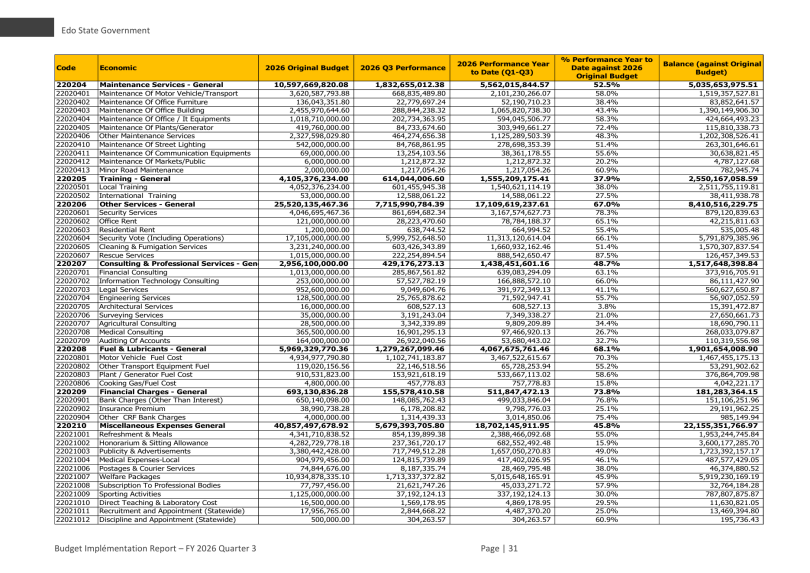
The Edo State government, under the leadership of Governor Monday Okpebholo, spent ₦2.39 billion on refreshments and meals and another ₦5.02 billion on welfare packages between January and September 2026, while expenditure on basic education stood at just ₦1.50 billion during the same nine-month period.
SaharaReporters’ analysis of the Edo State Government’s 2026 Third Quarter (Q3) Budget Implementation Report, published on October 28, 2026, showed that the state government spent a cumulative ₦10.08 billion on refreshments, meals, honoraria, sitting allowances, publicity, welfare packages and sporting activities between January and September 2026.
This is an expenditure that exceeded what was spent on primary healthcare and basic education during the same period.
The figures raise serious questions about the government’s spending priorities, particularly as public schools continue to face funding and infrastructure challenges and families struggle with the cost of accessing quality education and public healthcare facilities for essential services.
A breakdown of the report showed that Edo State spent ₦2.39 billion on refreshments and meals, ₦5.02 billion on welfare packages, ₦682.55 million on honoraria and sitting allowances, ₦1.66 billion on publicity and advertisements, and another ₦337.19 million on sporting activities, amounting to ₦10.08 billion within the first nine months of the year.
In contrast, the report showed that the state government’s actual spending on on basic education within the same nine-month period stood at only ₦1.50 billion, representing 11 per cent of its approved ₦13.63 billion budget.
The report further showed that the Edo State government spent ₦7.21 billion on primary healthcare between January and September 2026, representing just 20.5 per cent of the approved ₦35.27 billion allocation for the sector.
This means that while the government spent ₦10.08 billion on refreshments, meals, honoraria, sitting allowances, publicity, welfare packages and sporting activities, its combined expenditure on basic education and primary healthcare amounted to just ₦8.72 billion.
The expenditure showed a difference of approximately ₦1.36 billion in favour of refreshments, honoraria, publicity, welfare packages and sporting activities.
The figures present a troubling contrast for ordinary residents who depend on government-funded basic education for children whose education depends on public schools, and primary healthcare centres for maternal services, immunisation, essential medicines and treatment of common illnesses.
For parents struggling to educate their children, inadequate school infrastructure, insufficient teaching materials and poorly equipped classrooms can undermine the future of children who have no realistic alternative to public education.
For families in rural communities, a poorly equipped primary healthcare centre can mean travelling long distances to access medical attention, paying out of pocket for medicines or delaying treatment because the nearest public facility cannot provide the necessary services.
The scale of spending, particularly when compared with the poor execution of essential social-sector budgets, raises questions about value for money, transparency and the government’s priorities.
Edo State government approved ₦13.63 billion for basic education in 2026, but its actual expenditure by September 30 stood at only ₦1.50 billion, representing 11 per cent of the annual allocation.
This left approximately ₦12.13 billion unspent against the original budget after three quarters of the financial year had elapsed.
The report’s programme classification shows that only ₦258.43 million was spent on improving the quality of teaching and learning outcomes, against an approved ₦3.07 billion.
For infrastructure at all levels, the state recorded approximately ₦785.32 million in expenditure against an allocation of ₦6.5 billion.
There was no recorded expenditure against the ₦200 million allocation for equity and inclusiveness in educational services or the ₦200 million approved for improving the Education Information Management System.
The report also indicates that spending on capital projects in basic education achieved only about eight per cent of the original annual budget by the end of the third quarter.
According to the report, Edo State approved ₦35.27 billion for primary healthcare in 2026.
However, by the end of the third quarter, only ₦7.21 billion had been recorded as actual expenditure, leaving approximately ₦28.05 billion unspent against the original allocation.
The report’s functional classification further revealed that expenditure on pharmaceutical products stood at zero against an approved allocation of ₦1.005 billion.
There was also no recorded expenditure against the ₦20 million allocation for specialised outpatient medical services.
General hospital services had an allocation of ₦2.5 billion, but recorded no expenditure, while specialised hospital services recorded only ₦164.96 million against an allocation of approximately ₦4.01 billion.
Under public health services, the state spent approximately ₦6.85 billion out of an approved ₦18.43 billion.
These figures raise questions about how effectively the government’s healthcare budget is translating into medicines, equipment, functional facilities and accessible services for residents.
In its assessment, the report acknowledged substantial under-execution, particularly in capital investment, despite three-quarters of the financial year having elapsed.
It also warned that the large share of capital expenditure in actual basic education spending should not be mistaken for successful budget execution, noting that the figures alone do not establish whether money spent has translated into completed projects or improved educational services.