
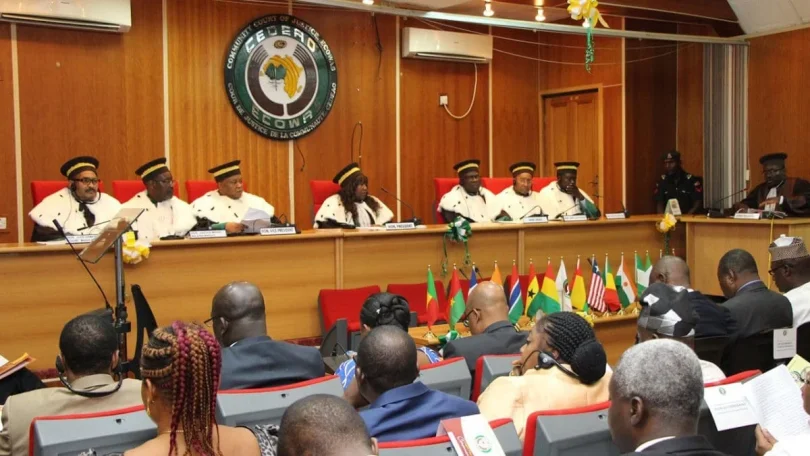
The Community Court of Justice of the Economic Community of West African States (ECOWAS) is set to make a major leap in judicial modernisation with the official launch of its Electronic Case Management System (ECMS) on Monday, June 29, 2026 (today).
The initiative marks a significant milestone in the Court’s digital transformation drive and underscores its commitment to delivering accessible, efficient, transparent and technology-driven justice throughout the West African sub-region.
The launch ceremony, themed “Advancing Digital Justice: Enhancing Access, Efficiency and Transparency through Electronic Case Management,” will be held at the Court’s headquarters in Abuja, Nigeria, and is expected to attract heads of ECOWAS institutions, representatives of member states, diplomats, legal practitioners, development partners, civil society organisations, academics and members of the media.
The event will be conducted in a hybrid format, allowing both physical and virtual participation, with simultaneous interpretation in English, French and Portuguese to ensure broad regional engagement.
According to the Court, the ECMS is a secure, multilingual, web-based platform designed to modernise judicial administration by digitising case management processes from filing to final disposition. The platform introduces electronic filing of cases, digital document management, real-time case tracking, automated registry workflows, virtual hearings and secure access to case information for judges, registry personnel, legal practitioners, litigants and other authorised users.
The system is the product of an extensive process involving software development, testing, data migration, user training and pilot implementation, paving the way for its full operational deployment.
The Court said the digital platform would significantly improve judicial administration by reducing dependence on paper-based processes, streamlining case management procedures, strengthening data security and promoting greater transparency and accountability.
Beyond enhancing institutional efficiency, the ECMS is also expected to expand access to justice by enabling legal practitioners and litigants across ECOWAS member states to engage with the Court electronically regardless of their geographical location, thereby removing barriers associated with distance and physical access.
The launch event will also provide stakeholders with an opportunity to witness demonstrations of the system’s key features and capabilities, while fostering dialogue on the benefits of electronic justice services in strengthening the administration of justice across the region.
The introduction of the ECMS aligns with the Court’s 2026-2030 Strategic Plan and reflects its determination to harness digital innovation to improve judicial performance, boost institutional effectiveness and expand access to justice throughout the ECOWAS community.
The development positions the ECOWAS Court among regional judicial institutions increasingly embracing technology to make justice delivery faster, more transparent and more accessible in an increasingly digital world.
Meanwhile, the ECOWAS Court of Justice, has dismissed a suit filed by the Incorporated Trustees of the Socio-Economic Rights and Accountability Project (SERAP) challenging Nigeria’s public borrowing practices, ruling that the organisation failed to provide sufficient evidence to prove that the country’s debt accumulation had resulted in violations of the socio-economic rights of Nigerians.
In a judgment delivered in Case No. ECW/CCJ/APP/05/22, the regional court held that while concerns over the impact of government economic policies on human rights fall within its jurisdiction, allegations of rights violations must be supported by concrete legal and factual evidence.
SERAP had approached the court, alleging that Nigeria’s persistent and allegedly unsustainable borrowing had created a huge public debt burden that had weakened the government’s capacity to provide essential public services, including healthcare, education and access to clean water. According to the organisation, the growing debt profile had disproportionately affected vulnerable and marginalised citizens and amounted to violations of rights guaranteed under the African Charter on Human and Peoples’ Rights and other international human rights instruments.
The Federal Republic of Nigeria denied the allegations and urged the court to dismiss the case.
In its decision, the court affirmed its jurisdiction under Article 9(4) of its Protocol, noting that claims relating to the impact of state policies on protected human rights fall within its human rights mandate. It also declared the application admissible and recognised SERAP’s status as a public interest litigant, observing that the case was instituted on behalf of Nigerians.
However, on the substance of the case, the court found significant gaps in the applicant’s arguments. It held that although SERAP presented statistical information on Nigeria’s external and domestic debt and highlighted the economic hardship allegedly experienced by citizens, it failed to identify the specific rights that had been violated, define the corresponding legal obligations of the Nigerian government, or establish a direct causal relationship between the borrowing policies and the alleged violations.
The court further noted that the applicant did not provide concrete evidence identifying particular communities or groups of persons that had suffered rights violations as a direct consequence of the government’s borrowing practices.
Describing the application as consisting largely of broad economic and political grievances, the court ruled that it did not satisfy the evidentiary standards required in human rights litigation before the regional tribunal.
Consequently, the court held that the alleged human rights violations arising from Nigeria’s borrowing policy had not been substantiated in law and in fact and dismissed the application in its entirety.
The judgment was delivered by a three-member panel comprising Justice Sengu Mohamed Koroma, who presided over the matter, Justice Gberi-Bè Ouattara, and Justice Edward Amoako Asante, who served as Judge Rapporteur.
... ECOWAS Court Launches Electronic Case Management System in Abuja, Dismisses SERAP Debt Suit ... Naijaonpoint.