
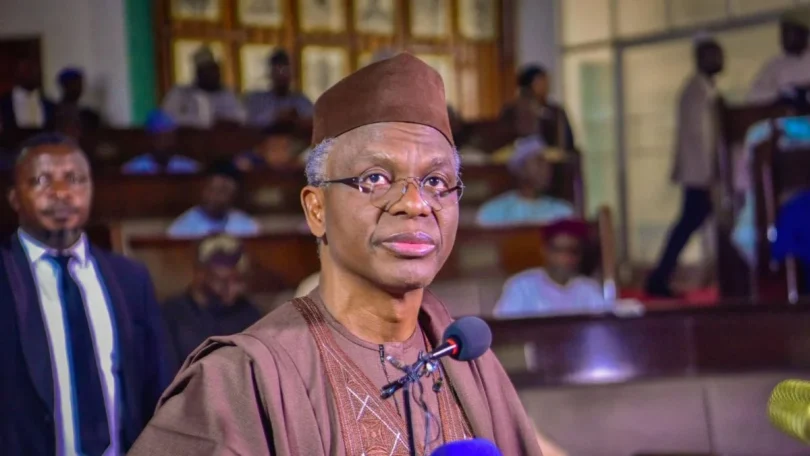
The Federal High Court in Abuja has rejected former Kaduna State Governor Nasir El-Rufai’s attempt to end his trial over the alleged unlawful interception of telephone communications belonging to the National Security Adviser, Nuhu Ribadu.
Justice Joyce Abdulmalik dismissed the former governor’s no-case submission on Monday, ruling that the prosecution had presented sufficient evidence to require him to enter his defence if he chooses to do so.
The decision means the case will proceed, with El-Rufai now expected to respond to the allegations brought against him by the Department of State Services (DSS).
The judge held that the evidence presented by the prosecution had established a sufficient basis for the court to invite the former governor to defend himself.
She consequently directed El-Rufai, who is the sole defendant in the case, to enter his defence.
The ruling followed an application by the former governor seeking to have the charges against him dismissed without requiring him to answer the allegations.
His legal team had argued that the prosecution failed to establish a case that would justify asking him to defend himself.
A no-case submission is an application made by a defendant at the close of the prosecution’s case.
It asks the court to determine whether the evidence presented is sufficient to require the defendant to respond to the charges.
If the application succeeds, the defendant may be discharged without opening a defence.
However, if it is rejected, the defendant is ordinarily given the opportunity to present evidence in response to the prosecution’s case.
In El-Rufai’s trial, the application was filed after the DSS concluded its presentation of evidence.
The agency called two witnesses before closing its case, after which the former governor’s counsel, Akinyemi Aremu, asked the court to rule that the prosecution had not established a case against his client.
Aremu urged the court to uphold the no-case submission, arguing that the evidence presented by the prosecution did not meet the threshold required to compel El-Rufai to enter a defence.
The application sought to prevent the trial from proceeding to the next stage.
The DSS opposed the request, insisting that the evidence before the court was sufficient to sustain the case against the former governor.
The prosecution’s lawyer, Oluwole Aladedoye, a Senior Advocate of Nigeria (SAN), adopted the agency’s counter-affidavit in opposition to the application.
Aladedoye argued that the defence had failed to adequately address Exhibit “B”, which the prosecution identified as containing an alleged admission by El-Rufai concerning the interception of Ribadu’s telephone communications.
The prosecution maintained that the exhibit was a significant part of its case and should be considered alongside the other evidence already presented before the court.
It argued that the material placed before the judge established a prima facie case, making it necessary for the former governor to respond to the allegations.
A prima facie case does not amount to a final determination of guilt. It means that the evidence presented is sufficient to require a response from the defendant at that stage of the proceedings.
The court must still consider the evidence and arguments presented during the trial before reaching a final decision on the allegations.
By dismissing the application, Justice Abdulmalik declined to terminate the proceedings at the close of the prosecution’s case.
El-Rufai will therefore have an opportunity to challenge the prosecution’s evidence, explain his position and present any defence permitted under the law.
In a related development, POLITICS NIGERIA earlier reported that the court rejected El-Rufai’s request to play the full CCTV footage in the alleged phone-tapping case.
The next stage of the trial will be important because the court will have to consider the response presented by the former governor against the allegations and evidence relied upon by the DSS.
The rejection of his application does not, in itself, establish that he committed the alleged offence.