
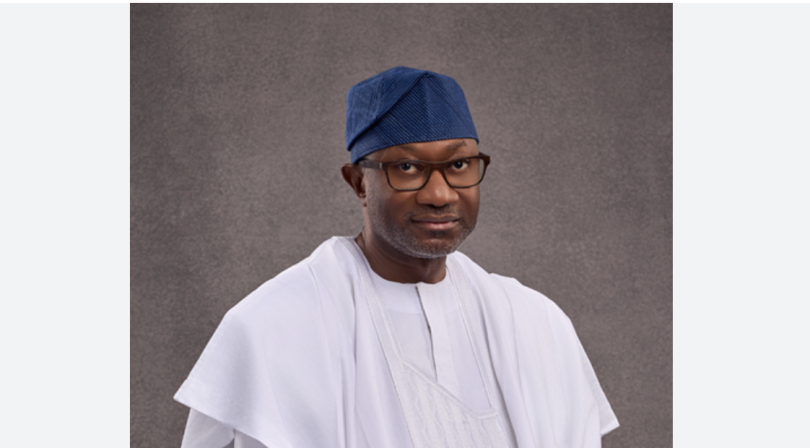
BREAKING: Femi Otedola Grants First-Ever Interview Since Becoming First HoldCo Chairman
First HoldCo is now worth more than ₦6 trillion, its chairman has become its largest shareholder with a 25.8% stake, and one of Nigeria’s most closely watched corporate turnarounds appears to be entering a defining new phase.
Femi Otedola rarely grants interviews, making this conversation with Nairametrics particularly significant. It also comes at a pivotal moment for both the billionaire investor and First HoldCo. Having committed hundreds of billions of naira of his personal wealth to the institution, Otedola has said little publicly about why he made that bet, how he views the bank’s dramatic transformation, or where he intends to take one of Africa’s oldest financial institutions.
In this exclusive interview, Otedola breaks that silence.
He explains why he continues to increase his stake in First HoldCo, reflects on the record write-offs that reset the bank’s balance sheet, discusses the valuation of Nigerian banks and the sharp re-rating of First HoldCo’s shares, responds to speculation about whether he intends to seek a controlling stake, addresses suggestions that he could eventually exit the investment as he has done with previous turnarounds, and shares his long-term vision for the institution.
Nairametrics: Why Financial Services?
Otedola: One of my personal business objectives is to make a significant and positive impact on society. Financial services is the engine room of the economy as it touches the lives of every individual. My position is further reinforced by the strategic importance of financial inclusion as an enabler of the Sustainable Development Goals aimed at the eradication of global poverty.
Investing in First Holdco Plc’s franchise value (with over 30 million customers, strategic branch network, deposit base and pan-African footprint) provides a solid platform that can be leveraged towards the realisation of these financial inclusion goals.
Nairametrics: When you made your investment, First HoldCo was carrying legacy challenges that eventually culminated in the record impairment losses reported in 2025. Was there any point during that period when you questioned your investment thesis, or were you always confident the bank would emerge stronger?
Otedola: First Holdco Plc was an institution on the brink. Before 2021, First Bank of Nigeria — the country’s oldest and once most trusted financial institution — stood at a genuine crossroads. Years of weak governance oversight had allowed unethical practices to take root at the highest levels of the organisation, culminating in a period where the institution’s stability was in serious question.
The bank’s loan book had deteriorated to the point where over ₦2 trillion in bad loans sat on its balance sheet — a burden compounded by a culture of recalcitrant and delinquent debtors who treated the institution as an outlet to exploit, obtaining credit facilities with little or no intention of repayment. The Central Bank of Nigeria found the bank’s capital position so compromised, and its governance failures so severe, that the institution stood on the verge of regulatory takeover to protect its over 30 million customers and minority shareholders.
In a decisive intervention, the CBN dissolved the entire board of First Bank and its holding company, citing breaches of regulatory directives, unresolved insider exposures, and a leadership transition executed without due process or regulatory approval.
Recognising the institution’s systemic importance and its potential for renewal, I began a deliberate, phased acquisition of shares in the institution. This was not a hostile or opportunistic move, but a calculated commitment to rescue, rebuild, and reposition First Holdco Plc.
That patient accumulation ultimately made me the Group’s majority shareholder and, in January 2024, its chairman. At that point I was convinced that there was no turning back. The Board approached the task with clear eyes about its scale — but drew energy and conviction from my antecedents. I had faced a similar challenge before; both African Petroleum Plc (later Forte Oil Plc) and Geregu Power Plc had been brought back from the brink of insolvency under my stewardship, transformed into profitable, well-run enterprises.
The Board was confident the same discipline could be applied to First Bank, anchored on a consistent pattern: People, Philosophy, and Process — the right leadership and talent, a clear guiding vision, and the operational rigour to execute it.
Nairametrics: Many investors saw a troubled institution, but you saw an opportunity. What did you see inside First HoldCo that convinced you the market was underestimating its true value?
Otedola: It was indeed a troubled institution that no one was going to touch. As I said earlier, I saw the potential in the franchise value (with over 30 million customers, strategic branch network, deposit base, and pan-African footprint) and took a strategic decision to capitalise on that and extract value for all its stakeholders. I was also convinced that Nigerian banks have historically traded at low price-to-book multiples despite strong ROE — a sector-wide discount tied to FX volatility, governance overhangs, and macro uncertainty rather than franchise quality.
From the above, I was clear that a well-executed plan to transform the institution would deliver the intrinsic value from this Behemoth. That conviction was rooted in a clear philosophy: that banking is fundamentally the business of trust, and that First Bank’s future depended on restoring the confidence of depositors, investors, and regulators alike. From this came a defined mandate — to rebuild First Holdco Plc into a modern, well-governed, and highly profitable institution, and in doing so, to position First Holdco Plc as a global standard for financial services, anchored on trust, respect, innovation, governance, and exceptional service delivery.
What followed was one of the most decisive turnarounds in Nigerian banking history: a full balance sheet clean-up, including a one-off ₦1.70 trillion impairment to our income statement and reserves to clear legacy exposures once and for all; an aggressive, multi-instrument recapitalisation programme — combining rights issues, private placements, and strategic divestments — that took the Group well beyond the Central Bank’s ₦500 billion minimum regulatory capital and toward an ambitious ₦1 trillion paid-up capital target; and a renewed leadership team driving improved asset recovery, increased earnings, and operational discipline.
By H1 2026, the results were unmistakable: profit before tax up 83.50 % year-on-year to ₦653.40 billion and a Return on Average Equity at 30.4% — the highest among Nigeria’s leading banking groups.
Nairametrics: You have continued to increase your ownership and now control about 25.8% of First HoldCo, making you its largest shareholder. There has also been considerable market speculation that you intend to increase your stake further, with some suggesting you could eventually target a controlling interest. What gives you the confidence to commit such a significant portion of your capital to one institution, and how do you respond to that speculation, and what role do you ultimately see yourself playing in First HoldCo?
Otedola: I am sure that you can see from my antecedents that my investment threshold is always over and above 51 percent. One of my key investment principles is that firm shareholder control with due regard for minority interest is a key ingredient to executing reforms and restructuring to deliver value to all stakeholders.
In African Petroleum Plc (later Forte Oil Plc), I gradually increased my shareholding from 28 to 75 percent before the sale in 2019. In a similar vein, I gradually increased my shareholding in Geregu Power Plc from 51 to 95 percent and then to 77 percent after its public listing in 2022. One thing is clear: our controlling stakes gave us the support structure required to execute our transformation and restructuring mandates, as evidenced by the success stories of these companies.
I am on the same trajectory with First Holdco Plc. To date, I have invested over ₦600 Billion of my personal wealth in First Holdco Plc — a figure that speaks not to speculation, but to unflinching confidence in the institution’s future, fundamentals and an unwavering personal commitment to its success.
That confidence is matched by a clear and deliberate path forward. Our future will be predicated on a strong human resource base, equipped with world-class processes to deliver innovation and unparalleled service delivery — all driven by the right philosophy. We are confident that First Holdco Plc has embarked on a clear path of sustainable growth and bountiful returns for our shareholders, built on an unshakeable foundation of transparency, accountability, reliability, and trust.
We have reinforced our risk management and credit control procedures in the past few years to embed and sustain a world-class credit culture (we impaired a total of over 3 trillion Naira in the past 10 years) and grow high-quality assets.
Nairametrics: You have built a reputation as an investor who identifies undervalued businesses, helps unlock their value, and, in some cases, exits after the turnaround is complete. Should shareholders view your investment in First HoldCo as a long-term generational commitment, or do you see yourself eventually monetising your investment once the bank reaches its full potential?
Otedola: The reputation and market opinion are not far from the truth. Yes, with respect to identifying undervalued businesses, transforming them, and unlocking value. The decision to sell, however, is not purely based on exiting like a private equity model but driven by market conditions and other personal objectives. However, the situation with my foray into and continuous investment in First Holdco Plc is completely different.
First Holdco (though a regulated business) with a 130+ year history and systemic importance differentiates it from a single-asset power or oil and gas business; it is a business built on the dynamics of the free-market concept and largely devoid of government interference. In an industry where trust is the key word for all stakeholders, the more we can harness that trust from our depositors, the more we can grow our depositors’ funds.
The more we can deliver shareholder value, the more we earn the trust of the investing public. The more we strengthen our corporate governance framework, the less intervention from the government and regulators.
From the above, it goes without saying that First Holdco is a long-term generational commitment unlike my previous involvement(s). The free-market platform of the financial services industry and our commitment to internal reforms provide the basis of my huge investment and hence a long-term commitment.
Nairametrics: The board has communicated an ambition to achieve a dividend payout ratio of around 60%. Investors naturally welcome higher dividends, but banks also need capital to grow. How do you strike the right balance between rewarding shareholders today and investing for long-term expansion?
Otedola: A ~60% payout ratio is generous by Nigerian Tier-1 bank standards but not unusual once a bank has cleared its capital requirements and is generating surplus capital faster than it can profitably deploy it. The balance typically works like this: capital adequacy and CBN’s recapitalisation floor come first — dividends are only declared from the surplus above what’s needed to support risk-weighted asset growth and regulatory buffers.
With H1 2026 pre-tax profit up 83.5% year-on-year to ₦653.54 billion and a full-year forecast of circa ₦1.2 trillion, First HoldCo is generating capital well ahead of its near-term loan growth needs, which is what creates room for a higher payout without starving the balance sheet.
The discipline is in keeping the payout linked to sustainable, recurring earnings — not the one-off recovery income that follows a clean-up year — so shareholders aren’t rewarded today at the expense of the bank’s ability to fund growth (retail expansion, digital infrastructure, pan-African operations) tomorrow.
I have always believed that well-managed banks should consistently reward shareholders through robust dividends and valuations that reflect their true earning power. Our latest half-year results demonstrate that this objective is well within reach. With our balance sheet now substantially cleaned up and capital strengthened, I believe First Holdco Plc should, over time, command valuation multiples above book value, as is common in more developed markets where banks delivering sustainable ROEs above 25% trade at significant premiums to book value.
Nairametrics: First HoldCo’s share price has more than doubled over the past year, significantly outperforming much of the market. To what extent do you think this reflects investor confidence in your leadership…the so-called “Otedola Effect”, and how much of it is simply the market beginning to recognise the bank’s intrinsic value?
Otedola: It is a mix-and-match of both. Without a doubt, the share price has rallied from ₦47.9 at end-2025 to ₦127+ by late July 2026 — a gain of roughly 165% year-to-date, making First HoldCo Nigeria’s most valuable banking stock in July 2026 (market cap ~₦5.78 trillion), overtaking Zenith Bank and GTCO.
I believe the market rally is a clear testament to my confidence in the institution, driven by continuous investment in the stock and the release of our record H1 2026 earnings. My continued buying signals conviction to the market that we are convinced about the future, and this is anchored in our disclosed earnings turnaround, not market sentiment alone.