
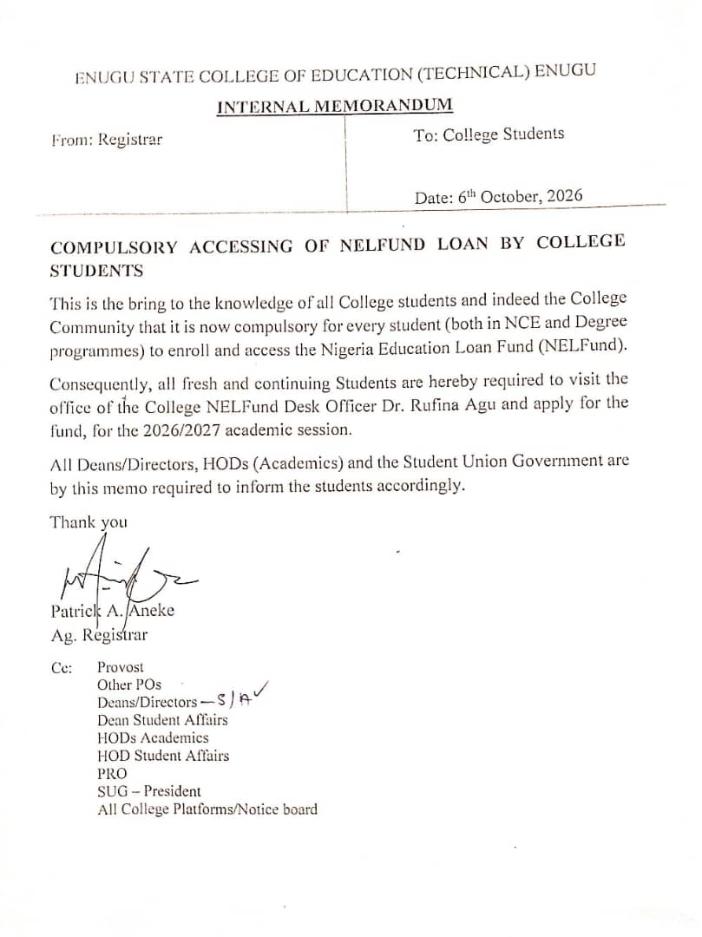
A controversial policy at the Enugu State College of Education (Technical), Enugu (ESCET), has sparked outrage after an internal memo and leaked WhatsApp conversations revealed that the institution has made applying for the Federal Government’s Nigeria Education Loan Fund (NELFUND) mandatory for students.
Students who fail to comply are now facing threats of being barred from taking examinations or forced to drop out entirely.
According to an internal memorandum exclusively obtained by SaharaReporters, the college management has mandated that all students, both at the Nigeria Certificate in Education (NCE) and degree levels, must enroll and access the NELFUND loan.
The memo, dated October 6, 2026, and signed by the Acting Registrar, Patrick A. Aneke, states: “This is the bring to the knowledge of all College students and indeed the College Community that it is now compulsory for every student (both in NCE and Degree programmes) to enroll and access the Nigeria Education Loan Fund (NELFund).
“Consequently, all fresh and continuing Students are hereby required to visit the office of the College NELFund Desk Officer Dr. Rufina Agu and apply for the fund, for the 2026/2027 academic session.”
“All Deans/Directors, HODs (Academics) and the Student Union Government are by this memo required to inform the students accordingly,” it added.
The policy has triggered a heated debate on a WhatsApp platform dedicated to college information, where the Dean of Students Affairs, Dr. Bertrand Ekwe, identified in the chat as Dr. @Sing Hu, defended the directive, confirming that a receipt showing registration for the Nigerian Education Loan Fund (NELFUND) scheme is now a prerequisite for examination clearance.
When a concerned student asked what would happen if their parents refused to allow them to apply for the loan, the account associated with the dean replied: “Then it might be very difficult for you to continue in ESCET.”
The student challenged the policy, arguing that NELFUND was established to assist financially disadvantaged students and that students who could not produce school fees receipts would be unable to obtain clearance to sit their examinations.
The dean subsequently confirmed that students without NELFUND receipts would not be allowed to take their examinations.
“So without the nelfund receipt or whatever, I won’t write exam,” the student asked.
The dean replied: “Yes for now or if management change their decision.”
The WhatsApp group also became a source of controversy over freedom to express opposing views, as the dean threatened to remove members who criticised the policy.
When another user urged the institution not to compel students who were uninterested in the loan scheme to apply, the account associated with the dean warned: “Don’t discourage others through this platform. We promote State Government interest here. If you continue, I will remove you.”
Some students expressed frustration over the directive, alleging that the policy was being driven by interests other than their welfare. One message circulating in the group also accused the school management of inflating fees displayed on the NELFUND dashboard.
“In as much we are supporting nelfund-loan, it shouldn’t be compulsory for all the students, nelfund loan was established for the less privileged students,” the message read.
“We shouldn’t make it compulsory because of selfish interest. A situation where school management will be collect above normal school fees from the students in students nelfund loan dash board. School fees, will be #8500k but school management will increase it to 9500k in students nelfund loan dash board. Is not fair oooo.”
With the school management reportedly maintaining its position, affected students are calling for the policy to be reviewed to allow those who do not wish to access the federal loan scheme to pay their fees directly and continue with their academic activities.
When the original version of the law called the Students Loans (Access to Higher Education) (Repeal and Re-Enactment) Act, 2024 or Students Loan Act, 2024, was passed in 2023, it was explicitly targeted at “indigent” students (those from humble backgrounds who could not afford fees).
It even carried a strict family income limit of less than ₦500,000 per year.
To prevent struggling students from being locked out due to paperwork or minor income fluctuations, the Students Loans Act, 2024 removed the strict income cap.
Officially, the text defines its purpose as “broadening the scope of access to students’ loans for higher education” for all qualified Nigerians. However, both the government and NELFUND’s public communications explicitly urge students from humble backgrounds who are actively “stressed by school fees” to prioritize using the scheme so they do not have to drop out of school.
Follow the Sahara Reporters channel on WhatsApp: https://whatsapp.com/channel/0029VaFClvtH5JM6SSsP7M2Y