
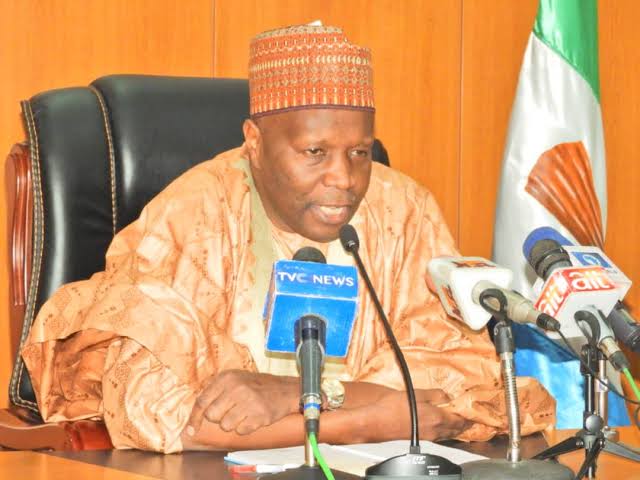
Gombe State Governor and Chairman of the Northern States Governors’ Forum, Inuwa Yahaya, has acknowledged that Boko Haram’s capacity has been significantly weakened but warned that the insurgency remains a serious security concern in Nigeria’s North-East.
Yahaya spoke in Maiduguri, Borno State, during the 13th meeting of the North-East Governors’ Forum, where governors from the six states reviewed the region’s progress and persistent challenges since the forum was established in 2020.
According to him, despite sustained military and security operations, insurgents continue to pose a threat to communities, while banditry and communal conflicts have created additional security challenges.
“Boko Haram has been weakened but not defeated, and we still see attacks on our communities. Banditry and communal clashes are emerging as new threats,” Yahaya said.
The Gombe governor expressed concern over the number of residents displaced by the insurgency who remain unable to return to their homes because of continuing security concerns.
He said the North-East had made progress in areas including infrastructure, energy, economic development, education, healthcare and security, but stressed that several major challenges still required urgent attention.
Yahaya identified the stalled Mambilla hydropower project, railway connectivity to the North-East and the expansion of broadband infrastructure as some of the region’s outstanding priorities.
He also called for the Kolmani oil exploration project to move beyond exploration and potential, urging stakeholders to ensure that it delivers jobs, revenue and wider economic benefits to communities in the region.
On the region’s natural resources, Yahaya warned against illegal mining and insisted that solid minerals should be exploited lawfully and used to improve the welfare of residents rather than finance criminal activities.
“Our solid minerals must be mined legally and for the benefit of our people, not to fund criminality,” he said.
Reflecting on the creation of the North-East Governors’ Forum, Yahaya said the six states initially came together because the challenges confronting the region crossed state boundaries and could not be effectively addressed by individual governments.
He recalled that insurgency, banditry, cross-border crime, infrastructure deficits, energy shortages and the humanitarian crisis required a coordinated response.
According to him, the forum has since developed a permanent secretariat, technical committees and sectoral groups aimed at improving cooperation among the states.
He listed joint advocacy for strategic road projects, the proposed Port Harcourt-Jos-Bauchi-Maiduguri railway corridor and development opportunities in Kolmani and the Lake Chad Basin among the issues the forum had presented to the Federal Government.
Yahaya also highlighted ongoing rehabilitation of the Dikwa-Gamboru Ngala and Bama-Banki roads, as well as the adoption of the Akwanga-Jos-Bauchi-Gombe-Biu-Maiduguri highway as a legacy road project.
Energy, Trade and Regional Development
On electricity, the governor said the Dadinkowa Hydropower Plant was contributing power to the national grid, while the new electricity framework had opened opportunities for states to pursue renewable energy projects.
Also Read: 2027: Tompolo rallies Taraba for Tinubu, donates campaign vehicles
He also disclosed that the forum had revived the North-East Trade Fair and was developing plans for a regional airline through a N30 billion financing arrangement involving the six states.
Despite these developments, Yahaya urged his colleagues not to lose sight of the region’s unresolved social challenges.
He noted that many children remained out of school and that health indicators in the region continued to lag behind those of other parts of the country.
“Too many of our children are still out of school, and our health indicators remain among the weakest in the country. We must be honest with ourselves and with our people. The challenges we set out to confront in 2020 have not gone away,” he said.
Yahaya further called for stronger implementation and accountability mechanisms to ensure that decisions reached by the governors translated into measurable improvements in the lives of residents.
He identified poverty, unemployment, illiteracy, drug abuse and illegal mining as issues that could worsen insecurity if left unchecked.
The governor also advocated stronger community-based security initiatives and urged the six states to deepen cooperation so that gains recorded by the forum would survive changes in government and continue to benefit future generations.