
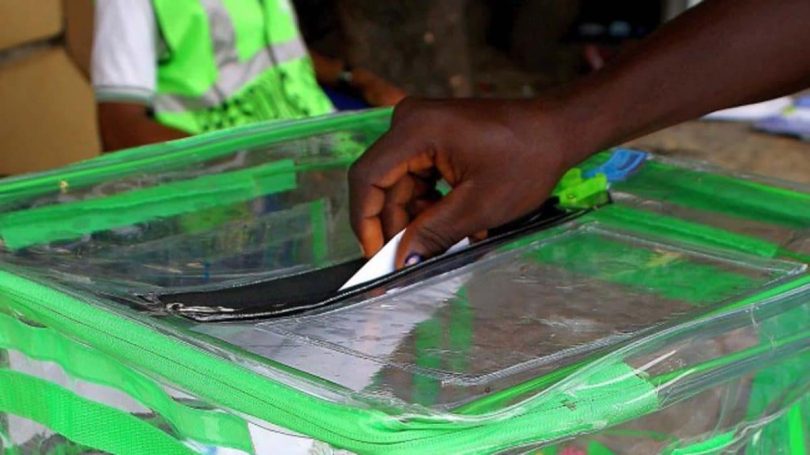
Lagos State Governor, Mr Babajide Sanwo-Olu, has said Nigeria’s future will not be determined by the outcome of the 2027 general election alone, but by what Nigerians and their leaders do with the mandate produced by the polls.
Sanwo-Olu spoke on Thursday as the special guest speaker at the seventh annual lecture of Freedom Online, held at the Sheraton Lagos Hotel, Ikeja.
The lecture, themed “2027 Elections: Economy, Security and Nigeria’s Future,” brought together politicians, media practitioners and other stakeholders to examine the challenges and prospects of the country ahead of the 2027 elections.
According to the governor, Nigerians would, in January 2027, elect a President for the eighth consecutive time since the return to democratic rule in 1999.
He, however, argued that the real test would come after the election, as the country would have to determine whether to consolidate ongoing reforms and tackle its security and economic challenges.
Sanwo-Olu said, “One hundred and thirty-five days from now, Nigerians will do something no generation before ours ever did: elect a President, peacefully and on schedule, for the eighth time in succession.
“Nonetheless, Nigeria’s future will not be decided on the 16th of January. It will be decided by what we do with the mandate that the 16th of January produces: whether we finish the reforms or abandon them halfway; whether we complete state policing or leave it on the drawing board; whether we turn our young people into a dividend or a grievance; whether we build the one-trillion-dollar economy or merely talk about it.”
The governor also charged the Independent National Electoral Commission (INEC) to ensure that it was fully prepared for the presidential and National Assembly elections on January 16 and the governorship and State House of Assembly elections on February 6, 2027.
He urged Nigerians to also play their part in ensuring credible elections.
On insecurity, Sanwo-Olu said job creation remained one of the most effective security policies, stressing that investment and employment could only thrive in a safe environment.
“We speak of the economy and security as though they were two subjects. They are one. Poverty feeds insecurity, and insecurity strangles the very economy that would cure poverty,” he said.
“When a farmer cannot go to his farm, the nation gets hungrier. When a school is not safe, the country gets another cohort of children who never learned to read. And the reverse is just as true.”
Chairman of the occasion and former Minister of Information and Culture, Alhaji Lai Mohammed, said the 2027 election should be viewed not merely as a contest for political power but as an opportunity to consolidate nation-building efforts.
Mohammed said the country’s security and economic challenges required consistency, patience, stronger institutions and national cooperation.
He argued that security remained a precondition for economic growth, while economic inclusion was necessary for political stability.
According to him, “No business thrives in an atmosphere of uncertainty, and no foreign or local investor deploys capital where safety cannot be guaranteed. In turn, political stability depends on economic inclusion.”
He urged stakeholders to strengthen the foundations of governance rather than merely criticise them.
Mohammed also charged the media to play a responsible role in the 2027 electoral process, warning against sensationalism, fake news and incendiary reporting.
He said the media had the power to inform citizens, interrogate claims, expose falsehoods and provide platforms for competing ideas, but could also deepen divisions when irresponsibly deployed.
“We therefore need a media that is robust without being reckless; critical without being destructive; patriotic without becoming partisan; and free without forgetting the enormous responsibility that comes with freedom,” he said.
Mohammed added that responsible journalism was particularly important during election periods because media reports could influence public perception, economic confidence and national security.
He urged journalists to focus the electoral discourse on policy, competence and concrete solutions rather than ethnic, religious or partisan sentiments.
The Senator representing Ogun East, Otunba Gbenga Daniel, said Nigeria could not achieve a strong economy without security, just as lasting security could not be achieved without a strong economy.
Daniel acknowledged what he described as encouraging signs in the Nigerian economy under the administration of President Bola Tinubu, including reported growth in the second quarter of 2026.
He, however, said economic progress should be measured beyond GDP figures and should reflect improvements in the daily lives of Nigerians.
He asked whether young Nigerians could find decent employment, farmers could safely access their farms, manufacturers could produce competitively and businesses could survive the rising costs of power, transportation and finance.
According to him, insecurity should be regarded not only as a security problem but also as an economic challenge.
“When farmers are afraid to cultivate their land, food production suffers. When roads are unsafe, the cost of transporting goods rises. When businesses spend excessively on protection, their competitiveness declines. When communities live in fear, investment is discouraged,” he said.
Daniel said Nigeria possessed enormous economic potential, citing its youthful population, entrepreneurial culture, technology sector, financial institutions and creative economy.
He called for greater investment in skills, employment, access to capital and technology, particularly for young Nigerians.
“If we give our young people opportunity, they will build Nigeria. If we deny them opportunity, frustration will grow and social stability will suffer,” he said.
He also called for greater economic diversification, noting that the non-oil sector accounted for the overwhelming majority of real GDP, with agriculture, manufacturing, technology, construction, financial services, tourism, entertainment and the digital economy playing increasingly important roles.
Daniel said Nigeria’s challenge was to convert the potential of these sectors into productive jobs, higher incomes and improved living standards.
He cited Lagos and Ogun states as examples of what could be achieved when population, enterprise, infrastructure and opportunity were combined, saying similar opportunities should be created across the country.
The Peoples Democratic Party (PDP) governorship candidate in Ogun State, Hon. Ladi Adebutu, called for stronger institutions and transparent elections as prerequisites for democratic development.
Adebutu argued that institutions must be strengthened and allowed to function effectively to restore citizens’ confidence in the political system.
He expressed concern about capital flight and the polarising effect of elections, while stressing the need for political leaders and citizens to speak truth to power.
“We need to have transparent elections. Elections have further polarised us. Our institutions should be strengthened so that people will have confidence in the system,” he said.
Adebutu added, “We must speak truth to power. We have no other country. We believe in the country.”
Earlier, the organiser and publisher of Freedom Online, Gabriel Akinadewo, said Nigeria appeared to be making progress politically but questioned whether similar progress was being recorded in other sectors.
Akinadewo called for the establishment of state police, describing insecurity as a “monster” that required urgent and innovative solutions.
He said Nigeria had developed a four-year electoral cycle but lacked a corresponding four-year cycle of development.
“In Nigeria, every four years, we have a full cycle of election but there is no four-year cycle of development. We are here to draw a line between governance and politics. Where does politics stop? Where does development start?” he asked.
Akinadewo also called for the modernisation of Nigeria’s laws to reflect contemporary realities.
“The task before us today is very simple. We can’t continue to use the system adopted in the ’60s to govern Nigeria of 2026 and beyond. By 2027, we must modernise our laws to adapt to the challenges of the 21st century,” he said.