
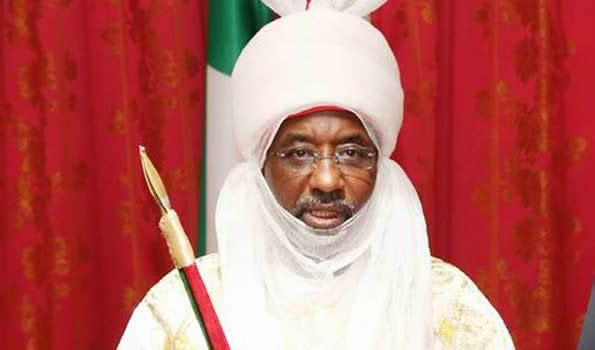
The Emir of Kano, Alhaji Muhammadu Sanusi II, has urged the President Bola Tinubu-led administration to stop treating criticism as an attack, emphasising the importance of allowing constructive dissent.
Sanusi gave this advice during a virtual speech at the Oxford Global Think Tank Leadership Conference on Tuesday, where he said Nigerians who speak out about poverty, hunger, and economic hardship should not be seen as enemies of the government.
“It’s not every time people talk about poverty or talk about difficulty that they’re just enemies of the government or making an attack on the president.
“That is not how to respond to economic distress,” he said.
The Emir also raised concerns about government spending, warning that Nigeria cannot achieve fiscal consolidation if it keeps spending without limits.
He pointed out that, according to the World Bank, debt servicing took up 124 percent of the Federal Government’s revenue in the first half of the year, stressing the urgent need to make the country’s debt more sustainable and to carry out needed structural reforms.
Sanusi said economic reforms should include more than just removing fuel subsidies and liberalising the exchange rate. He described these steps as part of a larger plan that should also focus on other important sectors.
He urged the government to set clear spending priorities, considering available resources and the country’s needs in areas like roads, electricity, agriculture, and technology.
The former Central Bank of Nigeria (CBN) governor said the government needs to make careful decisions about how to use its limited resources.
“Every $10 billion spent on roads is $10 billion taken away from electricity and agriculture,” he said.
Sanusi, however, acknowledged that the Tinubu administration’s economic reforms had recorded measurable progress, citing improvements in economic growth, inflation and foreign reserves.
He said Nigeria’s gross domestic product (GDP) growth had risen from an average of 0.9 per cent under the previous administration to 4.5 per cent.
“I think moving from an average growth rate of 0.9 per cent to 4.5 per cent is progress. Moving from inflation of over 30 per cent to 14.5 per cent is progress.
“Moving from the point where in 2023 the Central Bank’s reserves were maybe negative to where we are now, having reserves of $55 billion, is progress,” he said.
Despite the gains, the Emir said poverty, hunger, maternal mortality, malnutrition, education and healthcare remained major challenges that the reforms had yet to adequately address.
He stressed that the government should have introduced social safety net policies from the outset to cushion the effects of economic reforms on vulnerable Nigerians.