
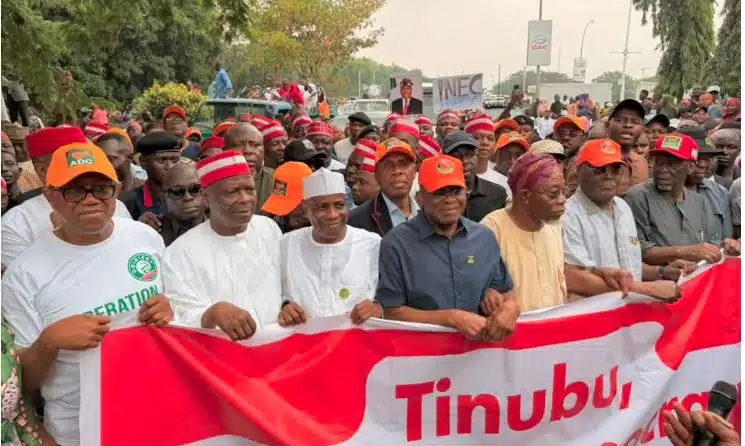
The G100 has begun a fresh push to bring Nigeria’s opposition parties closer together ahead of the 2027 general elections, with consultations already held with leaders of six political parties.
The group said its representatives had engaged key figures in the African Democratic Congress (ADC), Allied Peoples Movement (APM), Nigeria Democratic Congress (NDC), Peoples Democratic Party (PDP), Peoples Redemption Party (PRP) and Social Democratic Party (SDP) as part of efforts to explore a broader opposition alliance.
The consultations come barely two weeks after the G100 issued an open letter calling on opposition leaders, civil society organisations and Nigerians to embrace what it described as the Doctrine of Necessary Democratic Opposition.
In a statement issued on Monday by Salihu Lukman on behalf of the group, the G100 said the meetings involved national chairmen, presidential candidates and running mates of the participating parties.
Unlike the usual political negotiations that quickly become public spectacles, the G100 said it deliberately kept the consultations away from the media.
The group explained that the decision was necessary because of the sensitive nature of the discussions and the need to give political leaders room to speak openly without the pressure of public commentary.
“We have deliberately kept these consultations away from the glare of the media, in recognition of the sensitivity of many of the discussions and the need to allow party leaders to engage frankly and constructively without the pressure of premature public commentary,” the group said.
According to the organisation, ensuring that the discussions remained sincere and productive was more important than publicising every meeting.
The G100 said the conversations so far had been frank, constructive and encouraging, suggesting that some opposition leaders are increasingly recognising the need for greater cooperation ahead of 2027.
One of the major issues emerging from the consultations, according to the G100, is an acknowledgment among opposition leaders that defeating the political dominance of the ruling party would require more than individual party ambitions.
The group said the leaders it had engaged recognised that building a credible opposition would require compromise, sacrifice and the willingness to place national interests above narrow political calculations.
“The leaders we have engaged have also acknowledged that achieving a credible and effective opposition will require sacrifice, compromise and a willingness to place the larger interests of the country above narrow partisan or individual considerations,” the statement read.
But while the emerging consensus may sound encouraging, the G100 acknowledged that goodwill alone would not be enough.
The real challenge, it suggested, would be converting those sentiments into a practical political arrangement capable of surviving the competing ambitions of the various parties and their presidential hopefuls.
Abuja Summit Set For August 18
The consultations are expected to culminate, at least in the next phase, in a Summit of Opposition Parties scheduled for Tuesday, August 18, in Abuja.
The G100 said the summit would provide a formal platform for participating parties to examine possible mechanisms for closer cooperation and determine whether a workable framework for opposition collaboration can emerge.
The initiative is linked to the principles contained in the Ibadan Declaration, particularly its call for opposition parties to develop a credible route towards presenting a united and competitive alternative to voters in 2027.
Despite its push for greater cooperation, the group said it was not seeking to determine which party should lead the opposition or dictate how an eventual alliance should be structured.
Instead, the G100 described itself as a facilitator whose responsibility is to bring the parties to the table, build confidence and create an atmosphere for difficult political conversations.
“The G100 does not presume to dictate the outcome of these conversations,” it said.
The organisation added that its role was to help the parties confront difficult questions surrounding cooperation, sacrifice, accommodation and collective action.
Any agreement eventually reached, it said, must take into account the legitimate interests of the participating political parties while placing the broader interests of Nigerians at the centre.
Can The Opposition Actually Unite?
The push comes against the backdrop of years of fragmentation among Nigeria’s opposition parties, where multiple presidential candidates have often divided votes that might otherwise have strengthened a single challenger.
For the G100, that fragmentation is becoming increasingly difficult to justify as the 2027 election approaches.
The group argued that democracy would benefit if Nigerians were presented with a credible and competitive alternative rather than an opposition divided across several political platforms.
“At this critical moment in our national journey, fragmentation among those seeking to provide that alternative serves neither the opposition nor the Nigerian people,” it said.
The G100, however, acknowledged that opposition unity would not happen overnight.
It described the consultations of the past week as merely an initial step, stressing that meaningful cooperation would require patience, political courage and, perhaps most importantly, a willingness by individual actors to sacrifice personal and partisan interests for a broader objective.
With the August 18 summit now on the horizon, the question is no longer simply whether Nigeria’s opposition parties want to defeat the ruling party in 2027.
The bigger question is whether they can agree on how to do it—and, more importantly, who is willing to give up what to make that possible.