
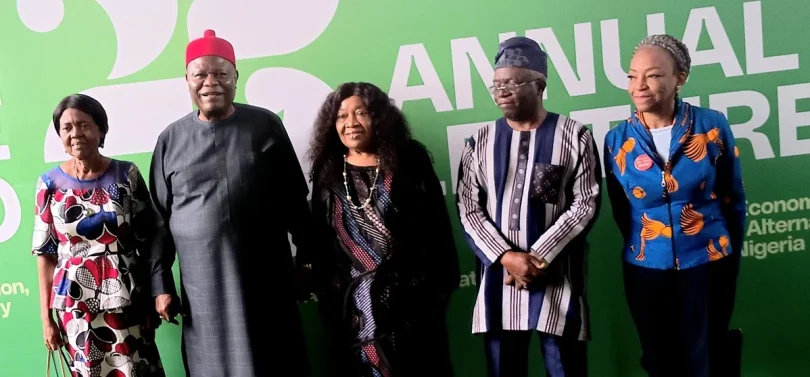
Human rights lawyer and activist, Mr. Femi Falana (SAN), and the Presiding Bishop of The Redeemed Evangelical Mission (TREM), Bishop Mike Okonkwo, have urged eligible Nigerian voters to stand up and ensure the credibility of the 2027 general elections.
The duo advised citizens not to abandon the electoral process to politicians who are desperate to either perpetuate themselves in office or seize power. Instead, they urged Nigerians to secure their voter cards, exercise their franchise, and actively defend their votes.
They spoke on Thursday in Lagos at the 25th Mike Okonkwo Annual Lecture, themed: “Democracy at the Crossroads: Electoral Credibility, Judicial Integrity and the Future of Nigeria.”
The keynote lecture was delivered by human rights activist, Mrs. Ayo Obe, who similarly advocated for active citizen participation and urged Nigerians to hold political office holders accountable.
Speaking at the event, held at the Muson Centre, Falana described Nigeria’s current democracy as a “mockery,” stating that election riggers have grown confident due to years of enjoying total impunity.
He cited past elections, including the previous Osun State governorship election, where political actors and their agents openly threatened opponents and engaged in vote-buying without facing legal consequences.
He called on anti-graft agencies, security forces, and the judiciary to wake up to their responsibilities to save the nation’s democracy.
Condemning the scale of financial inducement at the polls, Falana alleged that between ₦50 billion and ₦110 billion was spent to purchase votes in Osun State alone.
ALSO READ: Tinubu’s govt prioritising national security – Defence minister
He noted that per-vote payments rose from around ₦5,000 in Ekiti to between ₦20,000 and ₦50,000 in Osun, warning that vote prices could hit ₦100,000 per voter by 2027 if left unchecked.
Falana also faulted political parties for conducting rigged primaries through the imposition of “consensus” candidates.
He warned that the resulting wave of litigation was dragging the judiciary into political disputes it is ill-equipped to resolve, exposing the courts to public ridicule.
He further claimed that many judges eagerly look forward to being part of election petition tribunals due to personal financial benefits.
Addressing socioeconomic issues, the activist argued that the government’s neoliberal policies have deepened poverty and inequality.
He urged authorities to strengthen poverty-reduction initiatives and tackle the insecurity and unemployment driving citizens’ vulnerability to electoral manipulation.
He maintained that under existing Nigerian law, cash transfers to the poor are a legal entitlement, not a favour.
“Only Nigerians themselves can save democracy in our country,” Falana emphasised, warning that the credibility of the 2027 polls will determine whether the nation progresses or slides deeper into crisis.
He also cautioned against looking abroad for salvation, taking a swipe at politicians calling on U.S. President Donald Trump to intervene in Nigeria’s democracy.
Falana argued that Trump’s own track record—including pressuring a Georgia election official to “find” votes in 2020 and pardoning individuals convicted over the January 6 Capitol attack—disqualified him as a democratic role model.
In his remarks, Bishop Mike Okonkwo encouraged Nigerians to take the bull by the horns and consistently demand accountability.
“We cannot as citizens afford to be unconcerned about the people who govern us. If we do, they will continue to do what they like and we will be helpless,” the cleric said.
Bishop Okonkwo also cautioned against sweeping generalisations about judicial corruption, noting that judges usually decide cases based on the facts presented to them rather than sentiment.
“That is why it is vital for those on the front lines, especially political party agents, to keep clear and accurate records of what transpires at polling stations and collation centres,” he said.
He added that the adoption of technology has brought significant progress, ensuring that votes are increasingly being counted.
Comparing the political arena to a “shark-infested arena,” the bishop urged citizens to remain resilient. “You cannot say you won’t vote. If you don’t vote, they will remain there, control your life, and determine how you live. We all have roles to play to make our democracy work,” he concluded.
A major highlight of the event was the presentation of awards to the top three winners of this year’s Mike Okonkwo National Essay Competition among secondary school students nationwide .
Agburum Clinton Chimenem of Deeper Life High School, Port Harcourt, Rivers State, clinched the first prize, winning ₦800,000, a trophy, and a laptop. Alimi-Adeiga Mosorireoluwa of Holyland Senior College, Ipaja, Lagos, took second place, while Oloruntimilehin Elijah Oladipo of Isolo Comprehensive Senior High School, Lagos, finished third. The first and second runners-up received ₦500,000 and ₦400,000 respectively, along with laptops, while their respective schools were awarded desktop computers.
End