
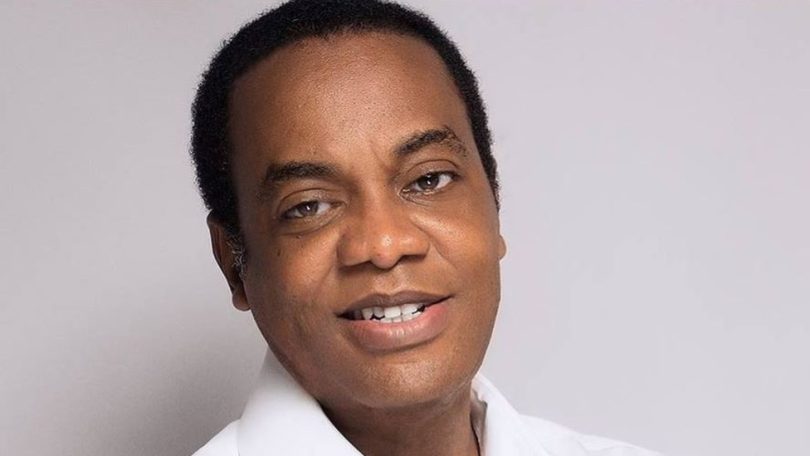
Former Cross River State Governor and Peoples Redemption Party (PRP) presidential candidate, Donald Duke, has declared his readiness to support whichever opposition candidate emerges from ongoing efforts to build a common platform ahead of the 2027 presidential election.
Duke made the commitment on Monday in Abuja at the G100 Summit of Nigeria’s Opposition Political Parties, where leaders and representatives of opposition parties gathered to explore the possibility of forming a united political force against the ruling All Progressives Congress (APC).
The former governor said his ambition to become president would not take precedence over the broader objective of giving Nigerians a stronger alternative in 2027.
He maintained that regardless of the outcome of the negotiations, he would remain committed to the coalition process and support the eventual decision.
“We will support any political party that emerges in 2027. Whatever decision is arrived at today, I will not walk away but will strive all along because that’s what the people want to see,” Duke said.
His position came as opposition politicians continued discussions over how to avoid repeating the fragmentation that characterised the 2023 presidential election.
Six opposition parties at the table
The summit, organised by the G100 in collaboration with the Minority Caucus of the House of Representatives, brought together representatives of six opposition parties.
They included the African Democratic Congress (ADC), Allied Peoples Movement (APM), Nigeria Democratic Congress (NDC), Peoples Democratic Party (PDP), Peoples Redemption Party (PRP) and Social Democratic Party (SDP).
The gathering is part of a wider attempt to develop a framework that could eventually produce a common opposition platform capable of challenging the APC in the next presidential election.
Speaking at the summit, G100 representative Salihu Lukman argued that the opposition had already paid a heavy political price for going into an election divided.
Lukman pointed to the 2023 presidential election, when opposition candidates collectively secured roughly 13 million votes but failed to turn the combined figure into victory because the votes were spread among several contenders.
He said the lesson from the election was straightforward: the opposition did not necessarily lose because its votes were stolen, but because it failed to coordinate them.
“Nobody stole thirteen million votes. We divided them ourselves, in public, and we did it knowing exactly what the consequence would be,” Lukman said.
According to him, the opposition must learn from previous political alliances, particularly the arrangement that preceded the 2015 general election.
He argued that the success of that alliance was not built on personal affection among the politicians involved, but on an agreed process.
“What they had was not affection. What they had was sequence. They agreed on the rules before they knew the outcome,” he said.
Lukman stressed that the current discussions were not intended to force any political party to dissolve or compel presidential aspirants to immediately withdraw from the race.
Rather, he said the objective was to create a negotiating platform where the parties could identify their interests, establish rules and determine how they could work together.
Opposition begins work on coalition framework
Under the proposed arrangement, the coalition would establish a Central Leadership Committee comprising senior representatives of the participating parties as well as presidential and vice-presidential candidates.
A Publicity and Communication Committee would also be created to coordinate the coalition’s public messaging, while a Legal Committee would handle legal issues arising from the proposed alliance.
Five additional working groups are expected to examine key areas of the proposed arrangement.
Their responsibilities would include developing proposals on democratic renewal, a possible single-term transition, a national reform agenda, opposition unity and the process for selecting a common presidential candidate.
The groups are expected to complete their work within four weeks, after which their proposals would be presented at another summit for consideration and possible adoption.
Lukman, however, warned that the coalition would only succeed if the politicians involved were prepared to make sacrifices.
He cautioned against entering the negotiations with predetermined outcomes or the expectation that every participant would get exactly what they wanted.
Also Read: 2027: Omoyibo mobilises Isoko for APC, backs Oborevwori, Joel-Onowakpo
“There is no version of this that costs nobody anything. Someone in this hall will have to accept an outcome he/she did not want. That is what unity is. It is not a communiqué. It is somebody’s disappointment, borne well,” he said.
The proposed coalition would also seek to establish what the G100 described as a “Government of National Competence”, with a four-year National Reset Programme.
To strengthen the arrangement, the group has proposed an enforceable Transition Charter that would bind the participating parties and individuals to the agreements reached during the negotiations.
No preferred candidate, Lukman insists
Lukman said the G100 was not backing any particular presidential aspirant and had no intention of deciding who should emerge as the opposition’s candidate.
Instead, he said the group’s primary concern was to create a credible political alternative for Nigerians ahead of 2027.
“Our only interest is the one stated in the Doctrine we published on August 2: that a democracy is sustained not merely by holding elections, but by the credible possibility of an alternative government,” he said.
“Today, that possibility is in this room. It is in nobody else’s hands.”
With Duke now publicly pledging to support whichever candidate emerges, the opposition’s latest attempt at unity has gained another significant commitment.
The bigger test, however, will come when negotiations move beyond speeches and declarations and individual political interests begin to collide with the demands of a common opposition platform.