
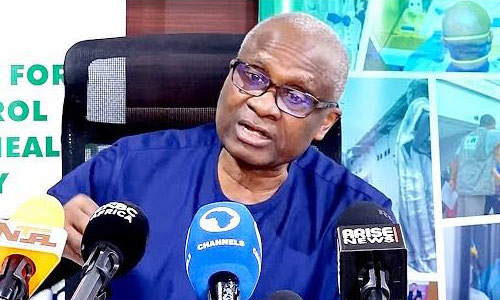
The Nigeria Centre for Disease Control and Prevention (NCDC) has clarified that the ₦10 billion emergency intervention fund approved by President Bola Tinubu was not exclusively meant for the fight against Ebola Virus Disease but was intended to strengthen Nigeria’s preparedness and response to multiple epidemic-prone diseases.
The Director-General of the NCDC, Dr Jide Idris, made the clarification in a statement issued on Monday, November 2, 2026, amid growing public controversy over the allocation and questions concerning the management of funds approved for the country’s public health emergency response.
Idris explained that the intervention was designed to strengthen disease prevention, preparedness, early detection, rapid response and recovery across several public health threats, including Ebola, Lassa fever, cholera, cerebrospinal meningitis, diphtheria, measles, monkeypox and antimicrobial resistance.
He disclosed that the ₦10 billion was released directly to the NCDC and not to the Presidential Task Force on Ebola Virus Disease, contrary to suggestions that the money was placed under the control of the task force.
According to him, the Presidential Task Force, chaired by the Chief of Staff to the President, Femi Gbajabiamila, was established primarily to coordinate the country’s response to Ebola, while the intervention fund was intended to support broader national health security activities.
“Was the money released to the Presidential Task Force (PTF) on EVD, chaired by the Chief of Staff to the President? No.
“The PTF was established primarily to coordinate the national response. The ₦10 billion in question was released to NCDC to address the broader health security needs outlined above,” Idris stated.
The clarification follows questions surrounding the timing and disbursement of the intervention fund, particularly after the NCDC Director-General disclosed during a press conference on October 25 that the money had not been released to the agency.
Although Idris has now confirmed that the funds were released to the NCDC, he did not specify the date of disbursement or explain when the agency received the money after his earlier statement.
Providing the background to the intervention, Idris explained that President Tinubu approved the ₦10 billion in June 2026 following the Ebola outbreak in the Democratic Republic of the Congo, which prompted concerns about the possible spread of the disease to other African countries.
He maintained that the request for emergency funding was never restricted to Ebola, explaining that many of the public health systems required to contain the disease were also necessary for responding to other infectious disease threats.
“In June 2026, as the outbreak in the Democratic Republic of the Congo became a global emergency, Mr President graciously approved a further N10 billion in emergency intervention funding. That fund was requested for all our epidemic-prone diseases, not Ebola alone, and now strengthens work already underway, as we had mobilised resources from government and partners and kept building,” he said.
The NCDC boss argued that the controversy surrounding the allocation should be considered against the scale of Nigeria’s public health security requirements, insisting that the country remained substantially underfunded in its preparedness for epidemics.
He disclosed that implementing the National Action Plan for Health Security (NAPHS 2.0), covering 2025 to 2029, would require approximately ₦522 billion over five years.
According to him, the estimated cost translates to an average annual requirement of ₦104.4 billion, considerably higher than the ₦10 billion emergency intervention approved by the President.
Idris explained that although the NCDC would not be responsible for funding every activity under the national action plan, the figures demonstrated the level of investment required to strengthen Nigeria’s capacity to prevent, detect and respond to infectious disease outbreaks.
He described the ₦10 billion intervention as approximately two per cent of the plan’s annual cost.
However, the financial figures indicate that ₦10 billion represents approximately 9.6 per cent of the stated ₦104.4 billion annual requirement, while the two per cent comparison corresponds more closely to the ₦522 billion five-year estimate.
The Director-General maintained that Nigeria’s population of more than 240 million people made sustained investment in health security particularly important.
He cited estimates by the Global Preparedness Monitoring Board indicating that countries require between $1 and $2 per person annually to achieve an acceptable level of epidemic preparedness.
Applying the benchmark to Nigeria’s estimated population, Idris said the country would require between $240 million and $480 million annually to maintain adequate preparedness against major public health threats.
“The gap, however, remains real. The Global Preparedness Monitoring Board estimates that a country needs US$1 to US$2 per person each year to be acceptably prepared for epidemics.
“For about 240 million Nigerians, that is US$240 million to US$480 million a year. Sustained investment from government, States and partners will close that gap,” he said.
The NCDC chief also provided a breakdown of the Federal Government’s recent financial allocations to the agency.
According to him, the NCDC’s budgetary allocation increased from ₦4 billion in 2024 to ₦7 billion in 2025.
He disclosed that the agency received an additional ₦5 billion intervention fund in 2025, while the 2026 Appropriation Act provided ₦22 billion for its activities.
The additional ₦10 billion approved in June 2026 was intended to complement these allocations and strengthen existing disease prevention and emergency response programmes.
Idris argued that despite the increases, government investment in public health preparedness remained inadequate, partly because budgetary priorities often favoured projects with more visible and immediate benefits.
“This background illustrates the extent to which health security remains underfunded, partly because public investment tends to favour more tangible and immediately visible interventions,” he stated.
He stressed that effective epidemic preparedness required investment in disease surveillance, laboratory capacity, emergency operations, contact tracing, healthcare worker protection, public awareness and rapid response systems.
According to him, strengthening those systems would enable health authorities to identify potential outbreaks early and prevent infectious diseases from escalating into national emergencies.
The Director-General warned that inadequate preparedness could result in avoidable deaths, disruption of economic activities and additional pressure on healthcare facilities.
He maintained that discussions about the ₦10 billion intervention should focus on sustainable and accountable financing rather than political controversy.
Idris also cautioned political actors and public commentators against spreading unverified information concerning the country’s health emergency response.
“It is unfortunate that political actors sometimes fail to distinguish responsible opposition from calumny and, in some cases, outright mischief. Health security is a matter of national security and should not be reduced to partisan contestation.
“Politicians and other public commentators must avoid fuelling infodemics, particularly during public health emergencies when accurate information and public trust are indispensable,” he said.
On the Ebola situation in Nigeria, the NCDC Director-General confirmed that the country recorded its first imported case of Bundibugyo Ebola Virus Disease on October 20, 2026.
He explained that laboratory confirmation was obtained within 24 hours of receiving an alert concerning the suspected infection in Abuja.
The case involved a 42-year-old Swiss woman who had travelled to Nigeria from Uganda and subsequently tested positive for the disease.
Following confirmation, Nigerian health authorities activated isolation, contact tracing, surveillance and other emergency response measures to prevent further transmission.
The patient was later evacuated to Switzerland for continued medical care alongside her husband, who had been identified as a close contact.
Idris, however, assured Nigerians that there was no active Ebola case in the country as of the time of his latest statement.
He explained that identified contacts remained under daily surveillance and would continue to be monitored until they completed the mandatory 21-day observation period without developing symptoms.
The agency had previously identified 62 contacts for monitoring, with the surveillance exercise expected to continue until November 13, subject to the absence of further infections.
The Director-General stressed that the absence of an active case did not mean surveillance and preventive measures would immediately end, as health officials remained committed to preventing any further transmission.
He also rejected calls for the postponement of elections, restrictions on travel and a blanket prohibition on public gatherings because of the Ebola situation.
According to him, the prevailing public health circumstances did not justify such measures.
Instead, the NCDC had developed technical guidelines to assist organisers of mass gatherings in implementing appropriate infection prevention and control measures.
He maintained that adherence to established public health precautions would allow political activities, public meetings and other gatherings to continue without unnecessary disruption.
The NCDC boss urged Nigerians to cooperate with health authorities, observe recommended preventive measures and refrain from circulating unverified information capable of undermining confidence in the country’s disease response efforts.
He reiterated that preventing outbreaks was less costly than managing widespread epidemics after they had already resulted in deaths, economic losses and pressure on public health infrastructure.
The clarification comes as Nigeria continues efforts to strengthen its national health security system amid growing concerns about infectious disease outbreaks across Africa.
Idris maintained that the ₦10 billion emergency intervention should be understood as part of the country’s broader disease preparedness programme rather than an allocation exclusively for Ebola, while calling for sustained financial commitments from the Federal Government, state governments and development partners.
Post Title: “₦10bn Emergency Fund Was Not For Ebola Alone” — NCDC Clarifies Allocation, Says Nigeria Needs ₦104.4bn Annually For Epidemic Preparedness By Naijaonpoint.