
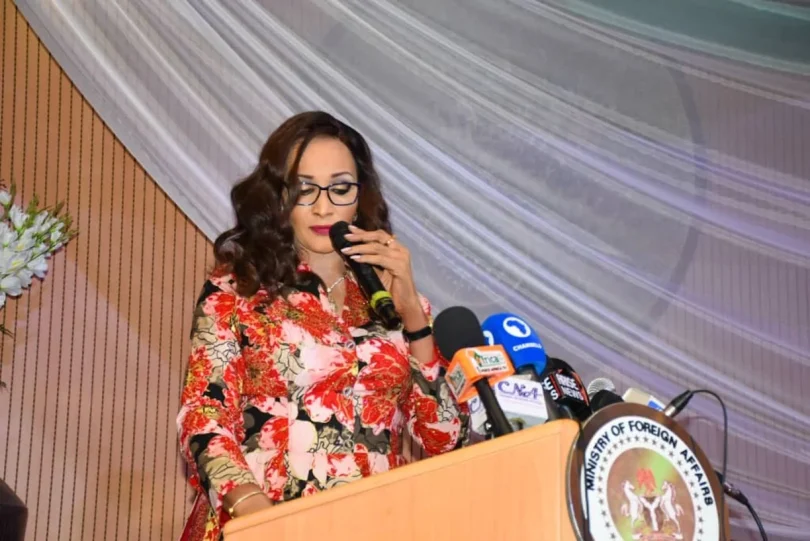
The Federal Government has urged Nigerian businesses to ramp up production and exports to take advantage of China’s decision to extend zero-tariff treatment to 100 per cent of tariff lines for African countries.
The Minister of Foreign Affairs, Ambassador Bianca Odumegwu-Ojukwu, said the policy could accelerate Nigeria’s industrialisation, create jobs and drive structural economic transformation if backed by increased productive capacity.
Odumegwu-Ojukwu stated this in a message to participants at an international seminar organised by the Centre for China Studies in Abuja at the weekend.
The seminar, themed, “China’s Zero-Tariff Treatment on 100% of Tariff Lines for African Countries and its Implications for Structural Economic Transformation in Africa,” examined the opportunities and challenges arising from China’s expanded market access for African products.
The minister described the policy as a historic development capable of shifting Africa-China relations from a focus on “aid and loans” to “trade and production.”
She said the duty-free access to China’s market of about 1.4 billion people could be a “game-changer” for Nigeria’s agro-processing, textiles, solid minerals and manufacturing sectors.
According to her, the initiative provides an opportunity for African countries to move beyond the export of raw commodities and develop value-added products, including processed agricultural goods, leather, pharmaceuticals, textiles and manufactured products.
She also said the policy could attract Chinese and other foreign investments into industrial parks, agro-processing facilities and manufacturing hubs, while strengthening regional value chains through the African Continental Free Trade Area.
The minister, however, cautioned that zero tariffs alone would not guarantee economic transformation, stressing that Nigeria must build the productive capacity required to take advantage of the expanded market access.
“Zero tariff is meaningless if we have nothing to export,” Odumegwu-Ojukwu stressed.
She said the Federal Government would prioritise productive capacity in areas including cocoa processing, sesame, leather, garments, pharmaceuticals and renewable energy components.
The minister added that the Nigerian Investment Promotion Commission and other relevant agencies were prepared to work with Chinese investors to establish factories in Nigeria for the production of goods for export to China.
She said the policy aligned with Nigeria’s foreign policy priorities under President Bola Tinubu’s Renewed Hope Agenda, particularly the pursuit of prosperity diplomacy.
Odumegwu-Ojukwu further identified reliable electricity, affordable finance, efficient logistics and adequate infrastructure as critical conditions for Nigeria to benefit from the zero-tariff arrangement.
She called for greater technical cooperation between Nigerian and Chinese regulatory authorities to enable Nigerian exporters to meet Chinese standards, including food safety and sanitary and phytosanitary requirements.
The minister said the Ministry of Foreign Affairs would facilitate engagements between Nigerian regulatory agencies, including the National Agency for Food and Drug Administration and Control and the Standards Organisation of Nigeria, and their Chinese counterparts.
On trade logistics and finance, she advocated streamlined shipping arrangements, trade finance and payment mechanisms in naira and renminbi to reduce transaction costs.
She said the ministry would also coordinate with relevant government agencies, the Chinese Embassy in Abuja, Nigerian diplomatic missions in China and other stakeholders to support Nigerian exporters seeking access to the Chinese market.
Odumegwu-Ojukwu said Nigeria would work to ensure that the zero-tariff initiative translated from policy declarations into increased production, exports and actual shipments of Nigerian manufactured and value-added goods to China.
She also stressed the need to address information gaps, improve Nigerian businesses’ access to Chinese buyers, meet international standards and maintain effective rules of origin to prevent the trans-shipment of non-African goods.
While thanking the Chinese government and people for the initiative, the minister urged Nigerian businesses to seize the opportunity.
“To our private sector, the door to China is now fully open. The question is: what are we taking through it?” she asked.