
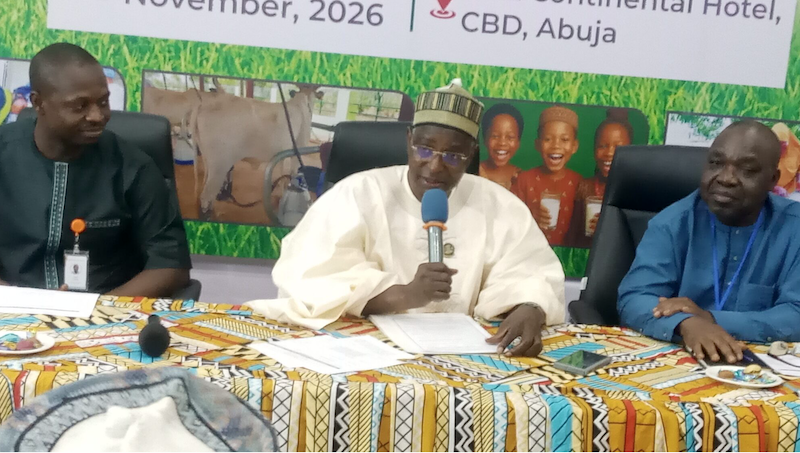
The Federal Government is collaborating with stakeholders to validate a national action plan aimed at boosting local milk production and reducing the country’s annual 1.5 billion dollars dairy import bill.
The Minister of Livestock Development, Idi Maiha, said this at a validation workshop on the National Action Plan for the Promotion of Local Milk Production in Nigeria on Monday in Abuja.
The workshop was organised by the Federal Ministry of Livestock Development (FMLD) in collaboration with the Economic Community of West African States (ECOWAS).
Maiha said reducing the import bill would require a practical and implementable action plan to build a modern, competitive and inclusive dairy sector.
He said the plan was anchored on the Nigeria Livestock Growth Acceleration Strategy (NLGAS 2025–2035), National Dairy Policy 2023–2028 and its implementation framework, as well as the Nigeria Livestock Master Plan and Livestock Sector Strategy 2026–2040.
Maiha said the era of holding conferences and workshops without tangible results in the dairy sector was over.
He urged stakeholders to move beyond discussions to implementing policies that would increase local milk production.
“Meaningful progress in the sector can only be achieved through direct engagement with farmers and other operators to identify challenges and develop practical solutions,” he said.
The minister expressed concern that Nigeria lacked reliable data on daily milk production, functional dairy cooperatives, their links with processors and challenges affecting milk collection and storage.
“How much have we done to reduce that $1.5 billion annual figure? How much milk are we making every day all over the country? That data is unavailable.
“So, whether import is going up or coming down, we do not know, because we have no evidence-based argument,” he said.
Maiha said the action plan must have clear priorities, designated implementing institutions, funded activities and measurable outcomes.
He outlined three priorities, including directing investment to commercially viable dairy-producing areas based on feed and water availability, farmers’ capacity, security, road access and demand from processors.
The second priority, he said, was addressing constraints to reliable local milk supply through year-round access to fodder and water, improved breeds, animal health services, extension support and quality control.
He identified the third priority as linking infrastructure to viable markets through milk collection and cooling centres managed by capable operators and supported by reliable off-take arrangements.
“We should invest in viable dairy businesses, not facilities that stand idle, because many dairy facilities built before independence are now moribund,” he said.
Maiha identified existing private-sector initiatives, including FrieslandCampina WAMCO’s farmer-centred programme, Nestlé Nigeria’s dairy development activities, and private farms operated by Arla, Integrated Dairies Ltd. and L&Z Integrated Dairy Farms, as foundations for expanding the sector.
He urged stakeholders to learn from Kenya, where cooperatives provide farmers with extension services on feeding, breeding, animal health and record-keeping, and Uganda, where private processors support milk collection, cooling and technical assistance for smallholder farmers.
“The lesson is straightforward: Connect farmers to advisory services, quality-based markets, and reliable buyers.
“Ensure the inclusion of women and youths in training, finance, technology and leadership,” he said.
Maiha assured stakeholders that the ministry would provide policy guidance, regulation and standardisation to support the sector.
He said the ministry would also work with investors and producers across the states, using quarterly dashboard reviews to monitor local milk procurement, quality, farmers’ incomes, private investment and the participation of women and youths.
“Let us create a plan that is ambitious in purpose and realistic in execution, one that strengthens livelihoods, expands safe milk supply, and makes Nigeria’s dairy sector more competitive and focused on national self-sufficiency,” he said.
He added that 21 states now had ministries of livestock, indicating readiness for coordinated action.
Earlier, the ministry’s Permanent Secretary, Dr Chinyere Akunjobi, said Nigeria spent more than 1.5 billion dollars annually on dairy imports in spite of its enormous livestock potential.
Akunjobi, represented by Dr Victor Egbon, Director of Ruminant and Monogastric Department, said the action plan would address major challenges affecting the industry.
She listed the challenges to include inadequate access to improved dairy breeds, quality feed, veterinary services, milk collection and processing facilities.
She called for increased private-sector investment and stronger capacity-building support for farmers.
Also, Dr Soule Goura, Coordinator, Milk Offensive Project, Agriculture and Rural Development, ECOWAS Commission, commended Nigeria’s efforts to develop the action plan.
He said Nigeria was a major dairy producer in West Africa, adding that the country played an important role in regional dairy development.