
She arrived in Lagos on October 29 with a church delegation for prayer. When the delegation finished and returned to Uganda, she stayed back alone.
Days later, she was allegedly caught at the Murtala Muhammed International Airport, Lagos, with 87 wraps of cocaine strapped to her body — for a promise of just $1,000.
That is the story the National Drug Law Enforcement Agency, NDLEA, told on Sunday, November 8, and it is the story other platforms have missed.
While others focused only on the N900m Tapentadol seizure, P.M.EXPRESS investigation focused on the human angle story behind the bust: how a prayer trip allegedly became a cover, how a hotel became a handover point, and how a courier was allegedly recruited for $1,000 to carry a risk that could cost her many years in prison.
The suspect, 34-year-old Ugandan woman, Farida Nansubuga, is presumed innocent until proven guilty by a court of competent jurisdiction.
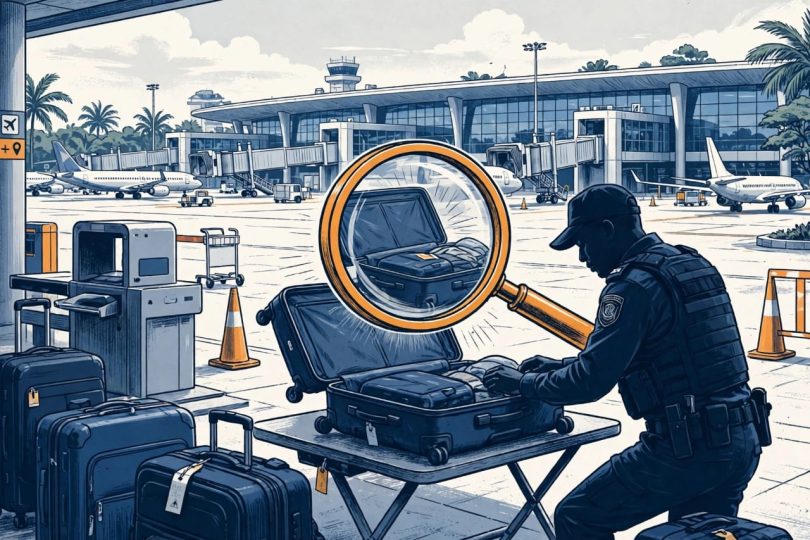
NDLEA said Nansubuga was arrested on Tuesday, November 3, at Terminal 2 of MMIA, Lagos, as she prepared to board a flight to Uganda.
Operatives became suspicious during a joint passenger screening exercise with aviation security personnel.
A search, NDLEA said, led to the discovery of 87 wraps of cocaine weighing approximately 1.15 kilogrammes, allegedly strapped around her pelvic region and concealed beneath two layers of underwear.
That concealment method, anti-drug experts say, is deliberate. It is meant to beat body scanners and physical checks. It is also extremely dangerous. If a wrap bursts inside the body, it can kill within minutes.
NDLEA did not say she swallowed the drugs. It said the wraps were strapped to her body.
What NDLEA said next is what makes this case different.
Nansubuga allegedly told investigators that she arrived in Nigeria on October 29 with members of her church delegation for a prayer session at The Synagogue Church of All Nations, SCOAN, in Ikotun, Lagos.
She allegedly told investigators that the other members of the delegation returned to Uganda after the prayer session, but she stayed behind.
P.M.EXPRESS noted clearly: NDLEA has NOT accused the church of any wrongdoing. The allegation, as stated by NDLEA, is that a prayer trip was allegedly used as cover. No evidence has been presented in court linking the church to the drugs.
The question investigators must now answer is: Who convinced her to stay back?
NDLEA said investigations revealed that she was directed to a contact in Nigeria, who allegedly arranged her transportation to a hotel where she received the cocaine.
She was allegedly promised a payment of at least $1,000 upon successfully delivering the consignment to its intended destination in Uganda.
$1,000 is about N1.5 million. For 1.15kg of cocaine, experts say that is a very small fee.
Drug control experts told P.M.EXPRESS that traffickers now use what they call “disposable couriers” — poor, desperate, or first-time travellers who are paid little, given little information, and abandoned if caught.
“The baron loses only the drugs, not a trusted member,” one former NDLEA officer told P.M.EXPRESS. “The courier carries all the risk. The baron carries all the profit.”
If Nansubuga had succeeded, she would have allegedly received $1,000. If she is convicted in Nigeria, she faces a long prison sentence under the NDLEA Act.
Who is the Nigerian contact? Who is the person she called “Joy”? Who paid for the hotel? Who bought the return ticket to Uganda? Did she change her ticket after the delegation left?
NDLEA has not yet named the contact. P.M.EXPRESS will not name any person not named by NDLEA or charged in court.
NDLEA said a Nigerian contact arranged her transportation to a hotel where she received the cocaine.
P.M.EXPRESS investigation: This is now the most important part of the case.
Hotels in Lagos are required to keep guest records, CCTV, and payment details. If NDLEA can trace the hotel, the booking, the payment, and the CCTV, it can trace the network behind Nansubuga.
Did the contact book the hotel in his name or hers? Did he pay cash? Did he meet her in the room or in the lobby? How long did she stay?
These questions will determine whether this was a one-woman attempt or part of a bigger syndicate operating between Lagos and Kampala.
Until NDLEA charges the case to court, these remain allegations and lines of investigation.
The cocaine case did not happen alone. In the same week, NDLEA recorded three other major seizures at Lagos airport.
On Friday, November 6, NDLEA intercepted 750,000 tablets of Tapentadol, 250mg, weighing 526 kilogrammes and estimated to be worth N900 million.
The consignment, NDLEA said, originated from Ahmedabad, India, and arrived aboard an Ethiopian Airlines flight on November 3. It was declared as Paracetamol Tablets 500mg.
It was packed in eleven cartons inside two wooden structures at the import shed of the Lagos airport.
P.M.EXPRESS noted: Tapentadol is an opioid. By declaring it as ordinary Paracetamol, traffickers allegedly hoped it would pass as a normal pharmaceutical import. NDLEA said forensic checks exposed the deception.
In another operation, NDLEA operatives at the import shed on November 4 intercepted 32 parcels of Loud, a potent strain of cannabis, weighing 16.15 kilogrammes and concealed inside two wooden sofas in a consolidated cargo that arrived from Texas in the United States aboard a Turkish Airlines flight.
A follow-up operation on November 6 led to the arrest of a 34-year-old caterer from Ibadan, Adeoye Sarafa Ojo, who allegedly walked in to collect the package. He is also presumed innocent until proven guilty.
In a fourth operation, NDLEA intercepted 46 blocks of cannabis weighing 22.2 kilogrammes, packaged in two cartons for shipment to the United Kingdom on November 3, at courier companies in Lagos.
There is a fifth angle other platforms buried.
NDLEA said it uncovered a syndicate importing chemicals used in the production of Colorado, a synthetic cannabis, from the United Kingdom.
The chemicals were allegedly hidden in nine parcels inside two cartons of snacks tagged “Michael Tea Guy” in a consolidated cargo that arrived aboard an Air Peace flight from the UK on October 23.
Two parcels contained 1.20 kilograms of cannabis, while forensic analysis of the other seven parcels confirmed them to be chemicals used in making synthetic cannabis.
A 51-year-old freight agent, Afolabi Abiodun Wale, who allegedly came to clear the consignment was arrested. Two more cartons for the same recipient later arrived from the UK aboard an Allied Air flight.
NDLEA said a sting operation conducted between October 26 and October 28 led to the arrest of 51-year-old Okwuite Benjamin Ojone when he took delivery of the four cartons.
A search of the two additional cartons revealed three parcels concealed in two packs of detergent, weighing 3.30 kilograms, and eleven plastic bottles of mostly liquid substances weighing 16.25 kilograms, bringing the total seizure to 1.20kg of cannabis and 28.65kg of synthetic cannabis chemicals.
This is the most dangerous angle for Lagos. Colorado is not ordinary cannabis. It is synthetic, unpredictable, and linked to mental health crises among young users in Lagos. If chemicals are now being imported to produce it locally, the problem is no longer just importation — it is local production.
Drug control experts told P.M.EXPRESS that Lagos airport is targeted because of volume. Thousands of passengers, tonnes of cargo, and hundreds of courier parcels pass through MMIA daily.
Traffickers, they say, now use three methods:
One, human couriers like Nansubuga, who hide drugs on the body and hope to pass screening.
Two, false declaration, like the Tapentadol declared as Paracetamol.
Three, concealment in household items, like Loud in sofas, chemicals in snacks and detergent, and cannabis in courier cartons to the UK.
NDLEA’s success in one week, experts say, shows that joint screening, intelligence, and follow-up sting operations are working — but also that traffickers are testing new routes every week.
All suspects arrested in these operations are presumed innocent until proven guilty by a court of competent jurisdiction.
NDLEA is expected to charge them to court after investigation. The prosecution will need to prove not just possession, but knowledge, intent, and the chain linking each suspect to each consignment.
For Nansubuga, the key evidence will be the 87 wraps, the screening report, her statement, and any phone or hotel records linking her to the alleged Nigerian contact.
For the Tapentadol case, the key evidence will be the import documents, the false declaration, and who was meant to clear the consignment.
For the Loud and Colorado chemical cases, the key evidence will be the sting operations, the delivery, and the forensic reports.
P.M.EXPRESS will follow all the cases to court and bring you updates.
For now, one fact is clear: She came for prayer. She stayed back for $1,000. She was allegedly caught with 87 wraps.
The question is: Who sent her, and how many more like her are still passing through.