
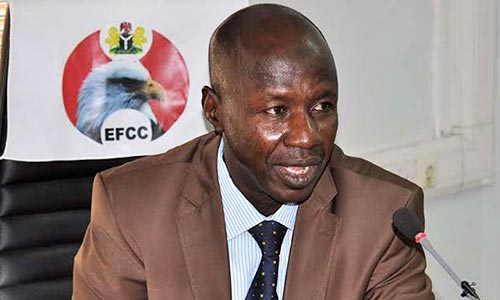
The Court of Appeal in Abuja has ruled that the prolonged retention of Ibrahim Magu as Acting Chairman of the Economic and Financial Crimes Commission (EFCC) was unlawful, overturning a 2019 judgment of the Federal High Court which had upheld his continued stay in office despite the Senate’s refusal to confirm him as substantive chairman.
A three-member panel of the appellate court delivered the judgment on Monday, September 21, 2026, in an appeal filed by Abuja-based lawyer Johnmary Jideobi, who had challenged Magu’s continued occupation of the EFCC chairmanship after his nomination was rejected twice by the Senate.
The decision effectively reverses the legal position taken by Justice Ijeoma Ojukwu of the Federal High Court in Abuja on December 4, 2019, when she held that the EFCC Establishment Act did not prescribe a specific time limit within which a person could remain as acting chairman of the anti-graft commission.
Magu was appointed Acting Chairman of the EFCC in November 2015 by then-President Muhammadu Buhari, following the exit of Ibrahim Lamorde. An official EFCC publication records that Magu formally took over the leadership of the commission on November 11, 2015.
His name was subsequently forwarded to the Senate for confirmation as substantive chairman in accordance with Section 2(3) of the EFCC Establishment Act, which requires the President’s appointment of the chairman and other members of the commission to be subject to confirmation by the Senate.
The Senate first rejected Magu’s nomination on December 15, 2016, citing a security report from the then Department of State Services. The nomination was returned to President Buhari for further action.
Buhari later re-submitted Magu’s name to the Senate, but the upper legislative chamber again declined to confirm him on March 15, 2017 after a confirmation hearing.
The National Assembly’s official record shows that the second rejection followed about two hours of questioning by senators on issues including human rights, recovered assets, management of recovered funds and personnel discipline.
Despite the two Senate rejections, Magu continued to head the EFCC in an acting capacity.
That development prompted Jideobi to institute an action at the Federal High Court in Abuja in March 2017, contending that Magu could not lawfully remain indefinitely as acting chairman after the Senate had refused to confirm him.
Jideobi’s case was one of several legal challenges brought over Magu’s continued stay in office.
At the Federal High Court, Jideobi argued that the Senate’s refusal to confirm Magu meant that his acting appointment could no longer continue and asked the court to determine the legality of his continued occupation of the office.
Justice Ojukwu, however, dismissed the challenge in her December 4, 2019 judgment.
The Federal High Court consequently held that the absence of a statutory time limit created a lacuna which left the then President with discretion over the continuation of the acting appointment.
The Federal High Court consequently held that the absence of a statutory time limit created a lacuna which left the then President with discretion over the continuation of the acting appointment.
Justice Ojukwu memorably described the situation as handing Buhari the proverbial “yam and the knife” because there was no specific statutory duration prescribed for service in an acting capacity.
The lower court also rejected reliance on a Senate rule cited by Jideobi, holding that the particular provision related to ministerial nominees and could not automatically be applied to the position of acting chairman of the EFCC.
Justice Ojukwu additionally held that Jideobi lacked the requisite locus standi to institute the action.
Although the Federal High Court dismissed the suits challenging Magu’s tenure, the judge reportedly urged the President to take the necessary steps towards having the leadership question at the EFCC properly resolved through the statutory confirmation process. Magu himself later relied heavily on that 2019 judgment in defending the legality of his tenure.
Dissatisfied with the Federal High Court’s decision, Jideobi approached the Court of Appeal.