
…Mbappé secures second consecutive Golden Boot as FIFA recognises standout performers after memorable 2026 tournament
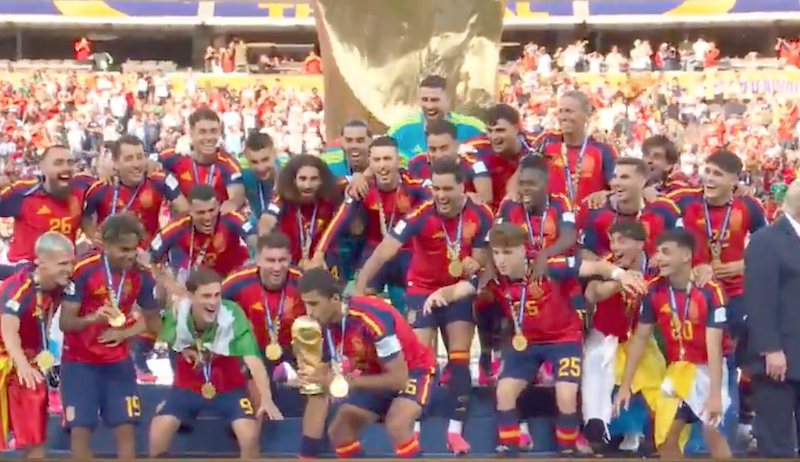
Spain’s unforgettable triumph at the 2026 FIFA World Cup was crowned with an equally remarkable haul of individual honours on Sunday night as FIFA recognised the tournament’s finest performers following the newly crowned champions’ dramatic 1-0 extra-time victory over Argentina in the final.
While Ferran Torres’ decisive strike secured Spain’s second world title, it was the collective brilliance of Luis de la Fuente’s side throughout the tournament that dominated the post-final awards ceremony.
TheNewsGuru (TNG) reports midfield maestro, Rodri was named winner of the prestigious Golden Ball as the tournament’s best player, while goalkeeper Unai Simón claimed the Golden Glove.
Teenage defender, Pau Cubarsí walked away with the Best Young Player Award, completing an unprecedented clean sweep of three of FIFA’s four major individual prizes.
Only France captain, Kylian Mbappé prevented Spain from claiming every major individual honour after finishing as the tournament’s leading scorer to win the Golden Boot.
The awards reflected not only Spain’s dominance throughout the competition but also the emergence of a new generation of footballing stars capable of shaping the international game for years to come.
Rodri crowned the world’s best
Few players influenced the 2026 FIFA World Cup as profoundly as Rodri.
The Spanish midfielder controlled matches with extraordinary composure, intelligence and precision, serving as the heartbeat of Luis de la Fuente’s championship-winning side.
Whether dictating possession, breaking up opposition attacks or launching Spain’s forward movements, Rodri consistently demonstrated why many regard him as the finest defensive midfielder of his generation.
His performance reached its peak in the knockout rounds, where Spain eliminated Portugal, Belgium, France and defending champions Argentina en route to the trophy.
Against Argentina in the final, Rodri once again produced a masterclass.
He dominated midfield, restricted Lionel Messi’s influence and ensured Spain maintained control for much of the contest before Ferran Torres’ extra-time winner settled the championship.
The Golden Ball recognised a tournament in which Rodri combined tactical discipline with remarkable consistency, leading Spain through an unbeaten campaign while anchoring one of the competition’s most complete teams.
Mbappé’s goals earn historic Golden Boot
Although France fell short of reaching the final, Kylian Mbappé once again proved that he remains international football’s most feared goalscorer.
The French captain finished the tournament with 10 goals, displacing Argentina’s Lionel Messi with 8 goals, to secure the Golden Boot and becoming the first player to win the World Cup Golden Boot twice.
Mbappé’s remarkable tally included a decisive brace in France’s thrilling 6-4 victory over England in the third-place playoff, ensuring he finished comfortably ahead of his nearest challengers.
His performances also elevated him further in World Cup history, adding another extraordinary chapter to an already remarkable international career.
While the Golden Ball eluded him this time, the Golden Boot reinforced Mbappé’s reputation as one of the most prolific forwards the tournament has ever seen.
Unai Simón rewarded for defensive excellence
Spain’s journey to the title was built not only on attacking quality but also on defensive solidity. At the centre of that success stood goalkeeper Unai Simón.
The Athletic Club shot-stopper enjoyed one of the finest tournaments by a goalkeeper in recent World Cup history, producing crucial saves throughout the competition while organising a defence that conceded only one goal across the entire tournament.
Simón kept seven clean sheets and set a new World Cup record by going 650 consecutive minutes without conceding, achievements that made him the overwhelming choice for the Golden Glove Award.
Although Argentina’s Emiliano Martínez produced several spectacular saves in the final, Simón’s consistency throughout the tournament ultimately proved decisive in FIFA’s voting.
Cubarsí announces himself to the world
Perhaps no player enhanced his reputation more dramatically than Pau Cubarsí.
At just 19 years old, the Barcelona central defender played every minute of Spain’s triumphant campaign, displaying maturity far beyond his age.
His composure in possession, intelligent positioning and ability to read the game allowed Spain to build attacks confidently from the back while remaining exceptionally difficult to break down defensively.
Cubarsí’s performance in the final typified his tournament.
Tasked with helping contain Lionel Messi and Argentina’s attack, the teenager delivered another assured display that confirmed his status as one of world football’s brightest defensive prospects.
FIFA rewarded those performances by naming him the tournament’s Best Young Player, recognising a breakthrough competition that could mark the beginning of a long international career.
Netherlands recognised for Fair Play
Meanwhile, The Netherlands received the FIFA Fair Play Award, honouring the team with the best disciplinary record and sporting conduct throughout the tournament.
Although they fell short of the latter stages of the competition, the Dutch earned praise for their professionalism and respect for opponents and match officials across the six-week tournament.
Spain’s collective brilliance reflected in the awards
The distribution of FIFA’s individual honours highlighted Spain’s dominance throughout the competition.
Three of the four principal individual awards went to Spanish players, underlining the balance that characterised Luis de la Fuente’s side.
Unlike many previous champions who relied heavily on one outstanding individual, Spain succeeded through collective excellence.
Rodri controlled midfield. Simón inspired confidence from goal. Cubarsí marshalled the defence with remarkable maturity.
Lamine Yamal and Nico Williams electrified opponents on the wings. Pedri orchestrated attacks. Ferran Torres delivered the defining moment of the tournament in the final.
The awards recognised individual brilliance, but they also reflected the strength of a squad that consistently functioned as a cohesive unit.
A tournament of unforgettable stars
Beyond the official winners, the 2026 FIFA World Cup showcased another generation of global football stars.
Messi produced memorable performances while leading Argentina to another final. Mbappé reaffirmed his standing among the world’s elite.
Erling Haaland spearheaded Norway’s impressive campaign. Jude Bellingham continued his emergence as England’s midfield leader. Lamine Yamal confirmed that football’s future had already arrived.
Together, they helped produce one of the most entertaining and competitive World Cups in history.
2026 FIFA World Cup Individual Award Winners
| Award | Winner | Country |
|---|---|---|
| Golden Ball (Best Player) | Rodri | Spain |
| Golden Boot (Top Scorer) | Kylian Mbappé (10 goals) | France |
| Golden Glove (Best Goalkeeper) | Unai Simón | Spain |
| Best Young Player | Pau Cubarsí | Spain |
| FIFA Fair Play Award | Netherlands | Netherlands |
As Spain celebrated with the FIFA World Cup Trophy beneath the lights of New Jersey, the post-match awards ceremony reinforced what six weeks of football had already established.
The champions had not only lifted the game’s most coveted prize; they had also produced the tournament’s finest player, best goalkeeper and brightest young talent.
For Spain, it was a night that perfectly encapsulated their supremacy on football’s grandest stage.