
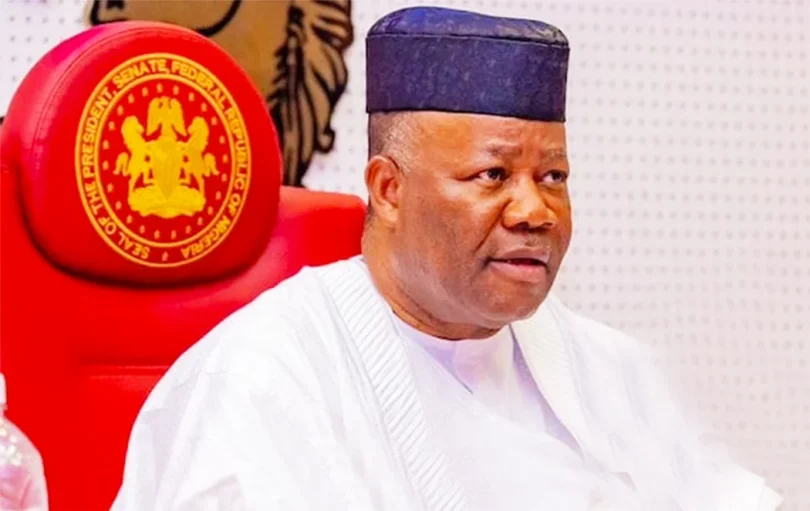
The President of the Senate, Godswill Akpabio, has disclosed that the National Assembly may amend the Electoral Act 2026 following concerns that some of its provisions have inadvertently disadvantaged lawmakers seeking re-election.
Akpabio made the disclosure on Tuesday during the opening of the 2026 National Assembly Open Week and the presentation of the Third-Year Legislative Scorecard of the 10th National Assembly in Abuja.
His remarks come in the wake of complaints by several federal lawmakers who lost their party tickets during recent primaries ahead of the 2027 general elections.
The Senate President admitted that some provisions of the Electoral Act had produced unintended consequences, leaving legislators vulnerable during party primaries.
According to him, while the law contributed to more peaceful primaries across the country, it also created challenges that lawmakers did not anticipate when enacting it.
“From even the Electoral Act that we passed, you can see not so many people were killed, if any, in many of the states of the federation during these primaries,” Akpabio said.
“But we shall tinker with the Act again to make sure that we are not the victims of our own actions.
“I don’t know when we get to the point, because I understand many members and many senators were overwhelmed by the leadership of the various constituencies because I don’t think I want to say states… and at the end of the day, we seem to have made a law against ourselves.”
Although Akpabio did not identify the specific provisions that may be reviewed, he assured lawmakers that the National Assembly would reflect on the legislation to ensure that future legislators are not placed at a disadvantage.
“But I assure you that we shall tinker with it so that future members and future senators will not have difficulty going back.
“Because the more people with experience that comes back, the more the country benefits from their activities,” he added.
The Senate President also defended the performance of the 10th National Assembly, describing it as the most peaceful and productive legislature since Nigeria returned to democratic rule in 1999.
He said the Assembly had recorded major achievements in lawmaking, constitutional amendments, and economic reforms through collaboration with the Executive.
Akpabio also dismissed criticisms that key bills were rushed through the legislative process, citing the proposed State Police Bill as an example of legislation that underwent extensive nationwide consultations before reaching the passage stage.
“People are not aware that we have worked on it for the past two and a half years. We have gone to all the regions in Nigeria. We have done public hearings across the country,” he said.
He urged Nigerians to study proposed legislation before criticising lawmakers on social media.
“Sometimes, before you comment on social media, take time to go through the work we have actually done.
“Our job here is to ensure that we make laws that will last for generations. We are not making laws for ourselves. We are making laws for the protection of Nigeria’s future and for generations unborn,” he said.
Earlier, Speaker of the House of Representatives Tajudeen Abbas disclosed that the House had received 2,747 bills in the last three years—the highest number since the return to democracy in 1999.
He said 363 of the bills had been passed, while 72 had received presidential assent.
Abbas also announced that the House would withdraw its earlier version of the State Police Bill to give priority consideration to a more comprehensive Executive Bill recently transmitted by President Bola Tinubu.
According to him, the new proposal, developed by a presidential committee chaired by the President’s Chief of Staff, Femi Gbajabiamila, contains stronger safeguards and a more robust framework for state policing.
“The House will therefore recall the version it earlier passed, and accord the Executive Bill the expedited consideration that a matter of this urgency deserves,” Abbas said.
He assured Nigerians that the bill would undergo public hearings and legislative scrutiny before passage.
Also speaking, Gbajabiamila said transparency, inclusion and institutional reforms remain essential to strengthening Nigeria’s democracy, adding that constructive cooperation between the Executive and Legislature does not undermine legislative independence.
Executive Director of the Policy and Legal Advocacy Centre (PLAC), Clement Nwankwo, commended the National Assembly for sustaining public engagement initiatives but urged lawmakers to intensify oversight of the Executive and prioritise constitutional amendments, electoral reforms, greater inclusion of women and improved transparency in legislative activities.