
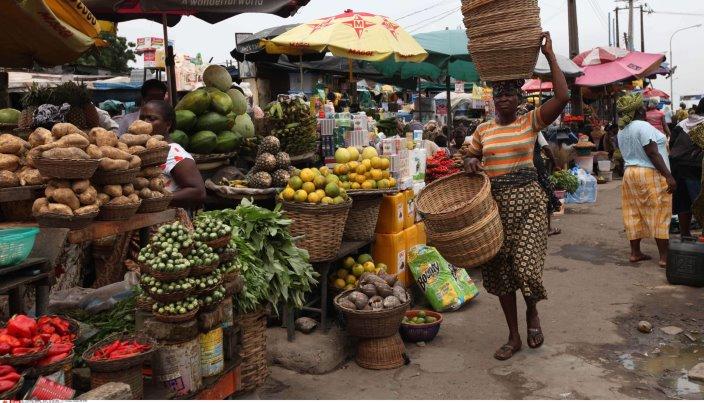
Violent land disputes have emerged as a major factor affecting Nigeria’s fragile food distribution system, and sitting at the epicentre of this crisis are two of Nigeria’s most important commercial cities, Ibadan and Abuja.
This is according to the findings in a new report by SBM Intelligence titled The Price of a parcel: An analysis of land disputes and their impact on food security in Nigeria.
The report, billed for official release on Tuesday 31 March 2026, reveals a growing crisis connecting land disputes to food supply disruptions, trader losses, and ultimately, inflated food prices for consumers.
SBM Intelligence drew from a dataset analysis of 54 violent incidents arising from land conflicts within a 76 month period, from October 2019 to January 2026, as well as a quantitative survey of 209 market traders and vendors across nine cities in all six geopolitical zones. This includes Abuja, Lagos, Ibadan, Bauchi, Kano, Onitsha, Awka, Port Harcourt and Calabar.
The report, seen by BusinessDay, shows that Nigeria’s capital city, Abuja, recorded the highest supply chain disruption score at 2.70.
“Abuja is Nigeria’s food distribution hub, drawing supplies from across the country. Its high vulnerability reflects exposure to conflicts from multiple source areas,” the report reads.
According to Abuja traders cited in the report, the frequent land disputes directly impact the supply and transport networks, resulting in supply delays and shortages, with 60 percent reporting that such delays happen very often.
The conflict-induced disruptions happening in farming communities in the Middle-Belt thus trickling down to Abuja in form of food shortage and supply delays, ultimately resulting in higher prices.
Source: SBM Intelligence Report
For Ibadan, the figures are much higher, with 100 percent of the traders surveyed reporting direct or indirect impact from land disputes. The SBM report described this city as having “perhaps the most alarming profile in the country.”
Nearly all respondents said disputes had increased, with the report noting that “64.5% [of traders] reporting disputes have ‘increased significantly’.”
Unlike Lagos, where food supply chains remain relatively stable despite an urban land crisis, Ibadan’s vulnerability lies in its proximity to contested agricultural zones. Supply disruptions are frequent, transport routes are increasingly unsafe, and traders face mounting uncertainty over inventory and pricing.
Across both cities, traders report “significant increase in the purchase price of goods from suppliers,” “increased transportation costs due to dangerous routes,” and “loss of income due to market closures or reduced customer traffic.”
These pressures ripple outward. When goods arrive late or in reduced quantities, prices rise. When transport becomes dangerous, costs are passed along. When markets shut or customers stay away, incomes shrink. The cumulative effect is a self-reinforcing cycle of economic strain.
At the heart of the crisis is a deeper institutional failure. Across the country, perceptions of authority effectiveness in resolving land disputes remain weak, averaging just 2.05 out of 4. As the report concludes, land conflicts “frequently overwhelm local peacekeeping capacities and judicial processes, exploding into communal warfare.”
In a few cases, state security forces also find themselves targeted in these attacks like in Niger state in 2022 when a land dispute led to the burning down of a police station. Similarly, in Osun state in 2025, seven police officers were injured by armed thugs while trying to restore peace.
In other cases, as is seen in a cited Anambra case, different parties begin to accuse the police operatives as being biased and colluding with the other parties. This accusations worsen the tension, making it near impossible for the law enforcement players to make a headway.
For Abuja and Ibadan, this failure carries outsized consequences. One is the nation’s distribution nerve centre; the other, a frontline market exposed to escalating rural conflict. Together, they show how unresolved land tensions are now reshaping Nigeria’s urban food economy.
As shown in the SBM report, the 54 violent incidents arising from land conflicts between October 2019 and January 2026, led to the death of at least 112 people.
Source: SBM Intelligence report
The recent Middle East crisis is now also impacting energy prices in Nigeria, and translating into increased logistics costs across key corridors. BusinessDay recent report shows that across many cities, transport prices have more than doubled, triggered by a 43.7 percent pump price increase from N835 per litre to over N1,200.
BusinessDay also reported earlier in the year, that Nigeria’s key trade corridors, especially around the commercial hubs are now under threat as insecurity spreads further west.
The March inflation data from the National Bureau of Statistics (NBS) also confirms that recent developments including the just-concluded Ramadan, have upended inflation gains of the last few months.
Dumebi Oluwole, Lead economist at Stears, confirmed that “Between February and March, the cost of living has already increased significantly, so we would expect the month-on-month inflation figure to carry more of the weight of those changes.”