
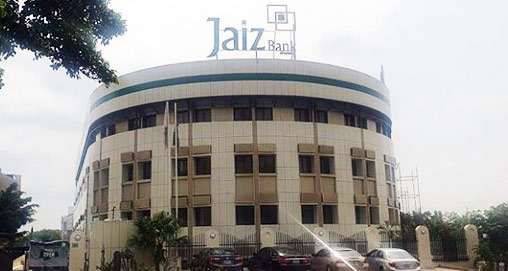
Scores of aggrieved customers of Jaiz Bank Plc have staged a protest at the bank’s main branch in Jos, Plateau State, over alleged fraudulent transactions involving more than ₦100 million, calling on the Central Bank of Nigeria (CBN), the Nigerian Bar Association (NBA) and the Federal Government to intervene and facilitate the recovery of their money.
The protesters, who gathered at the bank’s premises on Monday, November 2, 2026, accused the financial institution of failing to resolve complaints concerning funds they claimed were transferred or withdrawn without their authorisation.
The affected customers, who put the disputed amount at approximately ₦104 million, alleged that some of the transactions were facilitated by a former employee of the bank and insisted that the institution should be held accountable for losses arising from dealings they believed were legitimate banking transactions.
However, Jaiz Bank, through its legal adviser, Munir Barau, denied responsibility for the disputed funds, maintaining that the customers entered into private investment arrangements involving a former employee and her husband rather than transactions authorised by the financial institution.
The dispute has also resulted in criminal proceedings against the individuals allegedly involved and separate civil actions instituted against the bank at the Plateau State High Court, Jos Judicial Division.
During the protest, the customers carried placards demanding regulatory intervention and the recovery of their money.
Some of the placards bore inscriptions calling on the CBN to investigate the alleged unauthorised withdrawals, while others appealed to the Federal Government and the NBA for assistance.
One placard read, “Federal Government, come to our rescue, we have been cheated.”
Speaking on behalf of the protesters, Hashim Faruk said the dispute dated back to 2022, when several customers allegedly lost money through transactions involving a female employee of Jaiz Bank.
Faruk claimed that the affected customers had conducted their transactions through the bank and were subsequently unable to access funds they believed had been deposited or invested through its services.
According to him, the matter was eventually reported to the Criminal Investigation Department (CID) of the Plateau State Police Command, which commenced an investigation into the allegations.
He alleged that the police investigation identified a bank employee, Habiba Abdulrahman, as the person responsible for the disputed transactions.
Faruk further claimed that following the investigation, the police recommended that Jaiz Bank refund the affected customers, but the financial institution failed to comply.
He said repeated attempts to resolve the matter with the bank’s management had proved unsuccessful, leaving the customers with no alternative but to organise a public protest.
The protesters maintained that they had suffered financial hardship as a result of their inability to recover the funds.
They called for an independent investigation into the transactions, a definite timeline for recovering their money and accountability for anyone found responsible for wrongdoing.
Faruk appealed to the CBN to examine the circumstances surrounding the alleged withdrawals and determine whether the transactions complied with applicable banking regulations.
He also urged the NBA to provide legal support to the affected customers, particularly those who could not independently pursue litigation against the financial institution.
The protesters further called on the Federal Government to intervene, expressing concern that ordinary customers might struggle to obtain redress in a dispute involving a financial institution.
However, responding to the allegations, Jaiz Bank’s legal adviser, Munir Barau, who was designated by the management to speak on its behalf, rejected claims that the financial institution was responsible for the customers’ losses.
Barau maintained that the disputed funds were not paid into the customers’ individual Jaiz Bank accounts as claimed.
According to him, the money was instead deposited into personal accounts belonging to Abdulrahman and her husband, which were domiciled at the bank.
He explained that the couple allegedly collected money from individuals under private investment arrangements that promised periodic financial returns.
The bank’s legal adviser said the couple initially made monthly payments to the investors, with returns varying according to the amount invested.
He claimed that some customers received between ₦50,000 and ₦100,000 monthly before the payments allegedly stopped.
Barau cited the example of an individual who invested ₦10 million under an arrangement promising a monthly return of ₦400,000.
According to him, the arrangement continued for a period before the investor stopped receiving the expected payments.
He insisted that Jaiz Bank was not a party to the investment agreement and that the existence of personal accounts at the bank did not automatically make the financial institution responsible for the private transactions conducted through them.
The lawyer maintained that no official documentation had been presented establishing that the disputed investments were paid into accounts belonging to the bank itself.
He further disclosed that during the police investigation, detectives visited Abdulrahman’s residence and allegedly recovered several bank deposit tellers.
Barau said Abdulrahman and her husband had subsequently been charged with fraud and criminal conspiracy in connection with the transactions.
The allegations against the couple remain subject to the determination of the criminal proceedings.
Meanwhile, a joint venture agreement obtained in connection with the dispute provides further details about one of the investment transactions referenced by the bank’s legal adviser.
The agreement, bearing the name Munir Dansarina Global Ventures, identifies Abubakar Idris Zakariya and Munir Murtala Muhammad Dansarina as the parties to a private investment arrangement.
According to the document, Zakariya invested ₦10 million in August 2025 under an arrangement providing for monthly profit payments.
The agreement records that Zakariya had already received ₦1 million, leaving an outstanding balance of ₦9 million.
It further states that the investment initially attracted a monthly return of ₦400,000, which was subsequently reduced to ₦360,000 following the payment of the ₦1 million.
The financial terms correspond with the investment arrangement described by Barau in his explanation of the disputed transactions.
The agreement also contains a dispute-resolution clause requiring the parties to first attempt an amicable settlement before approaching a court of competent jurisdiction.
However, the document identifies Zakariya and Dansarina as the contracting parties and does not list Jaiz Bank as a party to the agreement.
While the agreement provides evidence of a private investment arrangement, it does not, by itself, determine whether bank personnel facilitated the transaction in an official capacity or whether the financial institution bears any legal responsibility for the investment losses.
Despite the bank’s explanation, some affected customers disputed its position, insisting that their dealings were conducted through the bank’s premises and established banking procedures.
One of the complainants, Amina Odoko, maintained that she dealt directly with Jaiz Bank rather than entering into a private arrangement with Abdulrahman.
According to her, the transactions took place within the bank’s premises and were supported by documents and payments processed through an account domiciled at the institution.
She questioned the bank’s attempt to distance itself from the disputed transactions when, according to her account, customers dealt with individuals working within the banking environment.
Odoko insisted that the circumstances surrounding the transactions justified a proper investigation into the role of the bank and its employees.
Her account directly contradicts the position advanced by Barau that the customers knowingly entered into personal investment arrangements with the former employee and her husband.
Further questions have emerged from a Jaiz Bank account statement showing a ₦4 million transfer from a children’s savings account to a beneficiary identified as Munir Dansarina Global Ventures.
The transaction, dated May 9, 2025, was recorded as a debit from an account belonging to Sani Ashraf Lawal Umar, identified in the statement as a children’s savings account maintained at the bank’s Jos branch.
The account statement also records a transfer charge of ₦53.75.
The beneficiary’s name corresponds with the business name appearing on the joint venture agreement involving Zakariya and Dansarina.
Other entries in the statement include credits of ₦999,500 and ₦1 million received from First Bank on May 7 and May 8, 2025, respectively, with transaction descriptions referring to Aisha Sani Muhammad.
A further credit of ₦60,000 was recorded on May 15, 2025, under a transaction narration referring to Habiba Abdulrahman.
The statement also shows cash deposits of ₦60,000 and ₦100,000 on June 16, 2025, alongside other credits recorded in subsequent months.
The statement establishes that a ₦4 million debit was recorded against the children’s savings account and that Munir Dansarina Global Ventures was identified as the beneficiary.
However, the available record does not establish whether the transfer was authorised, its precise purpose or whether it formed part of the investment arrangements described by the bank’s legal adviser.
The transaction also occurred in May 2025, whereas the separate joint venture agreement records Zakariya’s ₦10 million investment in August of the same year.
Consequently, the available documents do not establish that the two transactions formed part of the same arrangement.
Nevertheless, the transaction records provide an additional documentary basis for examining the movement of funds and determining the extent of any involvement by bank personnel.
The dispute has also resulted in several civil proceedings against Jaiz Bank before the Plateau State High Court, Jos Judicial Division.
One of the suits was instituted by Rose Dayu Gyang against Jaiz Bank Plc.
The writ of summons directs the bank to enter an appearance within 30 days of service and warns that failure to do so could enable the claimant to proceed with the action in the bank’s absence.
The document bears a Jaiz Bank receiving stamp dated March 13, 2026, and a High Court processing stamp dated April 10, 2026.
In another case, Umar Lawal Hashim and Aisha Sani Muhammad instituted proceedings against Jaiz Bank on behalf of themselves and their three minor children, Ashraf Sani Umar Lawal, Hauwa Khairy Umar Lawal and Muhammad Umar Lawal.
The originating process, received at the High Court on August 6, also directs the financial institution to enter an appearance within 30 days of service.
The action confirms that the family has taken the dispute before the court, although the available writ does not disclose the full particulars of the claims or establish liability against the bank.
A separate writ of summons also identifies Abubakar Idris Zakariya as a claimant in proceedings instituted against Jaiz Bank and Habiba Abdulrahman at the Plateau State High Court.
The writ directs the defendants to enter an appearance within 30 days, with a warning that proceedings could continue in their absence if they fail to respond.
Although the handwritten suit number on the document was not sufficiently legible, the originating process establishes the existence of legal proceedings involving Zakariya and the defendants.
Zakariya’s name also appears in the joint venture agreement detailing the ₦10 million investment arrangement with Munir Murtala Muhammad Dansarina.
The agreement and the court process therefore identify him as a party to the investment arrangement and as a claimant in separate litigation involving the bank and Abdulrahman.
However, the available court documents do not establish that any of the claims against Jaiz Bank have been determined or that the bank has been found liable for the alleged losses.
The existence of the civil suits also does not, by itself, establish criminal wrongdoing by the financial institution or the individuals named in the proceedings.
The dispute raises important legal questions about the circumstances in which a financial institution may be held responsible for transactions involving its employees, particularly where customers maintain that they acted through the bank’s premises, documentation or established procedures.
Among the issues requiring determination are whether the disputed payments were made through authorised banking channels, whether any employee acted within the scope of their official duties and whether the bank had any legal obligation to prevent or detect the alleged misconduct.
The question of whether customers knowingly entered into private investment arrangements, as maintained by the bank, is also central to the dispute.
While the customers insist that they conducted legitimate banking transactions and should be reimbursed, Jaiz Bank maintains that the investments were private arrangements involving its former employee and her husband.
The investment agreement, account statement and originating court processes provide different aspects of the disputed transactions but do not conclusively resolve responsibility for the alleged losses.
The affected customers have consequently renewed their demand for the intervention of the CBN, urging the financial regulator to conduct an independent investigation into the movement of the funds and the bank’s handling of the complaints.
They also appealed to the NBA to assist those seeking legal remedies and called on the Federal Government to ensure that the matter receives appropriate attention.
With civil proceedings already instituted and criminal allegations pending against the individuals identified by the bank’s lawyer, the dispute remains unresolved.
The protesters maintained that they would continue demanding the recovery of their funds until the circumstances surrounding the transactions are fully investigated and an appropriate resolution is reached.
Post Title: “We Have Been Cheated” — Jaiz Bank Customers Protest Alleged ₦104m Missing Funds, Demand CBN, NBA Intervention As Bank Denies Liability By Naijaonpoint.