
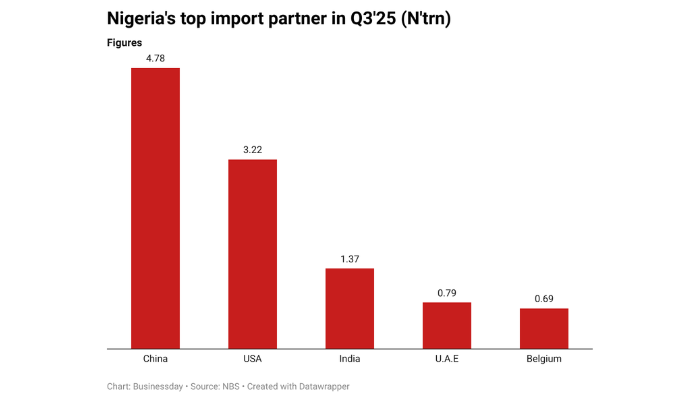
Despite rising global trade tensions and tariffs affecting cross-border commerce, the United States stands as Nigeria’s second-largest source of imports in the third quarter of 2025, according to the foreign trade statistics report.
According to data released by the National Bureau of Statistics (NBS), in Q3’25, Nigeria imported goods worth N3.22 trillion from the United States, accounting for 19.96 percent of the country’s total imports, valued at N16.12 trillion.
This boom in Nigeria’s imports from the USA comes despite a 15 percent tariff imposed upon Nigeria’s exports to the USA. Despite the imposition of this tariff structure, Nigeria opted for a non-retaliatory response.
Imports accounted for 41.41 percent of total trade in the third quarter of 2025, with a value of N16,122.98 billion, representing a 5.51 percent increase compared to N15,281.18 billion recorded in Q3 2024, and a 5.47 percent increase from N15,286.78 billion recorded in Q2 2025
Data from the NBS shows that petroleum products dominated Nigeria’s import structure during the quarter, valued at N5.15 trillion or 31.97 percent of total imports.
This was followed by machinery and transport equipment, which stood at N4.25 trillion or 26.36 percent, and chemicals and related products, valued at N2.35 trillion, accounting for 14.56 percent of imports.
Beyond energy, the United States remained a major supplier of agricultural commodities, particularly durum wheat, which featured prominently among Nigeria’s most imported food items in Q3 2025.
Read also: Nigeria’s trade surplus narrows as imports rise, exports rebound in Q3
Wheat imports from the United States accounted for a significant share of total agricultural imports, reflecting Nigeria’s heavy dependence on foreign grain supplies to meet domestic consumption and industrial processing needs.
According to the report, petroleum products dominated Nigeria’s import structure during the quarter, valued at N5.15 trillion or 31.97 percent of total imports.
Nigeria also imported substantial volumes of machinery and transport equipment, valued at N4.25 trillion or 26.36 percent of total imports, as well as chemicals and related products worth N2.35 trillion, representing 14.56 percent.
These categories include capital goods and intermediate inputs, where American manufacturers remain globally competitive, particularly in sectors tied to construction, manufacturing, and energy.
Nigeria’s total imports rose by 5.51 percent year-on-year from N15.28 trillion recorded in the corresponding quarter of 2024, and by 5.47 percent quarter-on-quarter compared with N15.29 trillion in Q2 2025, underscoring sustained domestic demand despite foreign exchange constraints.
Trade flows between the two countries were not one-sided. On the export side, Nigeria’s total exports to the Americas stood at N2.58 trillion in Q3 2025, according to the NBS, with crude oil and gas-related products forming the bulk of shipments. Although the United States was not among Nigeria’s top five export destinations during the quarter, analysts say energy trade continues to underpin bilateral commercial relations.
In total, Nigeria’s exports rose to N22.81 trillion in Q3 2025, representing an 11.08 percent increase year-on-year and a 0.28 percent rise quarter-on-quarter, largely driven by crude oil and gas shipments.
Nigeria’s total merchandise trade stood at N38.94 trillion in the third quarter of 2025, up 8.71 percent from the same period in 2024 and 2.36 percent higher than the preceding quarter.