
Unilever Nigeria Plc delivered a strong first-half performance despite mounting foreign exchange costs and aggressive spending on brands, as strong consumer demand for its food products helped offset rising operating expenses and preserve profitability.
The consumer goods manufacturer reported an 8.3 per cent increase in profit after tax to N15.60 billion in the six months ended June 30, 2026, from N14.41 billion in the corresponding period of last year, while revenue crossed the N100 billion mark for the first time in a half-year period, reflecting stronger pricing, improved volumes, and sustained demand across its portfolio.
Revenue surged 22.2 per cent to N119.92 billion from N98.10 billion, extending the growth momentum seen over the last two years as Nigeria’s consumer goods companies gradually recover from the inflation shock and severe foreign exchange volatility that disrupted operations in 2023 and 2024.
The latest earnings reinforce a broader trend emerging across Nigeria’s fast-moving consumer goods (FMCG) industry. While inflation remains elevated, exchange-rate volatility has moderated significantly compared with the previous two years, allowing manufacturers to plan production more efficiently, rebuild inventories, and gradually restore consumer demand through carefully calibrated pricing strategies.
Food business remains the growth engine.e
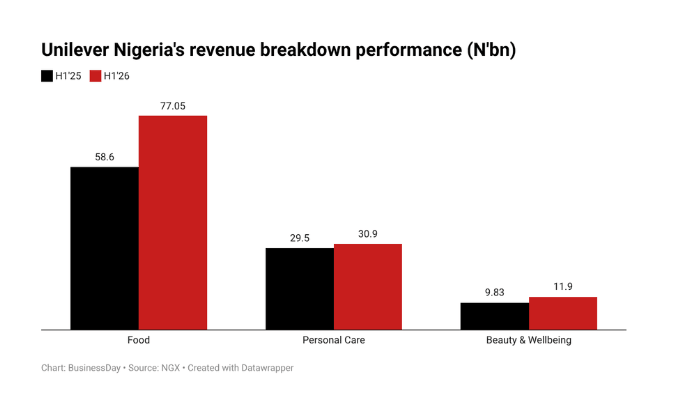
The biggest contributor to growth remained the company’s Foods division. Segment disclosures showed food products generated N77.05 billion, accounting for more than 6 per cent of total revenue, up from N58.68 billion a year earlier.
Personal Care contributed N30.97 billion, while Beauty & Wellbeing generated N11.90 billion, indicating that food products continue to dominate Unilever Nigeria’s earnings mix amid sustained demand for seasoning and savoury products.
Domestic sales remained the primary revenue source, contributing N117.2 billion, representing nearly 98 per cent of turnover. Export revenue almost doubled to N2.72 billion, suggesting a gradual expansion of regional trade within the Unilever network.
Cost pressures persist despite revenue growth.
Higher sales were accompanied by rising production costs. Cost of sales increased 16.4 per cent to N65.18 billion from N55.99 billion, largely reflecting higher raw material costs and inventory revaluation losses.
Unlike the previous year, the company incurred N846.8 million in inventory revaluation losses, compared with a revaluation gain recorded in 2025. However, there were no restructuring costs during the period after the company completed earlier restructuring programmes that affected the previous year’s accounts.
Even with higher production costs, gross profit expanded 3 per cent to N54.74 billion, significantly outpacing revenue growth.
Gross profit margin consequently improved to 45.6 per cent from 42.9 per cent, indicating that pricing actions continued to offset increases in production expenses while preserving profitability.
Heavy investment in brands weighs on operating expenses
One of the most notable features of the half-year result was the sharp increase in marketing expenditure.
Marketing and administrative expenses jumped 25.6 per cent to N26.39 billion, with brand and marketing spending surging to N13.96 billion from N7.73 billion.
The company attributed the increase to continued investment aimed at strengthening market presence, improving customer engagement, and defending market share amid intense competition across the consumer goods sector.
Meanwhile, overhead costs declined modestly to N9.06 billion, while royalty and service fees paid under agreements with Unilever’s global parent remained broadly stable at N3.36 billion. Those payments cover technology licences, trademarks and global management support services.
Despite the higher operating costs, operating profit rose 29per cent to N24.36 billion, reflecting the strength of revenue growth.
Interest income cushions FX losses
Finance income continued to provide an important earnings buffer.
Interest earned on call deposits and bank balances rose to N6.51 billion, up from N5.82 billion, reflecting returns generated from the company’s substantial cash holdings.
However, finance costs increased more than threefold to N1.70 billion, mainly because of a N1.33 billion foreign exchange loss on bank balances, compared with virtually no comparable FX loss in the previous year.
As a result, net finance income declined to N4.82 billion from N5.34 billion, partially offsetting improvements from core operations.
The balance sheet shows Unilever Nigeria remains one of the strongest cash-generating companies on the Nigerian Exchange.
Although cash and cash equivalents declined from N110.75 billion at year-end to N97.15 billion, the company still holds one of the largest cash positions among listed consumer goods firms.
The reduction largely reflected: payment of N18.67 billion in dividends; N6.01 billion invested in property, plant and equipment; and tax payments of almost N21 billion during the period.
Inventories rose 15.3 per cent to N26.64 billion, suggesting the company increased stock levels to support higher production and protect against supply-chain disruptions.
Trade receivables expanded sharply to N11.46 billion, reflecting higher sales activity, while advances and prepayments increased to N10.15 billion, driven by larger supplier advances and higher deposits for imported raw materials.
Management noted that advance payments were made to suppliers to secure favourable pricing for raw and packaging materials, while import deposits represent foreign currencies purchased to fund letters of credit for imported inputs. These moves indicate the company is proactively securing supply amid continued uncertainty in global commodity markets.
During the period, Unilever invested more than N6 billion in property, plant and equipment, lifting total fixed assets to N28.89 billion from N24.41 billion at the end of 2025.
The investments included additional capital work-in-progress and transfers into production assets, signalling continued expansion of manufacturing capacity and operational efficiency despite Nigeria’s challenging business environment.
Cash generated from operations remained robust at N25.94 billion. However, actual operating cash flow fell sharply to N4.90 billion from N17.44 billion after the company paid almost N21 billion in taxes.
Meanwhile, financing cash outflows increased significantly because of dividend payments exceeding N18.6 billion, reinforcing Unilever Nigeria’s reputation as a strong dividend-paying company despite macroeconomic headwinds.