
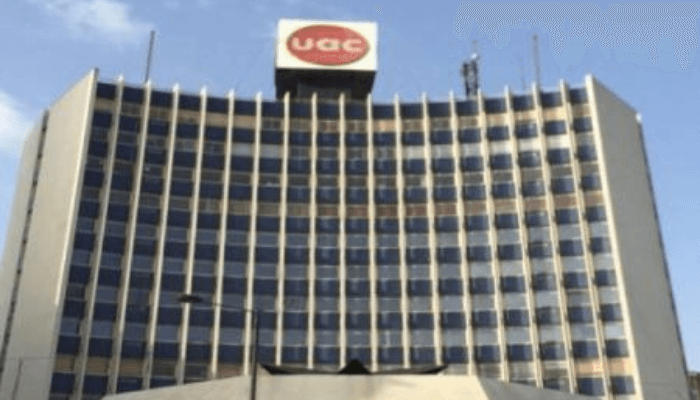
UAC of Nigeria Plc grew profit for the first half of 2026 by 172 percent to N20 billion, as its newly consolidated Chivita|Hollandia business (C.H.I. Limited) transformed the scale of Nigeria’s oldest conglomerate.
Group revenue rose 3.3 times to N365 billion, gross profit climbed 3.7 times to N105 billion, and operating profit nearly quadrupled to N49 billion, the company said in results for the six months to June 2026 released Wednesday. Profit before tax more than tripled to N34 billion.
The bulk of that growth traces to a single event: UAC’s N182.5 billion cash acquisition of C.H.I. Limited from The Coca-Cola Company, completed in October 2025. The juice and dairy maker behind Chivita, Hollandia, and Capri-Sun brands is now folded into UAC’s packaged food and beverages segment, whose revenue jumped more than sevenfold to N307 billion in the half.
“Our results for the first half of 2026 reflect progress against the objectives to deliver scale, integrate C.H.I. under UAC’s ownership, drive margin expansion, and optimise working capital,” said Fola Aiyesimoju, UAC’s group managing director. Net debt, he added, fell by N37 billion on account of strong cash generation.”
Net finance cost jumped 338 percent to N15.9 billion in the half-year, while it was 512 percent in the second quarter, as interest on the borrowing taken to fund the C.H.I. deal outpaced income from short-term deposits.
UAC paid out N25 billion in cash interest on loans against gross borrowings of N307 billion at the half-year, and the underlying facilities are not cheap: a N69.5 billion term loan carries a 24.5 percent rate, and a N25 billion loan note sits at 15 percent, both in naira. Roughly N98 billion is drawn under a dollar-linked import finance facility priced at SOFR plus five percent, which shields against local rate risk but exposes the group to further naira depreciation. Just under half of total borrowings N149 billion, falls due within a year, including a N39.8 billion commercial paper tranche maturing in July 2026, meaning refinancing execution, not just profitability, will shape the next few quarters.
Annualised return on equity more than doubled to 52 percent, but that reflects leverage as much as performance: equity attributable to shareholders was trimmed by a N10.8 billion purchase of scheme shares for UAC’s long-term incentive plan in the half, shrinking the denominator against which returns are measured. Return on invested capital, a cleaner efficiency gauge that isn’t distorted by the size of the equity base, fell to 25.2 percent from 39.6 percent a year earlier, signalling that the capital now deployed in the group, swollen by the acquisition, is generating a lower return per naira invested than it did before the deal.
The packaged food and beverages segment itself carries negative net assets of N72.3 billion on the segment table, a reflection of how much acquisition-related debt and liabilities sit against that business specifically.
Free cash flow swelled to N71 billion from N8.8 billion a year earlier, helped by a N30 billion release of inventory as the group worked down stock built up around the acquisition, a one-off tailwind that will not repeat every half. Net debt-to-EBITDA improved to 2.7 times from 5.9 times, and gearing eased to 406 percent from 494 percent, genuine progress. But the quick ratio, which strips out inventory, stands at just 0.3x, and the current ratio is a bare 1.0x— a balance sheet still built around converting stock into cash rather than one sitting on a liquidity buffer.
Segment breakdown for H1 2026
Segment performance was uneven beneath the group numbers. Packaged food and beverages, now carrying C.H.I.’s weight alongside legacy UAC Foods brands like Gala and SWAN, delivered a profit before tax of N33.6 billion for the half, up nearly fivefold. Paints, through Chemical and Allied Products (CAP), grew revenue 11.5 percent and pushed into the mid-tier decorative market with the launch of Dulux Spruce, though profit growth rose by 17% as gains were reinvested in marketing.
The other two platforms stayed in the red. Edibles and Feed, hit by falling finished-goods prices across the agricultural commodities chain, saw revenue drop 31 percent and posted a N326 million loss before tax for the half, albeit narrower than a year earlier.Quick-Servicee Restaurants, the Mr Bigg’s and Debonairs Pizza network continued shrinking, with revenue down 6.9 percent on store closures and a N589 million loss before tax.
Basic earnings per share for the half rose to 658 kobo from 238 kobo.