
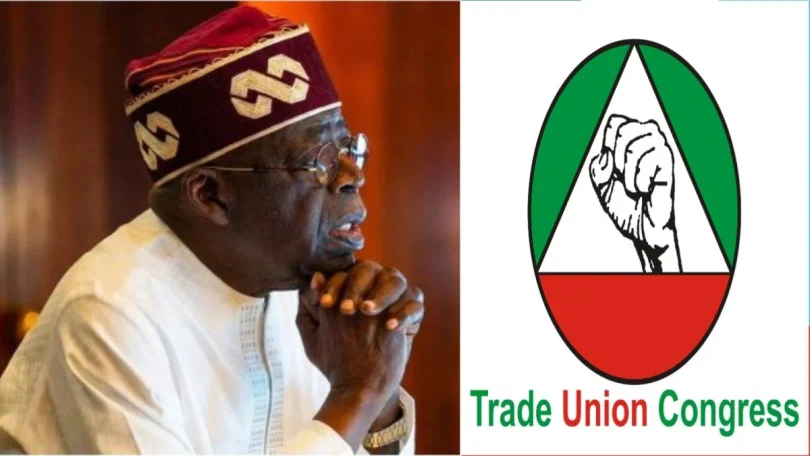
The Trade Union Congress (TUC) has called on President Bola Tinubu’s administration to take further measures to strengthen the naira, saying a stronger exchange rate would help reduce the pressure on petrol prices and the wider cost of living.
TUC President, Comrade Festus Osifo, made the demand on Wednesday in Abuja after a meeting of the union’s National Administrative Council (NAC). He said the exchange rate remained one of the major factors affecting the prices of fuel and other essential commodities in the country.
Osifo said the government should work towards moving the naira to between N700 and N800 to the dollar. He argued that the currency remained undervalued despite recent improvements in the foreign exchange market.
“We cannot be tired talking about exchange rate because it is central to literally everything. Today, the official rate is just a little above 1,300 Naira to the USD, but we see that government can still do better.”
He said a stronger naira would have an effect beyond the foreign exchange market.
According to him, it would also reduce the cost of petroleum products, food, fertiliser, equipment and other items that depend heavily on foreign exchange.
The TUC president also commended the Governor of the Central Bank of Nigeria, Olayemi Cardoso, for measures aimed at stabilising the naira and improving macroeconomic conditions.
However, Osifo said the current exchange rate was still not satisfactory to the labour centre.
“We commend the CBN governor Cardoso for the great work that he is doing in the Central Bank, but we can still do much more because we still believe that 1300 Naira to $1 is still undervalued.”
He explained that the position of the union was not that the naira should be returned to the levels where it was considered overvalued.
Rather, he said the government should pursue policies that would allow the currency to trade at a stronger and more sustainable level.
“From all international commentators, from economic think-tanks, both local and international, from scholars, currently our Naira is undervalued and is not trading at the strength it should.
“Yes, we knew that before, when it was around N400, it was overvalued, but today at N1,300 it is still undervalued. So, government should do everything possible to move the Naira to the right value.”
Osifo linked the exchange rate directly to the continued pressure on Nigerians, particularly through the prices of petroleum products.
TUC had previously argued that intervention in the foreign exchange market could help lower the cost of crude supplied to domestic refineries and, in turn, reduce petrol prices.
The union’s latest position comes as workers continue to deal with the effects of high living costs.
TUC said the government should therefore pay attention not only to broader economic indicators but also to the impact of economic policies on households and workers.
Osifo said some macroeconomic indicators were beginning to show signs of improvement, including inflation and exchange-rate stability.
He, however, maintained that the government needed to translate such improvements into tangible relief for Nigerians.