
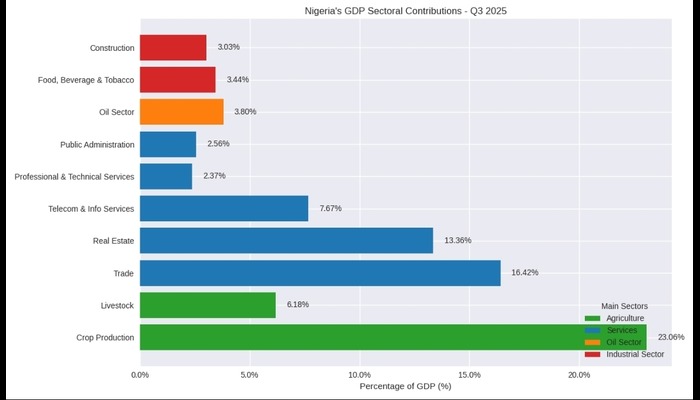
The National Bureau of Statistics (NBS) announced on Monday that Nigeria’s gross domestic product (GDP) grew by 3.98 percent (year-on-year) in real terms in the third quarter of 2025. This performance, slightly higher than the 3.86 percent recorded in the same period of 2024, was largely driven by the non-oil economy that contributed over 96 percent of the national output.
The data highlights a gradual structural shift away from over-reliance on crude oil, with agriculture and services emerging as the main engines of growth.
Agriculture remained the backbone of the economy, accounting for just over 31 percent of real GDP. Crop production led the charge, contributing 23.06 percent, with its growth rate rising to 3.79 percent from 2.55 percent in Q3 2024. Livestock added another 6.18 percent, underscoring the sector’s central role in sustaining national output and food security.
Read also: Nigeria’s Oil GDP grows by 5.84% on higher production
The services sector continued to dominate, representing 53.02 percent of GDP. Trade activity contributed 16.42 percent, reflecting sustained household consumption and retail spending across the country. Real estate also proved resilient, accounting for 13.36 percent of output.
Telecommunications and Information Services, a key driver of the digital economy, contributed 7.67 percent to GDP while recording a strong real growth of 5.78 percent, signalling the sector’s increasing importance in productivity and connectivity. Professional, scientific, and technical services and public administration added 2.37 percent and 2.56 percent, respectively, showing the growing sophistication of Nigeria’s service-based economy.
The oil sector, though still critical for government revenue, accounted for only 3.80 percent of GDP. Crude petroleum and natural gas production rose to an average of 1.64 million barrels per day, up from 1.47 million the previous year, but the sector’s real growth of 5.84 percent reflected a slowdown from previous periods, illustrating its declining proportional significance to overall economic output.
Read also: Nigeria’s economy expands 3.98% on oil sector growth
Other contributors included the industrial sector, with food, beverage & tobacco manufacturing adding 3.44 percent and construction contributing 3.03 percent amid ongoing infrastructure projects and private development.
The performance of agriculture and services helped stabilise the broader economy, offsetting slower growth in certain manufacturing segments. While challenges such as inflation and security concerns persist, the Q3 results indicate a steadily diversifying economy increasingly supported by non-oil activities, providing a stronger foundation for future growth.