
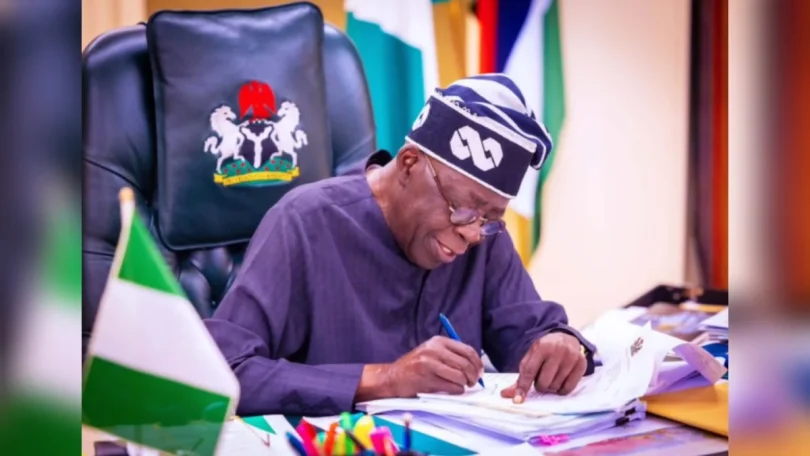
President Bola Ahmed Tinubu has officially launched the construction of the $3.5 billion Bakassi Deep Seaport in Cross River State, marking a major step towards the development of Nigeria’s maritime sector and the expansion of port operations beyond Lagos.
The groundbreaking ceremony was held on Friday in Calabar, with Vice President Kashim Shettima representing the President.
Shettima described the project as a historic achievement after several years of delays, political challenges and uncertainty surrounding its implementation.
He said the Federal Government was determined to move the project beyond promises and begin the actual construction of a facility expected to transform Cross River’s economy and strengthen Nigeria’s position in international maritime trade.
“I have not come to Calabar to cut a ribbon and dance ekpe masquerade. I am here to break ground and break centuries-old jinx,” Shettima declared.
The Vice President recalled that the Bakassi Deep Seaport had been discussed for several decades but repeatedly faced difficulties that prevented its realisation.
According to him, many people had considered the project unrealistic and doubted whether it would ever move beyond the planning stage.
“Many people believe that this port will never happen. They said it will be a pipe dream. They said Bakassi will only be remembered for what we lost. Today, we answer them with a shovel, with concrete, with steel, and with hope. A renewed hope that a dream deferred can become a dream actualized.”
Shettima particularly praised Cross River State Governor, Senator Bassey Edet Otu, for his commitment to securing the necessary approvals and financial backing for the project.
He said the governor’s efforts had helped revive an initiative that had remained largely inactive for years.
He further described the seaport as a major legacy project that would have a lasting impact on the history of Cross River State.
“If Governor Bassey Edet Otu fails to construct one single classroom, this edifice we are celebrating here will imprint his name in gold in the annals of contemporary Nigerian history. This is a legacy that generations yet unborn will celebrate, applaud, and thank him immensely,” he said.
Tracing the history of the project, Shettima explained that discussions about establishing a major seaport in the area dated back to the colonial period.
He noted that the project was redirected in 2014, while its Environmental and Social Impact Assessment was completed by March 2015.
However, the initiative struggled to progress until Governor Otu’s administration secured a fresh financial arrangement with the African Export-Import Bank (Afreximbank).
According to Shettima, the governor’s efforts to secure $3.5 billion in financing from the bank in February 2025 provided the financial support needed to move the project forward.
“But like a canoe without a paddle, the idea drifted into the doldrums until His Excellency Governor Bassey Edet Otu getting new legs, securing $3.5 billion from Afreximbank, became the oxygen needed in February 2025,” Shettima said.
He maintained that the Federal Government was fully committed to the successful completion of the project, stressing that its importance extended beyond Cross River State.
“Today, the federal government is standing fully behind it. This is beyond a Cross River dream; it is a Nigerian project.”
The Bakassi Deep Seaport is designed to accommodate large vessels with a draft of about 20 metres.
The facility is expected to handle some of the biggest ships currently unable to access several Nigerian ports.
It will also be supported by a 260-kilometre superhighway designed to serve as an evacuation route for goods and commodities.
The road corridor is expected to connect the port with major markets and commercial centres across the North, East and West of the country.
Shettima dismissed suggestions that the establishment of another major seaport outside Lagos would create competition between the commercial city and Cross River.
“There is a rumor in some quarters that the West, Lagos, or Abuja never wanted a port to work anywhere outside Lagos. If that were true, would I be standing here today with a shovel in my hand?” he asked.
He added that the development of additional ports would strengthen Nigeria’s overall trading capacity rather than undermine existing facilities.
“Lagos is not our enemy. Lagos is our elder brother in trade. No country eats with one hand. No country carries all its loads on one shoulder; that shoulder will break.”
The Vice President noted that more than 80 per cent of Nigeria’s foreign trade currently passes through Lagos, putting considerable pressure on existing port facilities and contributing to congestion, delays and increased transportation costs.
He said the establishment of the Bakassi Deep Seaport would provide an alternative route for international trade and improve the movement of goods into different parts of the country.
“When Lagos is free, Nigeria breathes. And when Calabar walks, Nigeria walks on two legs,” he said.
Shettima also highlighted Nigeria’s maritime advantages, noting that the country has approximately 853 kilometres of coastline along the Gulf of Guinea and an exclusive economic zone extending beyond 200 nautical miles.
He said Nigeria accounts for more than 60 per cent of West Africa’s Gross Domestic Product but handles only about 25 per cent of the region’s cargo trade.
“Truth is, our neighbours are eating the food from our own pot,” he said.
The Vice President placed Nigeria’s blue economy potential at approximately $44 billion, equivalent to about N70 trillion annually.
He also noted that global marine trade generates between $2.7 trillion and $3 trillion yearly and supports more than 350 million jobs worldwide.
He disclosed that revenue generated from Nigeria’s marine and blue economy sector increased to N1.83 trillion in 2025, compared with N700 billion recorded in 2023.
“My people, the sea is no longer just water to look at; it is wealth to have. And this is the heart of the Renewed Hope Agenda. Our goal is to build a $1 trillion economy by 2030, with growth of at least 7% by 2027,” he said.
Shettima explained that the Bakassi Deep Seaport would generate employment opportunities across several sectors, including shipping, construction, transportation, hospitality, engineering and international trade.
He listed dock workers, crane operators, truck drivers, welders, engineers, customs officers and market women among those expected to benefit from the development.
He also said agricultural products from different parts of Cross River would gain improved access to international markets once the facility becomes operational.
Cocoa from Ikom, rice from Ogoja, timber, solid minerals and other commodities from the state’s industrial sector would have an alternative route to international destinations.
“Calabar will become again what it was: a city of merchants, of ships, of culture, of carnival, and now of commerce.”
In a message directed at the people of Bakassi, Shettima acknowledged the historical challenges faced by the community following the transfer of the Bakassi Peninsula to Cameroon after the International Court of Justice ruling.
He said the people had experienced significant losses involving territory, oil resources, revenue and economic opportunities but maintained that their resilience and hospitality remained intact.
“Bakassi Peninsula was not the end of your story, but the beginning of your next chapter. The same water that took something from you will now bring something back. The Atlantic that people feared will now feed your children,” he said.
The Vice President urged residents to support the project and protect it from political disagreements and misinformation.
“Please stand with this project. Protect it from politics and rumour.”
He also linked the development to the Tinubu administration’s political agenda ahead of the next election, urging residents to support continuity.
“And on election day, some 60 days from now, remember who stands by you. Who stands with you and who stands for you. Not just with words, but with a shovel,” he said.
“Do not forget the president who came to break ground and plant the seed of change from a civil service economy to a fast-paced marine-backed blue economy. Vote for continuity. Vote for Renewed Hope.”
Shettima thanked Tinubu for providing the political backing required to move the project forward, describing the groundbreaking as an indication of the Federal Government’s commitment to infrastructure development.
“This is beyond politics. This is clearly governance and political will at its best,” he said.
Speaking at the ceremony, Governor Bassey Otu described the Federal Government’s participation as an important indication that the long-standing concerns of the people of Bakassi were receiving attention.
He said the groundbreaking represented a significant achievement after years of administrative, legal, political and environmental challenges that had delayed the project.
Otu credited the Tinubu administration with providing the necessary support and approving additional marine corridors and seaport developments, which he said had strengthened the prospects of coastal states.