
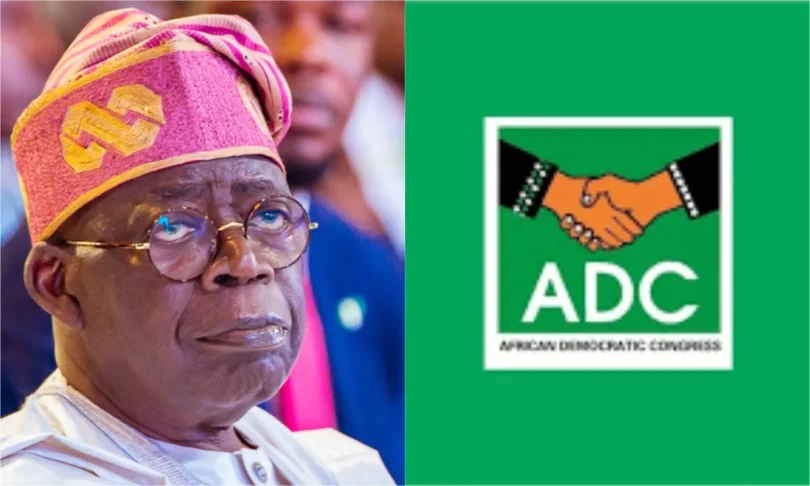
The African Democratic Congress, ADC, has raised the alarm over what it described as an ‘appointment fiasco’ in the President Bola Tinubu administration.
In a statement by its National Publicity Secretary, Bolaji Abdullahi, the ADC said the National Assembly must establish whether the President is still fit to discharge the duties of his office.
The party said it is alarmed by an episode in the affairs of the Federal Government, where a man publicly removed from office by presidential directive reportedly continues to occupy that same office and still hold meetings with senior officials of the same government.
According to the ADC, if the reports concerning the Border Communities Development Agency, BCDA, are true, then this is no longer about one disputed appointment, but something far more disturbing.
Parts of the statement read, “Who is actually in charge of the Nigerian Presidency? When a President announces the appointment of one person and another simply ignores that directive and carries on in office, Nigeria is no longer witnessing administrative confusion. We are witnessing a struggle for control of the Presidency itself.
“The BCDA episode cannot be dismissed as an isolated incident because it follows a growing and disturbing pattern. Nigerians are still watching in bewilderment, the embarrassing spectacle of the so-called phantom Presidential Foreign Intervention Promotion Council (PFIPC), a government agency that officially did not exist, yet somehow operated at the highest level of government, and conducted itself with the confidence of a legitimate institution.
“It was only when allegations emerged of its fake Director-General’s collaboration with the President’s Chief of Staff that the scandal could no longer be ignored.
“Taken together, these episodes reveal a Presidency steadily losing its monopoly over one of the most fundamental powers of government: the constitutional authority to appoint and remove public officers.
“Today, Nigerians no longer know whether an appointment announced by the Presidency is final, whether a dismissal actually takes effect, or whether someone somewhere possesses a superior authority capable of overruling presidential decisions without explanation.
“Effectively, the Tinubu administration has become a place where official announcements compete with unofficial power, where competing interests fight over appointments and patronage. Under President Tinubu, the Nigerian Presidency, like the Nigerian economy and Nigeria’s security situation has started to resemble a system governed by the principle of the survival of the fittest.
“This is made even worse by a disturbing pattern of public reversals that has become the defining feature of this administration. From the hurried suspension of the Cybersecurity Levy after nationwide outrage, to the withdrawal of the Expatriate Employment Levy following resistance from investors, to repeated policy summersaults and contradictory government announcements across several sectors, Nigerians have become accustomed to a government that announces first, retreats later, and explains afterwards.
“A government that cannot consistently stand by its own decisions gradually loses not only credibility, but authority. Investors become uncertain. The bureaucracy became confused. Public institutions begin to test the limits of their power because they no longer know whether Today’s directive will still exist tomorrow.
“At this point, Nigerians deserve answers that go beyond carefully managed press statements. Who is exercising the constitutional powers of the President? Who authorises appointments? Who countermanded the President’s directive at the BCDA, if indeed it has been countermanded?
“Who permitted a fictitious agency to masquerade as an arm of the Presidency? These are not opposition questions. They are constitutional questions. They go directly to the integrity of executive authority and the stability of our nation.”