
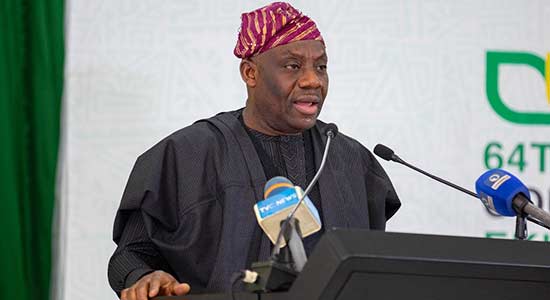
The Minister of Education, Dr Maruf Tunji Alausa, has challenged Nigerian universities and the National Agency for Science and Engineering Infrastructure to transform publicly funded research into marketable products, businesses and employment opportunities.
Alausa said Nigeria could no longer afford to leave valuable research findings on university shelves or limit innovations to academic publications and prototypes without converting them into solutions that contribute to economic development.
The minister spoke on Monday, August 24, 2026, while addressing vice-chancellors, directors of academic affairs, directors of postgraduate studies and officials of the Federal Ministry of Education’s Directorate of University Education.
The meeting focused on opportunities for collaboration between universities and NASENI through the proposed NASENI Campus.
According to Alausa, the initiative could create a functional pathway connecting university researchers with advanced laboratories, prototyping facilities, investors and manufacturing companies.
“We must move from research to commercialisation. Our research outputs should not end as academic publications or prototypes. We need to take those ideas from the laboratory to the marketplace,” he said.
He explained that Nigeria needed a deliberate system through which an idea developed in a university laboratory could proceed to intellectual-property protection, product development, investment, manufacturing and the establishment of a viable business.
Drawing lessons from the innovation ecosystem around Cambridge, Massachusetts, in the United States, Alausa said Nigerian researchers should be supported to patent their inventions and attract investors capable of building businesses around their discoveries.
“This is how human capital becomes human development,” the minister said.
He noted that Nigeria’s lecturers, researchers, students and skilled professionals would remain underutilised unless universities were strategically connected to industry and sources of investment.
Alausa consequently charged NASENI to establish stronger affiliations with universities located around its development centres.
He said universities possessed researchers and innovative ideas, while NASENI could provide technology-development infrastructure, prototyping facilities, links to investors and connections with manufacturing industries.
The minister also urged the agency to support the patenting of university inventions, connect researchers with venture-capital providers and facilitate the creation of spin-off companies from promising innovations.
According to him, the global transition to cleaner energy provides Nigeria with an opportunity to use its natural resources and research capabilities to create new industries instead of merely exporting raw materials.
According to him, the global transition to cleaner energy provides Nigeria with an opportunity to use its natural resources and research capabilities to create new industries instead of merely exporting raw materials.
The Executive Vice-Chairman and Chief Executive Officer of NASENI, Khalil Suleiman Halilu, said the agency was already working to close the gap between research and industrial production.
Halilu said the effort aligned with President Bola Tinubu’s directive that Nigerian innovations must progress beyond prototypes to actual manufacturing.
He explained that the proposed NASENI Campus, situated within a 100-hectare free-trade zone, was being developed as an integrated ecosystem accommodating researchers, professors, prototyping facilities, industries and commercialisation opportunities.
According to him, several factories and industrial facilities have already been established within the zone, allowing researchers to interact directly with manufacturers and potential investors.
The Vice-Chancellor of the University of Abuja, Professor Hakeem Babatunde Fawehinmi, said the institution’s existing collaboration with NASENI demonstrated the potential of the proposed model.