
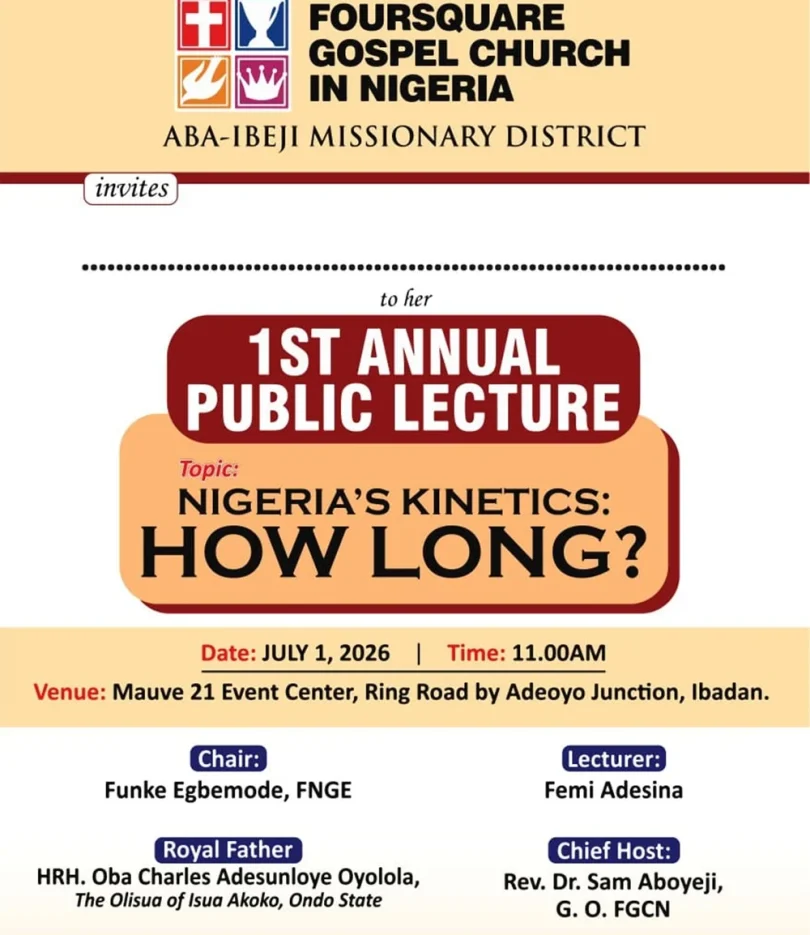
Former Deputy Governor of the Central Bank of Nigeria (CBN), Dr. Tunde Lemo; former presidential spokesman, Mr. Femi Adesina; former President of the Nigerian Guild of Editors, Funke Egbemode; and ace columnist and Saturday Tribune Editor, Dr. Lasisi Olagunju, have called for sweeping structural and governance reforms to rescue Nigeria from its persistent political and economic challenges.
The four eminent Nigerians spoke at the First Annual Public Lecture of the Foursquare Gospel Church, Aba-Ibeji, Ibadan, where they examined the country’s governance trajectory and urged leaders and citizens to embrace reforms capable of unlocking Nigeria’s vast human and natural resources.
In his keynote address, titled “Nigeria’s Kinetics: How Long?”, Adesina lamented that Nigeria’s enormous potential had been squandered by poor leadership, corruption and weak institutions.
“As long as the worst of us continue to rule the best of us, there can be no solution to Nigeria’s problems,” he said, while stressing that the country’s vast population and abundant natural resources should ordinarily make it a global success story.
ALSO READ: I feel so sad when people insult Tinubu — Umahi
Lemo also advocated a comprehensive review of Nigeria’s federal structure, describing the current governance framework as inadequate for addressing the country’s contemporary realities. He urged Nigerians to become more deliberate in demanding accountable and competent leadership, warning that emigration could not provide a lasting escape from the nation’s problems.
Speaking during the lecture, Olagunju argued that Nigeria’s decline was rooted in the abandonment of the principles that made the country function effectively in the 1960s and the early post-independence years.
He said Nigeria worked during the days of Chief Obafemi Awolowo because of the quality of leadership and the genuine federal constitution under which the country operated.
According to him, Nigeria would remain difficult to govern unless the present “unitary” federal system is abolished and replaced with a truly federal constitutional arrangement that restores autonomy and healthy competition among the federating units.
He maintained that meaningful national progress would remain elusive without far-reaching structural reforms capable of addressing the country’s recurring governance and development challenges.
Chairperson of the occasion, Funke Egbemode, said Nigeria’s problem was no longer a shortage of ideas but the inability of successive governments to translate vision into tangible improvements in the lives of citizens.
She urged leaders at all levels to focus on practical implementation of policies that would improve the welfare of Nigerians.