
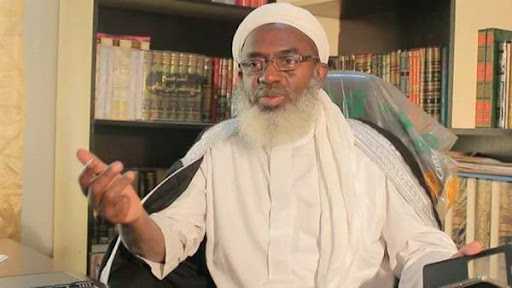
Islamic cleric and security commentator Sheikh Ahmad Gumi has urged the Federal Government to reconsider its heavy spending on military operations and instead explore dialogue with armed groups operating across the country.
The cleric said lasting peace cannot be achieved through force alone. According to him, negotiations remain the most practical path to resolving Nigeria’s worsening security crisis.
Speaking in a recent interview, Gumi warned that the military’s “kinetic” approach has never worked and only fuels violence, and added a sharp warning for those in power:
“Even IPOB, who wants succession, if they lay down arms and negotiate, I will support them. We can’t keep buying guns while society burns.”
Gumi maintained that the government has continued to pour huge amounts of public funds into military campaigns without achieving meaningful progress in restoring peace. He argued that the approach has only prolonged conflicts in several parts of the country.
The cleric also claimed that massive security allocations have not translated into stability, suggesting that some of the funds meant for operations often fail to address the root causes of violence.
“If you give the military money, they will go and buy houses abroad. We need to break the cycle of using guns as a solution,” he said.
He further argued that eliminating insurgent leaders or launching repeated military raids has not weakened extremist groups.
According to him, such tactics sometimes strengthen armed groups by creating new cycles of retaliation and recruitment.
Gumi pointed out that insecurity continues to spread across several regions, including the North-East, North-West and parts of the South-East. He said the persistence of attacks despite heavy security spending shows that the strategy needs urgent review.
The cleric also questioned the government’s spending priorities, saying funds committed to warfare could be redirected to address Nigeria’s social and economic challenges. In his view, improved infrastructure and basic services would help tackle some of the conditions that fuel unrest.
He lamented the state of public infrastructure in the country, noting that poor roads, unstable electricity supply and weak social systems continue to affect millions of Nigerians.
“Electricity is erratic and very expensive. Roads are terrible. Nothing is working here. Spending that money on defense is just wasting resources,” Gumi said.