
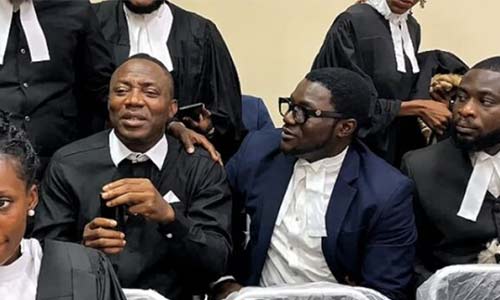
The Federal High Court sitting in Abuja has reserved ruling to 6 October 2026 on whether the Director-General of the Department of State Services can be compelled to appear in person and testify as a defence witness in the trial of the presidential candidate of the African Action Congress, Mr. Omoyele Sowore.
Honourable Justice Mohammed Umar fixed the date after hearing argument from both sides on a subpoena issued at the instance of the defence and directed to the Director-General, Mr. Tosin Ajayi.
Mr. Sowore is being prosecuted by the Department over posts published on X and on Facebook in August 2025, in which he described President Bola Ahmed Tinubu as a “criminal” and accused him of lying about the level of corruption in the country.
By an amended charge filed on 5 December 2025 he was re-arraigned on two counts. He pleaded not guilty, after which the prosecution called its witnesses and tendered exhibits. The prosecution closed its case on 16 March 2026.
The defence secured an order of the court requiring the Director-General to appear and give evidence.
Counsel to the defendant, Mr. Adeyinka Olumide-Fusika, SAN, told the court that the decision to subpoena the Director-General in his personal capacity had been necessitated by the evidence of the second defence witness, Mr. Uwem Davies, an official of the Department, who, while testifying, repeatedly said that only the Director-General could answer some of the questions put to him.
On 28 July 2026 the Attorney-General of the Federation and Minister of Justice, Mr. Lateef Fagbemi, SAN, attended court leading the prosecution team and argued that it was wrong for the defence to insist on the personal attendance of the Director-General. On that basis, the parties reached an understanding that an official of the Department would be nominated to stand in for him.
The defence told the court that the understanding had broken down because no proper arrangement was made for the nominated witness to appear.
“I was informed that the service of hearing notice was effected on the DSS but I’ve not seen any sign that he is here this morning,” Mr. Olumide-Fusika said.
“At the last adjourned date, we had an understanding that rather than pursuing the DG to appear, we opted to go for any officer to appear. Since no witness is here, we are insisting now that the DG himself should come. The order of the court and the hearing notice was directed at him, so, he has to be in court.”
“The prosecution repudiated the understanding we had, therefore, the DG has to come. The subpoena did not say any officer, it was directed to the DG, specifically.”
He added that the Attorney-General had never filed any process in the matter and that everything said on the day he appeared should be discountenanced, since he was not the person who filed the charge.
“It was the understanding we had with the AGF that made us to ask any officer to appear and the prosecution has repudiated it. For the Prosecution to come to court this morning and behave as if there was never any understanding, we must draw a line, we are tired of being tossed around,” he said.
Prosecuting counsel, Mr. Akinlolu Kehinde, SAN, argued that it was wrong to insist on the personal attendance of the Director-General, and told the court that an official of the Department had been designated for the purpose, was present in court and was ready to proceed.
He relied on the decision of the Supreme Court in Ishaq v Soniyi (2002) ALL FWLR Part 498, page 347 at 373, where, he said, it was held that where a subpoena is directed to a named official, it would be absurd to insist that only the named officer must appear in compliance with it.
He said the Director-General has no personal interest in the case and acted in an official capacity, and that since the Department has cases in the various divisions of the Federal High Court, it is practically impossible to expect him to attend all proceedings.
“On 28 July, 2026, the AGF led me when this issue came up. The DG of DSS’ name appears in the subpoena in his personal capacity and the AGF argued that where the name of a person, who is acting in a position in office appears in a subpoena, it will be absurd for the person to come to court because it’s not a personal matter,” he said.
“That is why an officer from that office is here to give evidence. He has no personal interest in this matter, therefore, if they are not willing to go on, the court should close their case because we must make progress in this matter. The witness from the DSS is available. It is not an act of charity that the prosecution agreed to send an officer.”
He added: “This case is over a year old. The prosecution closed its case since March 16, 2026. It is not an act of charity on the part of the defence to argue that, at a point it agreed that an official of the DSS should come, but now it is insisting on the DG alone.”
“The decision as to who should attend court is at the discretion of the court, not that of the defence. An official of the DSS is competent to give evidence in place of the DG,” he said.
... “SSS DG Must Appear Personally Because Subpoena Was Directed At Him” — Sowore’s Counsel Insists As Court Fixes October 6 For Ruling ... TheNigeriaLawyer.