
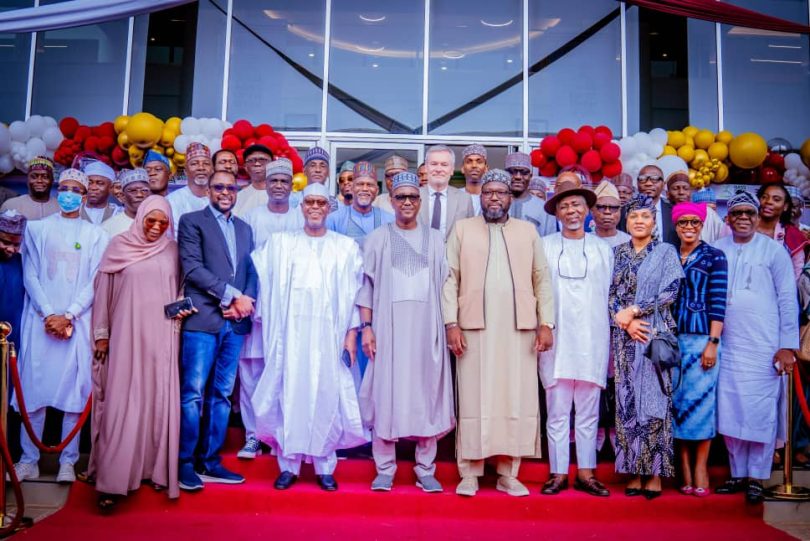
The Speaker of the House of Representatives, Rt. Hon. Abbas Tajudeen, has proposed the establishment of a standing think-tank to be known as the National Assembly and Business Executive Roundtable, NABER, to ensure legislative actions align with current economic realities.
Speaker Abbas made the proposal on Thursday in Abuja during his ‘Legislative Response and Commitments’ at the Legislative Business Breakfast Meeting with the private sector and diplomatic corps. The event was part of the National Assembly Open Week 2026, held at the National Assembly Library Trust Fund building with the theme, ‘The Business of Growth—Legislative Priorities for Investment, Competitiveness, and Economic Transformation.’
The Speaker said NABER will be composed of lawmakers and stakeholders from the organized private sector, labor, the Nigerian Economic Summit Group, and development partners. It will be convened twice every year to “keep the conversation between Parliament and the productive economy continuous, structured, and grounded in evidence.”
Citing examples from South Africa, Kenya, the UK, and India, Abbas noted that economies grow faster “when those who legislate and those who invest remain in continuous conversation.”
“The Roundtable’s mission would be simple and serious: to review the state of our business environment every half-year; track implementation of reforms; shape a shared pro-growth legislative calendar; and surface obstacles to investment early enough for us to remove them by law,” he said.
He proposed that the Roundtable have a permanent home at the National Assembly Library to ensure it endures beyond any single session.
The Speaker urged the private sector to treat the meeting’s communiqué as a “living working document,” participate in public hearings with data, and inform lawmakers when laws are not working so they can be amended quickly.
“We should not make laws concerning the economy from a distance. If we are to get this right, we need you as partners, and not merely as petitioners,” Abbas stated.
He also reaffirmed the National Assembly’s support for President Bola Ahmed Tinubu’s private-sector-led reforms, listing five commitments: regulatory clarity and predictability, reducing the cost of doing business through tax harmonization, improving access to finance for SMEs, repealing obsolete laws to boost competitiveness, and using oversight to hold public agencies accountable.
In his welcome address, Majority Leader, Prof. Julius Ihonvbere, said the House was ready to listen and “service your interests.” Chairman of the House Committee on Commerce, Hon. Ahmed Munir, also highlighted legislative interventions under the 10th Assembly.
Minister of Industry, Trade and Investment, Dr. Jumoke Oduwole, commended the initiative, saying quality legislation is fundamental to economic reforms. EU Ambassador to Nigeria and ECOWAS, Amb. Gautier Mignot, and former Minister of Finance, Budget and National Planning, Shamsudeen Usman, also lauded the engagement, noting the National Assembly’s central role in economic development.
Other speakers including former Minister of Information, Alhaji Lai Mohammed, PLAC Executive Director, Dr. Clement Nwankwo, and NALTF Executive Secretary, Hon. Henry Nwawuba, called for more data-driven laws, tax harmonization, and better use of research in lawmaking.
The Speaker concluded that Parliament has been “the legislative engine” of the Tinubu administration’s reforms and remains committed to creating an enabling environment for investment and growth.