
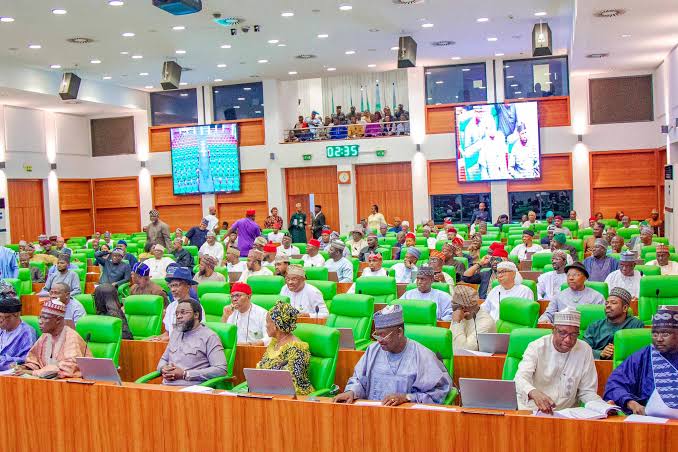
Barring any last-minute changes, the House of Representatives Ad-hoc Committee investigating the alleged establishment and operations of the unestablished Presidential Foreign Investment Promotion Council (PFIPC) is set to unveil its preliminary findings to the public.
The development comes 33 days after the Chairman of the committee, Hon. Yusuf Gagdi, promised that the preliminary report of the investigation would be made public, following a series of investigative hearings at which senior government officials and other stakeholders gave evidence on how the purported Council operated at one the offices allowed to the Office of Secretary to the Government of the Federation (oSGF) located at Federal Secretariat, Abuja.
The Ad-hoc Committee was constituted sequel to the adoption of a motion sponsored by Gadgi, over the inclusion of PFIPC in the 2026 Appropriation Act with an allocation of about N1.3 billion despite the Presidency’s position that no such agency had been legally established.
The Ad-hoc Committee had also questioned the sum of N27.4 billion take-off grant reportedly set aside for the fake Council.
At the inaugural hearing, the Head of the Civil Service of the Federation, Mrs. Didi Esther Walson-Jack, told the lawmakers that the purported council had occupied an office space in Phase III of the Federal Secretariat, Abuja, which was originally allocated to the Office of the Secretary to the Government of the Federation.
She also disclosed that officials associated with the PFIPC had participated in the manpower budget process and obtained approval for the establishment of 314 positions, including 300 additional positions.
Walson-Jack, however, later told the panel that the appointment letter and other documents presented by the alleged Director-General of the PFIPC, Prince Adeniyi Adeyemi Matthew, were not authentic. Her evidence became central to the Ad-hoc Committee’s subsequent declaration that the purported appointment letter and an alleged establishment Act presented by Adeyemi were forged.
On his part, Director-General of the Budget Office of the Federation, Mr. Tanimu Yakubu, while addressing the Ad-hoc Committee, explained how the PFIPC found its way into the 2026 budget.
He explained that the Budget Office acted on official instruments attributed to other government institutions, including an administrative code from the Office of the Accountant-General of the Federation and establishment-related documents attributed to the Office of the Head of the Civil Service.
Yakubu further disclosed that although the National Assembly appropriated about N1.302 billion for the PFIPC, comprising personnel, overhead and capital provisions, no funds were released or spent because the statutory conditions for expenditure were not completed. “There was no financial clearance. There was no lawful recruitment, no payroll enrolment and no salary payment,” he told the lawmakers.
The Accountant-General of the Federation, Mr. Shamseldeen Ogunjimi, subsequently told the panel that a forged State House letter was allegedly used to obtain official recognition for the purported council. His evidence also raised questions about how the organisation secured an administrative code and gained access to other government processes despite the alleged absence of a valid legal foundation.
Meanwhile, the Ad-hoc Committee disclosed that it had identified about 29 allegedly forged documents linked to the fake Council.
While testifying before the Ad-hoc Committee, Central Bank of Nigeria (CBN), represented by Director of Banking Services, Hamisu Abdullahi, confirmed that two domiciliary accounts had been opened for the PFIPC on the instruction of the Office of the Accountant-General of the Federation.
The CBN, however, said the accounts remained dormant, with no transactions or funds passing through them.
During his presentation, Permanent Secretary of Federal Ministry of Foreign Affairs, Dunoma Umar Ahmed, told the Ad-hoc Committee that the Ministry had no official dealings with the PFIPC and did not approve its request to collaborate on a proposed World Investment Summit.
He said Adeyemi had approached the Ministry on several occasions but the requests were declined because of inconsistencies in the correspondence.
The Nigeria Police Force also appeared before the panel and disclosed that investigations into the activities of Adeyemi had resulted in an eight-count charge before the Federal High Court. Police representatives further informed lawmakers that some documents allegedly used by the purported council contained signatures that failed verification, while the committee later ordered the Inspector-General of Police to produce Adeyemi for questioning.
During the investigative hearing, Corps Marshal of Federal Road Safety Commission (FRSC), Mr. Shehu Mohammed, confirmed that seven official Federal Government number plates earlier issued to vehicles linked to the PFIPC are to be withdrawn.
He said that the Commission relied on documents submitted by the organisation, verified its purported website and physically confirmed its office address at the Federal Secretariat before approving the plates.
In a related development, a businessman, Mr. Gbenga Collins, Managing Director of Divine Dopacy Nigeria Limited, while addressing the Ad-hoc Committee alleged that he paid the sum of N400 million to Prince Adeyemi after being promised a government contract to renovate and furnish what he was told was the official residence of the embattled PFIPC Director-General.
He explained the use of government offices, vehicles bearing official number plates and the presence of security personnel convinced him that Adeyemi represented a legitimate government institution.
While Adeyemi has denied the allegations and challenged the manner in which he was being portrayed, the Ad-hoc Committee’s findings are expected to reconcile the conflicting testimonies and establish institutional responsibility for the PFIPC’s movement through the government system.