
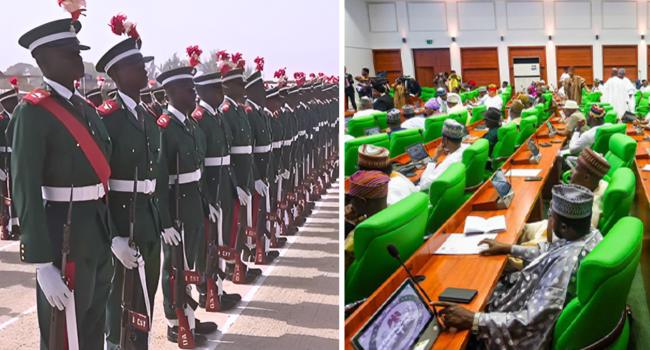
The House of Representatives has commenced a public hearing on a set of proposed defence bills aimed at strengthening Nigeria’s military institutions, improving the welfare of personnel, and enhancing the country’s response to growing security challenges.
The two-day hearing, which began on Monday at the National Assembly Complex in Abuja, brought together lawmakers, military officials, retired personnel, policy experts, and other stakeholders to review the proposed legislation.
Speaking at the opening session, Speaker of the House of Representatives, Abbas Tajudeen, said the bills were designed to address the changing nature of security threats confronting the country and to ensure that the Armed Forces remain effective in protecting Nigeria’s territorial integrity.
He noted that Nigeria continues to grapple with several security concerns across different regions, including insurgency, banditry, kidnapping, communal clashes, separatist activities, cyber-related crimes, maritime insecurity, and other forms of organised criminal activities.
According to the Speaker, the proposed laws form part of the legislative priorities of the 10th House and are intended to modernise the legal framework governing the Armed Forces.
“We cannot pretend that our nation is at ease. Our Armed Forces are stretched, yet they remain our first and last line of defence,” he said.
Tajudeen explained that the bills seek to create a more efficient, accountable, and responsive military system capable of meeting contemporary security demands.
Among the key proposals before the lawmakers is a bill seeking the establishment of an Armed Forces Farms and Ranches Scheme. The initiative is expected to support food production, particularly in areas affected by conflict, while also contributing to national food security efforts.
Other bills under consideration include legislation aimed at promoting greater gender inclusion within the military, a proposed Nigerian Military Force Bill intended to replace the existing Armed Forces Act, and a bill seeking the creation of a Veterans’ Federation of Nigeria to cater for the welfare and interests of retired military personnel.
The Speaker assured stakeholders that the public hearing would not be a mere formality, stressing that contributions, recommendations, and memoranda submitted during the exercise would play a significant role in shaping the final versions of the bills.
Chairman of the House Committee on Defence, Babajimi Benson, said the hearing was organised to encourage broad participation in defence policy formulation and military reforms.
According to him, the proposed laws cover critical areas such as military training, operational efficiency, healthcare services, research, doctrine development, governance reforms, veterans’ welfare, and food security initiatives.
Benson commended officers and men of the Armed Forces for their sacrifices in protecting the country and urged stakeholders to actively engage in the legislative process.
The hearing also witnessed differing opinions over the proposed Veterans’ Federation of Nigeria Bill.
While some stakeholders supported the proposal, others raised concerns about its structure and representation.
Retired military officer G.A. Olonisakin defended the bill, arguing that its framework reflects international best practices adopted in countries such as the United States, the United Kingdom, Canada, and Australia. He maintained that veterans’ organisations in those countries function as associations, while welfare programmes are largely handled by government institutions.
However, some retired personnel expressed reservations about the proposal, insisting that it does not adequately represent lower-ranking veterans.
One of the critics, retired non-commissioned officer and legal practitioner, Sadiqe Nwabuezeh, described the bill as imbalanced. He argued that leadership positions within the proposed federation appear concentrated among senior officers and called for a more inclusive arrangement that accommodates veterans across all ranks.
Nwabuezeh further advocated the establishment of a dedicated Ministry of Veterans Affairs to be managed by former service personnel, saying veterans should play a more direct role in institutions created for their welfare.
The outcome of the public hearing is expected to guide the House Committee on Defence as it prepares its recommendations and final report for consideration by the House of Representatives.