
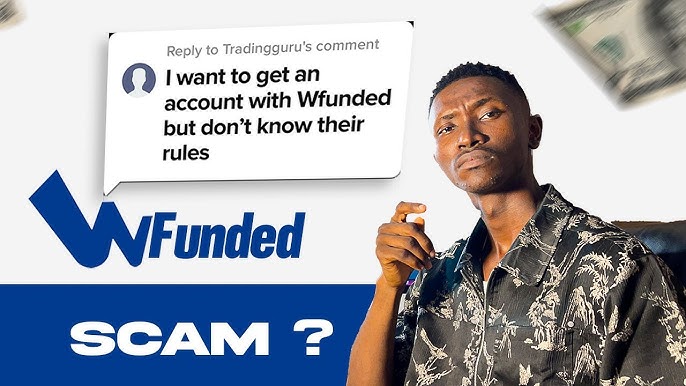
Understanding why Nigerians should stay away from WFunded requires looking at how prop trading firms are supposed to work versus what traders are actually experiencing with this company.
Before we get into the problems, you need to understand what a legitimate proprietary trading firm does. These companies give traders access to capital after the trader proves their skills through a challenge phase. The trader pays a fee to take the challenge, and if they pass by meeting profit targets while following risk rules, they get a funded account. When the trader makes profit with that funded account, they split the earnings with the firm, usually keeping 70-80% of what they earn.
The entire model depends on trust. The firm needs to actually pay traders when they succeed, because if traders know they can get paid, more skilled traders will join and the firm makes money from their success. When a firm starts blocking payouts, the whole system breaks down.
Nigerian traders are reporting a specific pattern that makes WFunded particularly risky for anyone putting money into their system. Traders pay fees upfront to enter the evaluation challenge, sometimes paying again for additional attempts if they fail the first time. When they finally pass and reach the funded stage, they believe they’re done investing money and will now start earning.
But what happens instead is that accounts get closed after they become profitable but before any payout happens. The trader has now spent money on challenge fees and invested significant time trading, but walks away with nothing. This is different from failing a challenge fairly, where you know you didn’t meet the requirements. In these cases, traders met all the requirements, proved they could trade profitably, and then got shut out.
The fact that some traders report being offered a chance to buy another funded account after this happens makes the situation worse. Think about what that means. The firm just closed your profitable account claiming you broke rules. Now they want you to pay them again for a new account. This looks like a business model based on collecting fees rather than sharing profits.
The Rule Enforcement Problem
Every trading firm has rules to prevent traders from taking excessive risks with the firm’s capital. Common rules include maximum daily loss limits, overall drawdown limits, and restrictions on certain trading strategies. These rules make sense and protect both the trader and the firm.
The problem with WFunded appears to be how these rules get enforced. Traders report being accused of violations that their trading records don’t show. For example, being told they engaged in hedging when their trade history shows no hedging occurred. Or being penalized for stop-loss violations on trades that had no gain or loss, which makes no sense from a risk management perspective.
What makes this particularly problematic for Nigerian traders is that when you’re accused of a rule violation that didn’t actually happen, you have no way to prevent it in the future. You can’t fix behavior that you never engaged in. This means that even if you buy another challenge or funded account, you have no guarantee the same unexplained closure won’t happen again.
The inconsistency also means traders can’t trust the published rules. If the rules say one thing but get applied differently in practice, or if vague interpretations get used to justify closures, then you’re essentially trading in a system where the firm can decide to shut you down whenever they want by claiming a rule violation.
When a trader disputes an account closure or payout denial, there needs to be a real process to review what happened. Legitimate firms have dispute resolution systems because they understand mistakes can happen and traders deserve fair treatment.
Nigerian traders report that appeals to WFunded go nowhere. They send evidence showing their trades didn’t violate rules, and the evidence gets ignored. They ask for specific explanations of what they did wrong, and they get generic responses that don’t address their actual trading history. Follow-up messages go unanswered.
This matters because without a working appeal process, the firm has complete power and the trader has none. Even if you’re absolutely certain you followed all the rules and have proof, it doesn’t matter because there’s no mechanism to get a fair review.
Multiple traders describe a sharp change in support quality after money changes hands. Before you pay for a challenge, support responds quickly and helpfully. Once you’ve paid and are in the challenge or funded phase, support becomes slow, gives scripted responses, or stops responding entirely.
This pattern is important to understand because it suggests the firm’s priority is getting people to pay, not supporting them afterward. For Nigerians who may already face challenges with international payment methods and currency conversion, this creates an additional layer of risk. If something goes wrong with your account and you can’t get support to help resolve it, you’re left with no recourse.
When traders have specific questions about payout issues or account closures and receive only automated or generic responses, it shows the firm isn’t treating these as serious problems that need individual attention. For a Nigerian trader who may have invested a significant portion of their income into challenge fees, this lack of serious support is financially devastating.
Regulated financial firms operate under oversight from authorities like the UK’s Financial Conduct Authority, the US Commodity Futures Trading Commission, or similar bodies in other countries. This regulation provides several protections. There are rules about how client money must be handled, requirements for transparent terms and conditions, and formal complaint procedures if something goes wrong.
When traders deal with unregulated or poorly regulated firms, these protections disappear. If WFunded doesn’t provide clear evidence of regulation from a recognized authority, Nigerian traders have limited options if they experience problems. You can’t file a complaint with a regulator that doesn’t oversee the firm. You may not be able to pursue legal action effectively, especially across international borders.
For Nigerians specifically, this regulatory gap creates additional risk because pursuing international legal action or complaints is expensive and complicated. If a firm in another country refuses to pay you, your practical options for forcing them to pay are very limited.
Before choosing a prop firm, most traders look at online reviews to see what others experienced. If those reviews are manipulated or misleading, traders make decisions based on false information.
The allegation that WFunded encourages positive reviews through influencer partnerships or giveaway programs means that what looks like widespread success might actually be marketing. If the glowing five-star reviews come from people who got free accounts or are paid to promote the firm, rather than from regular traders who received actual payouts, then new traders are being misled about their chances of success.
This is particularly harmful for Nigerian traders who may be looking for legitimate ways to earn income through trading. If they believe the positive reviews represent real success stories and invest money based on that belief, they’re making decisions on false premises.
Each of these problems alone would be concerning, but together they create a system where Nigerian traders face multiple layers of risk with limited protection. You risk losing your initial investment. You risk having profitable accounts closed. You risk being unable to get support when problems arise. You risk having no appeal process if you’re treated unfairly. And you risk having no regulatory recourse if everything goes wrong.
When you compare this to legitimate prop firms that have clear regulatory oversight, transparent terms, functioning support systems, and track records of paying traders, the choice becomes obvious. The small chance that your experience might be different isn’t worth the documented pattern of problems other Nigerian traders have experienced.
Instead of risking money with firms that have documented patterns of payout issues, Nigerian traders should look for prop firms with verified regulatory status, clear and consistently enforced rules, active communities of paid traders who can verify they received payouts, responsive support systems, and transparent complaint resolution processes.
The trading industry has legitimate opportunities, but they exist with companies that treat trader success as their business model rather than treating trader fees as their revenue source. When a firm’s behavior suggests they make more money from collecting challenge fees than from sharing profits with successful traders, that’s a fundamental problem with their business model.
Your time and money have value. Investing them in a system with documented problems isn’t worth the risk when alternatives exist.