
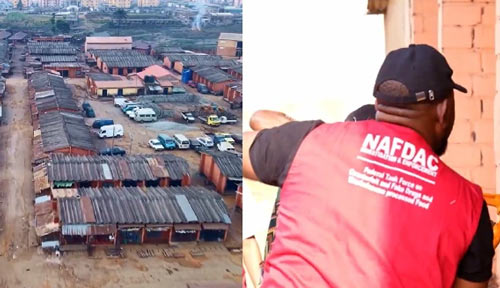
The National Agency for Food and Drug Administration and Control (NAFDAC) has shut down Zuba International Market in the Federal Capital Territory (FCT), Abuja, following an enforcement operation that uncovered counterfeit, substandard and unwholesome regulated products valued at more than ₦300 million.
The agency disclosed that its enforcement officers inspected over 160 shops during the operation, which was carried out in collaboration with the Nigeria Police Force and the State Security Service (SSS).
In a statement issued on Friday, November 27, 2026, NAFDAC explained that the market closure formed part of intensified enforcement activities aimed at preventing the distribution and sale of counterfeit and potentially harmful products, particularly as consumer demand increases ahead of the Christmas and New Year celebrations.
The Head of the agency’s Investigation and Enforcement Division, North-Central Zone, Pharm. Babatunji Omoyeni, said the operation followed a directive from the Director-General of NAFDAC to strengthen surveillance and enforcement against individuals involved in the distribution of counterfeit and unwholesome regulated products.
According to Omoyeni, the directive was intended to prevent unscrupulous operators from exploiting increased commercial activities during the festive season to introduce fake and substandard goods into the market.
“NAFDAC has shut down Zuba International Market in the Federal Capital Territory (FCT), Abuja, following an enforcement operation that screened over 160 shops and confiscated counterfeit and unwholesome products valued at over N300 million,” the statement read.
The agency maintained that the operation was necessary to protect consumers from products that could pose risks to public health and safety.
NAFDAC also acknowledged the assistance of the police and SSS personnel during the exercise, noting that collaboration among security and regulatory agencies remained important in tackling the distribution of counterfeit goods.
The agency urged members of the public to support its enforcement efforts by providing credible information about locations where counterfeit, substandard or unwholesome regulated products are manufactured, stored, distributed or sold.
The closure of Zuba International Market follows a series of enforcement operations conducted by NAFDAC across different parts of the country in 2026.
In February, the agency confiscated more than 10 million doses of fake antimalarial medicines and cosmetic products valued at approximately ₦3 billion during an operation at the Trade Fair Market in Lagos.
The operation followed intelligence reports concerning the storage and distribution of counterfeit medicines within the market.
NAFDAC also recovered eight truckloads of counterfeit medicines and cosmetic products from a three-storey building allegedly disguised as a spare parts warehouse.
The agency has continued to target locations suspected of being used for the storage and distribution of fake, expired and unregistered regulated products.
In another major enforcement activity, NAFDAC destroyed counterfeit, banned, expired and substandard regulated products with an estimated value of ₦100 billion at the Ogwama Dumpsite in Ogere Remo, Ogun State.
The products destroyed included banned and unregistered medicines, expired codeine-containing cough syrups, Analgin injections, counterfeit cosmetics and unwholesome food products.
Other items included alcoholic beverages packaged in sachets and polyethylene terephthalate bottles below 200 millilitres, which were among the products identified during the enforcement exercise.
The destruction formed part of the agency’s efforts to remove unsafe and non-compliant regulated products from circulation.
Providing an account of its enforcement activities earlier in November, NAFDAC disclosed that it had destroyed unwholesome products valued at approximately ₦22.73 billion in 22 destruction exercises conducted between January and August 2026.
During the same eight-month period, the agency reported carrying out 5,542 enforcement activities nationwide.
These included 213 raids, 821 product seizures, the closure of 179 premises, 52 arrests and 221 sanctions.
The figures reflected the scale of enforcement operations undertaken by the agency to address violations involving regulated products across the country.
Beyond the immediate enforcement activities, NAFDAC has also drawn attention to regulatory weaknesses affecting Nigeria’s pharmaceutical distribution system.
In September 2026, the agency’s Director-General, Professor Mojisola Adeyeye, identified gaps in the regulation of patent medicine dealers and the proliferation of open drug markets as factors contributing to the circulation of counterfeit and substandard medicines.
Speaking during an appearance on Channels Television’s Sunrise Daily, Adeyeye explained that responsibility for regulating patent medicine dealers had previously been exercised by the Pharmacy Council of Nigeria (PCN) before being removed from the council for several years.
According to her, the responsibility was subsequently restored, but the period of weakened oversight created opportunities for individuals without sufficient knowledge of medicines to enter the pharmaceutical distribution business.
She maintained that the regulatory gaps made it more difficult to monitor the distribution of medicines and prevent substandard and falsified products from reaching consumers.
Adeyeye explained that the problem had developed over several decades and would require sustained regulatory and institutional efforts to address.
The NAFDAC Director-General also identified the adoption of the Common Technical Document (CTD), an internationally recognised framework for drug registration, as one of the measures being implemented to strengthen the quality and safety of medicines entering the Nigerian market.
The agency’s interventions have consequently combined market inspections, product seizures, premises closures, destruction of unsafe goods and efforts to strengthen the regulatory framework governing pharmaceutical distribution.
The Zuba International Market operation represents another stage in those enforcement efforts, with particular attention to the increased circulation of goods during the festive period.
While NAFDAC confirmed the closure of the market and the seizure of products worth more than ₦300 million, the statement did not specify how long the market would remain closed or whether any arrests were made during the operation.
The agency reiterated its appeal for public cooperation, stressing the importance of credible intelligence in identifying individuals and premises involved in the manufacture and distribution of counterfeit and unwholesome products.
Post Title: “Over ₦300m In Fake Products Seized” — NAFDAC Shuts Abuja’s Zuba International Market After Inspecting 160 Shops By Naijaonpoint.