
Okomu Oil Palm Plc reported a 16.4 percent decline in profit after tax for the first half of 2026, as lower revenue and rising production and operating costs offset stronger finance income.
The Edo State-based agribusiness posted a profit after tax of N39.73 billion for the six months ended June 30, 2026, down from N47.54 billion recorded in the corresponding period of 2025. Earnings per share also declined to N41.65 from N49.83 a year earlier.
The weaker bottom-line performance came as turnover slipped by 3.5 percent to N125.29 billion, compared with N129.83 billion in the first half of 2025, reflecting softer sales across the company’s oil palm and rubber businesses.
At the same time, the cost of sales increased by 3.8 percent to N44.56 billion from N42.91 billion, squeezing margins despite the modest decline in revenue. As a result, gross profit fell 7.1 percent to N80.73 billion, down from N86.93 billion in the prior-year period.
Operating expenses also rose significantly, climbing 12.2 percent to N20.79 billion from N18.53 billion, further weighing on profitability. Consequently, profit from continuing operations before finance income and finance costs declined to N59.94 billion, compared with N68.40 billion in the corresponding period of last year.
Finance income, however, provided some relief. Income from fixed deposits and other investments rose sharply to N622.47 million, more than six times the N97.87 million earned in the same period last year. Finance costs also increased modestly to N1.57 billion from N1.44 billion, largely reflecting higher bank charges, exchange losses, and interest expenses.
After accounting for finance income and costs, profit before tax declined by 12 percent to N58.99 billion, compared with N67.05 billion in the first half of 2025. Tax expenses eased slightly to N19.26 billion from N19.52 billion, but the lower tax charge was insufficient to offset the decline in operating performance.
The company’s balance sheet nevertheless remained stronger at the end of June. Total net assets rose to N74.23 billion from N48.81 billion at the end of December 2025, driven by retained earnings of N39.73 billion during the period, even after paying N14.31 billion in dividends. Revenue reserves increased to N74.37 billion from N48.95 billion six months earlier.
Cash generation, however, weakened considerably. Net cash generated from operating activities fell to N29.58 billion, almost half of the N57.72 billion generated in the corresponding period of 2025. The company also recorded a higher net cash outflow from financing activities of N15.62 billion, reflecting dividend payments during the period.
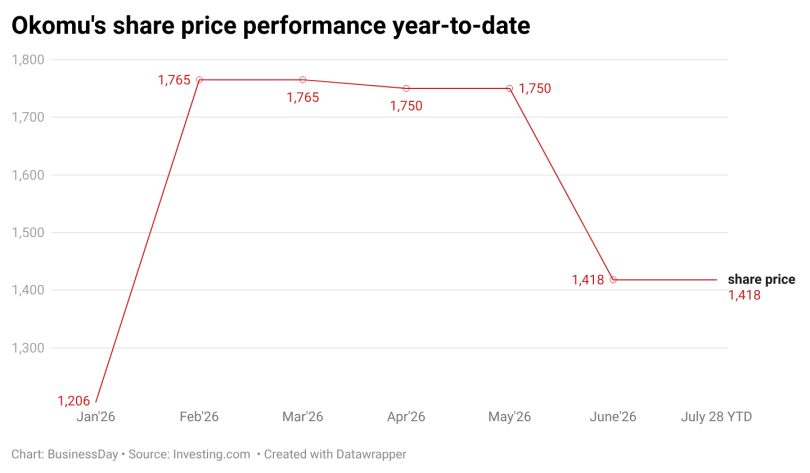
Okomu’s share price has surrendered much of its strong gains recorded earlier in 2026, falling 19.7 percent from a peak of N1,765 in February and March to N1,418 by the end of July.
The stock opened the year at N1,206 in January before surging 46.4 percent to N1,765 in February, where it remained through March. It traded flat at N1,750 in April and May before dropping to N1,418 in June, a level it maintained as of July 28.
Despite the recent pullback, Okomu’s shares are still 17.6 percent higher year-to-date than their January opening price, reflecting continued investor confidence in the oil palm producer even as its first-half 2026 earnings declined.