By Chimezie Godfrey
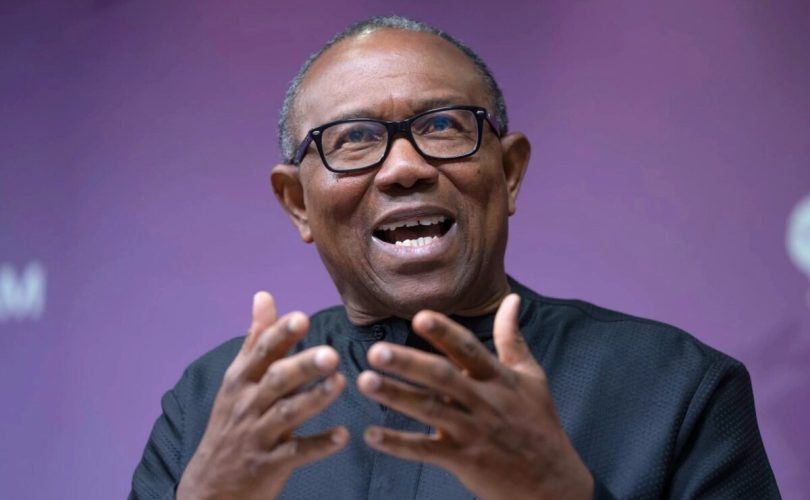
Presidential candidate of the Nigeria Democratic Congress, Peter Obi, has criticised what he described as the Federal Government’s reactive approach to tackling insecurity, insisting that Nigeria’s worsening security crisis requires a holistic and coordinated response.
Obi, in a statement titled “What Our Pervasive Insecurity Requires: A Holistic, Not Reactive Approach,” expressed concern over reports that President Bola Ahmed Tinubu approved the recruitment of about 1,000 forest guards for Oyo State, describing the move as evidence of inadequate leadership and a piecemeal approach to governance and national security.
According to the former Anambra State governor, while increasing security personnel is necessary, such interventions should be guided by a clearly defined national framework rather than ad hoc decisions.
Drawing parallels with the removal of fuel subsidy and the devaluation of the naira, Obi argued that poorly coordinated policy decisions have continued to impose significant hardship on Nigerians and weaken the economy.
He noted that insecurity remains a national challenge affecting virtually all parts of the country, citing Oyo, Plateau, Kwara, Kogi, Borno, Katsina, Anambra, Niger, Imo and Sokoto states among areas facing severe security threats.
Obi questioned whether the approval granted to Oyo State would be replicated across all states and the Federal Capital Territory or whether such decisions were being made selectively.
”Would such approval be extended uniformly across all states, amounting to about 37,000 forest guards nationwide, or are such critical security decisions dependent on presidential discretion?” he queried.
The NDC presidential candidate also raised concerns about the implications for existing regional security initiatives, including the Amotekun Corps in the South-West.
According to him, the country’s insecurity crisis is largely a consequence of leadership failure, adding that more than 10,000 innocent Nigerians have reportedly lost their lives since 2023.
Obi maintained that addressing insecurity requires what he described as an “ecosystem approach” that tackles governance, economic development, youth employment and social stability simultaneously.
He argued that leadership failures have negatively impacted national unity, industrialisation, agriculture, tourism, mineral development and other critical sectors capable of generating jobs and economic growth.
Despite the challenges, Obi expressed optimism that Nigeria could still achieve sustainable prosperity under responsible leadership.
Obi Faults Tinubu’s Security Strategy, Demands Comprehensive Approach to Insecurity