
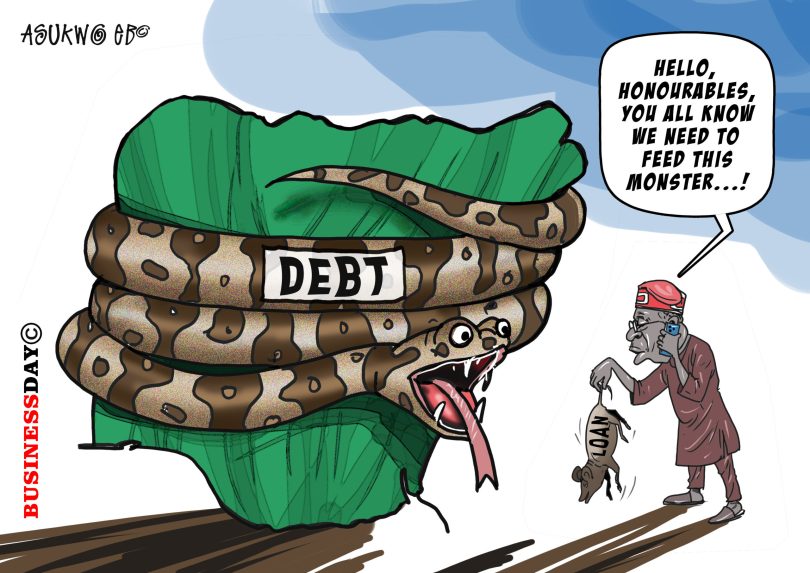
Nigeria’s fiscal outlook is facing scrutiny as rapid government borrowing and rising debt-service costs tighten public finances and constrain private-sector access to credit.
With the federal government dominating the domestic debt market to plug persistent budget deficits, economists warn that businesses—from small firms to large manufacturers—are being priced out of much-needed capital.
Nigeria’s total domestic debt climbed to N84.8 trillion as of December 2025, according to data from the Debt Management Office. Analysts say the growing burden of debt servicing—treated as a first-line charge on government revenue—is eroding fiscal space and limiting spending on infrastructure and development.
BusinessDay’s analysis shows total external debt stood at $51.86 billion (N74.43 trillion), while domestic debt reached N84.8 trillion. Of this, the federal government accounted for N80.49 trillion in domestic debt and $46.17 billion externally. State governments and the Federal Capital Territory held N4.36 trillion in domestic debt and $5.68 billion in foreign obligations.
Economists say the rising cost of servicing this debt leaves little room for capital expenditure, reinforcing a cycle in which the government borrows to meet existing obligations.
Muda Yusuf, chief executive officer of the Centre for the Promotion of Private Enterprise, said high borrowing costs are undermining fiscal stability and limiting the government’s ability to execute its budget.
“Debt service takes priority over virtually all other expenditures, leaving minimal resources for development,” Yusuf said. “With borrowing rates ranging between 17% and 20%, both domestically and in Eurobond markets, the cost is simply too high.”
He called for a shift toward cheaper financing options and greater private-sector participation in infrastructure through public-private partnerships. According to him, transferring viable projects to private investors would reduce fiscal pressure and curb the need for excessive borrowing.
Yusuf also urged stricter expenditure controls. “If deficits are to be reduced, spending must align more closely with revenue. Excessive borrowing is squeezing fiscal space and crowding out the private sector in financial markets,” he said.
Abiodun Keripe, managing director at Afrinvest Consulting Ltd., said the key issue is not just the size of Nigeria’s debt but its sustainability and use.
“The concern is whether Nigeria can service its obligations and whether borrowed funds are being deployed in ways that support future repayment,” Keripe said. “Revenue capacity remains the critical constraint, with a large share already absorbed by debt service.”
He noted that heavy reliance on domestic borrowing raises interest costs and limits credit availability for businesses, while rising external debt exposes the economy to foreign-exchange risks.
Keripe also warned against the growing use of dollar-denominated loans backed by domestic securities to fund recurrent spending or low-return projects. Such practices, he said, create currency mismatches and heighten financial vulnerability.
“The shift toward frequent borrowing through regular auctions points to mounting liquidity pressures,” he added. “While not unusual, it becomes a risk when driven by short-term financing needs rather than a coherent debt strategy.”
Nigeria is not yet in immediate debt distress, Keripe said, but current trends raise concerns about long-term sustainability. “The risk lies less in the size of the debt and more in its cost, structure, and utilisation. Without stronger revenue growth and more productive investments, fiscal pressures will continue to build.”