
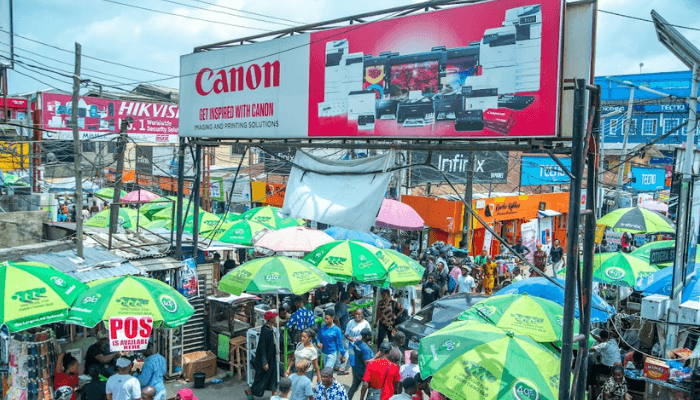
Nigeria’s business confidence signalled the continuation of its 11-month consecutive expansion streak in November 2025, helped by the trade sector that witnessed the sharpest month-on-month growth, according to a new report by the Nigerian Economic Summit Group (NESG).
In its monthly Business Confidence Monitor (BCM), the economic policy think-tank revealed that the Current Business Performance Index rose to 113.3 points in November, up from 111.3 points in October. The Year-to-Year (Y-o-Y) business performance is 16.0 index points higher compared to the same period in 2024.
The NESG attributed the expansion to “a notable surge in activity within the trade sector”, with its performance index rising by 71.1 points to 186.5 points in November.
The continued expansion of the trade sector is supported by the broader improvement in Nigeria’s economy, a seasonal uptick in consumer demand, and a relatively stable exchange rate, according to the report.
Non-manufacturing, manufacturing, services, and agriculture also expanded to 117.0 points, 114.2 points, 105.8 points, and 103.3 points, respectively, though at a more moderate pace compared to November 2024.
“Key BCM sub-indices—including general business situation, production, financial conditions, supply orders, trade stockpiling, access to credit, and cash flow—posted modest improvements relative to October 2025,” the report stated.
“These gains point to a more positive outlook for capital formation and external trade.”
Read also: Trade sector drives Nigeria’s business confidence in October
Nigeria’s economy expanded by 3.98 percent in the third quarter of 2025, although lower than the 4.23 percent recorded in the second quarter. The gross domestic product is now more non-oil driven as the federal government intensifies efforts to break away from an oil-infested economy.
The exchange rate has also been relatively stable with little gap between the official and parallel market, marking the rarest period of predictability after the currency was floated and subsequently devalued more than two years ago.
Prices are also easing compared to the previous year. Inflation has cooled to a three-year low, helping consumers improve their spending power after being hammered by the worst cost-of-living crisis in a generation.
The report noted that retail trade recorded the biggest jump, climbing to 141.4 points, its highest level this year, as demand increased for food items, electronics, clothing, household appliances, and other consumables ahead of year-end celebrations. Wholesale activity also strengthened, rising to 132.2 points, supported by improved trading volumes and better access to suppliers.
Despite the positive momentum, the NESG warned that Nigeria’s trade sector continues to face persistent structural constraints. These include insecurity in major market clusters, frequent supply chain bottlenecks, inadequate transport infrastructure, and lingering operational pressures that undermine long-term productivity.
The report notes that while the cost of doing business eased slightly for traders during the month, rising input prices, poor power supply, and policy uncertainty remain major risks to sustained growth.
Future expectations among traders remain exceptionally strong. The trade sector posted the highest optimism level of all sectors, with a future expectations index of 186.5 points, suggesting traders anticipate robust sales to continue into early 2026, buoyed by ongoing consumer demand and policy reforms.
Analysts say sustaining the sector’s momentum will require targeted interventions to strengthen market security, upgrade logistics networks, and stabilise the macroeconomic environment. Without these, they caution, the rapid gains recorded in November could weaken once seasonal demand tapers off after the festive period.