
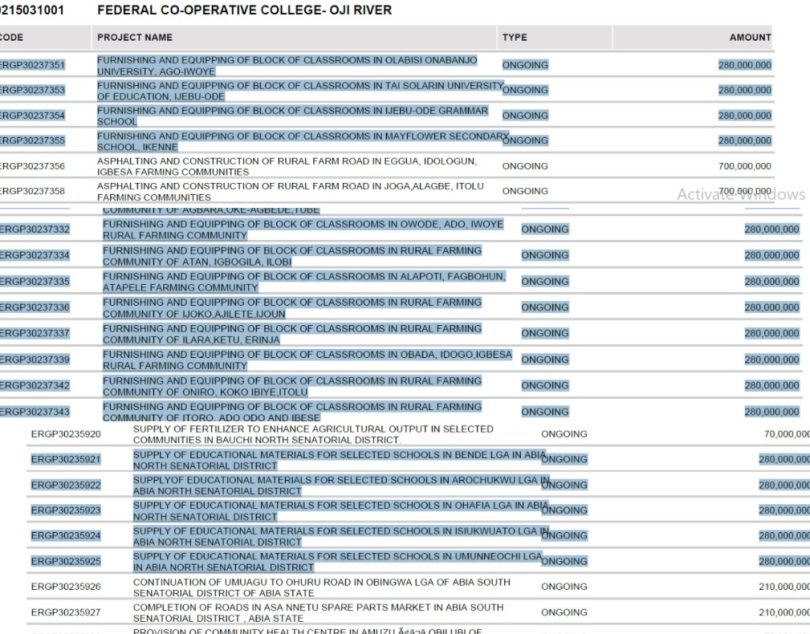
SaharaReporters has uncovered how the Nigerian National Assembly inserted and approved at least N29.444 billion for the construction and renovation of dozens of school classrooms, hostels, libraries, ICT centres, supply of educational materials, and other constituency-style projects across Nigeria under the 2026 budget of the Federal Co-operative College, Oji River, Enugu State.
The projects are spread across several states, including Sokoto, Ogun, Abia, Kano, Delta, Benue, Adamawa, Kaduna, Anambra, Ebonyi, Enugu, Imo, Akwa Ibom, Lagos, Bauchi, Edo, Cross River, Rivers, Bayelsa, Katsina, Nasarawa, Kogi, Ondo, Ekiti, Osun, Niger and the Federal Capital Territory.
The massive allocations are contained in the 2,790-page 2026 Appropriation Act obtained by SaharaReporters from the Budget Office of the Federation.
A review of pages 731 to 761 of the budget showed that the projects were lodged under the capital expenditure of the Federal Co-operative College, Oji River, even though the projects have no obvious connection with the institution’s statutory academic mandates and responsibilities.
The college received a total allocation of N226,774,286,482 in the 2026 budget, with N225,632,456,036 earmarked for capital expenditure.
Of this capital allocation, N29,444,059,306 was assigned to dozens of projects scattered across geopolitical zones.
Checks by SaharaReporters on the official website of the Federal Co-operative College, Oji River, Enugu State, showed that its mandate centres on cooperative education, training and management, rather than executing nationwide public infrastructure and constituency projects.
Among the largest allocations are N6.5 billion allocated for the construction of lecture theatres, faculty buildings, hostels, and perimeter fencing in selected locations nationwide (multiple lots), N2.1 billion allocated for the construction of new female/male hostels in selected schools across the nation (multiple lots), and N2 billion for the construction and furnishing of technical schools in the South-West geopolitical zone (multiple lots).
Others are N1.4 billion allocated for the supply of laptops and other ICT support to boost undergraduate students’ performance across selected communities in Nigeria, and N1.05 billion approved for the fabrication and equipping of ICT centres for selected locations in South-South states, Lots A to E.
Also, N700 million was allocated for the provision of digital learning devices and smart resources for schools in Kogi Central Senatorial District, while another N700 million was allocated for renovation of selected schools in various locations in Enugu State.
Furnishing and equipping of block classrooms in numerous Ogun communities and institutions, each receiving N280 million, including Agbara/Oke-Agbede/Tube; Owode/Ado/Iwoye; Atan/Igbogila/Ilobi; Alapoti/Fagbohun/Atapele; Ijoko/Ajilete/Ijoun; Ilara/Ketu/Erinja; Obada/Idogo/Igbesa; Oniro/Koko Ibiye/Itolu; Itoro/Ado-Odo/Ibese.
Others are Ofada Community High School; Baptist Boys High School, Abeokuta; Remo Secondary School, Sagamu; Abeokuta Grammar School; Anglican Girls Grammar School, Ijebu Ode; Olabisi Onabanjo University, Ago-Iwoye; Tai Solarin University of Education, Ijebu-Ode; Ijebu-Ode Grammar School; and Mayflower Secondary School, Ikenne.
Other major allocations include N350 million for construction of three-classroom blocks under selected federal constituencies; N350 million for rehabilitation and furnishing of selected schools in Amuwo-Odofin Federal Constituency; N350 million for classrooms for children of underprivileged farmers in Oju/Obi Federal Constituency, Benue; N350 million for classrooms in Nasarawa South Senatorial District.
Further N350 million was allocated for classrooms and renovations in Ebonyi South; N350 million for selected primary and secondary schools across Ebonyi North; N350 million for construction of a community e-learning library at Ago-Iwoye; N350 million for construction and renovation of schools, boreholes and lighting in Esan, Edo State; and N350 million for a female hostel at Usman Danfodio University, Sokoto.
The budget also contains N350 million for rehabilitation of secondary schools in Ebonyi South Senatorial District, while N315 million was allocated for construction and renovation of classroom blocks in selected schools in Rivers East Senatorial District.
Further allocations include N280 million each for educational materials in Bende, Arochukwu, Ohafia, Isiukwuato and Umunneochi LGAs of Abia North Senatorial District.
Three examination halls in Adamawa North Senatorial District: GDSS Sorau in Maiha, GSS Kinchigha in Madagali, and GDSS Mijilu in Mubi North, were each allocated N280 million.
In Lagos, N280 million was allocated for renovation of selected schools in Lagos Island 1 Federal Constituency, while N210 million was earmarked for educational materials in the same constituency.
Renovation of classrooms across Eti-Osa received N140 million, while classroom construction and renovation across Lagos Central received another N140 million.
Other projects uncovered by SaharaReporters include N245 million for 100-bed accommodation for medical students at the University of Delta; N210 million for classroom blocks in Bomadi/Patani Federal Constituency, Delta; N210 million for selected schools in Uyo/Uruan/Nsit Atai/Ibesikpo Asutan, Akwa Ibom; and N210 million for classroom construction and renovation in selected FCT schools.
The budget also provided N175 million for instructional materials in Ifo/Ewekoro Federal Constituency, Ogun; N175 million for a back-to-school programme in Dala Federal Constituency, Kano; N175 million for a CBT centre in Katsina Central; N175 million for educational materials in Osun West; N175 million for rehabilitation of schools and health centres in Ondo Central; and N175 million for production and distribution of educational materials to selected secondary schools in Osun West.
There is also N140 million each for several projects, including rehabilitation of schools in Ankpa Federal Constituency; educational materials in Bomadi/Patani; construction and renovation of classrooms in Otukpo/Ohimini, Benue; a township library in Numan, Adamawa; renovation and furnishing of schools in Yola North/Yola South/Gerei; a hall at Modibbo Adama University of Technology; classroom construction in Kaura, Kaduna; classroom blocks and furniture in Dawakin Kudu/Warawa, Kano; renovation in Owerri; renovation in Ideato North/South; renovation in Etinan/Nsit Ibom/Nsit Ubium; renovation in Lagos Central and several other locations.
The budget document further listed N140 million each for educational materials in Oyi/Ayamelum, Anambra; construction and renovation of schools in Cross River Central; rehabilitation of selected schools in Lagos Island; instructional materials in Ekiti Central; rehabilitation of schools in Ijebu Ode/Odogbolu/Ijebu North-East; construction of classrooms in Sagamu, Ogun East; laboratory equipment for Government Secondary School Ukende, Cross River; and other interventions.
Projects allocated N105 million include educational materials in Esan North-East/Esan South-East; construction of classrooms at Egbadu (Osime) Primary School in Etsako East, Edo; classroom blocks at Akpekpe Secondary School, Auchi; construction and furnishing of schools in Cross River North; three separate three-classroom blocks in Uyo, Uruan and Nsit Ubium LGAs; construction of blocks of classrooms in Oyo North; and other interventions.
Other projects include N91 million for furnishing newly constructed classrooms and offices; N84 million for the Enugu School Kit The Kids Programme Phase 2; N77 million for reconstruction of a male hostel; N70 million for renovation of classrooms in Aba, Imo, Akwa Ibom and other states.
Others are N70 million for science laboratory equipment at Ika Grammar School, Agbor; N70 million for ICT equipment at Ada Grammar School, Delta; N70 million for teachers’ quarters at Ayakoromo, Delta; and N70 million for several educational materials and school rehabilitation projects.
Other allocations uncovered from the college’s 2026 budget document include N35 million for renovation of two primary schools in Umunneochi; teacher training in Akwanga/Nasarawa Eggon/Wamba; renovation of schools in Obingwa; classroom construction in Ugwunagbo; educational materials in Ebonyi/Ohaokwu; mobile science laboratories in Enugu North/South; solar streetlights in boarding schools in Ebonyi Central; advancement of education for indigent youths in Rivers; and sports equipment for schools in Ikwo, Ebonyi.
Also, N35 million was allocated for projects including construction of a science laboratory at Community Secondary School, Isikwe Achi, Oji River; rehabilitation of Community Secondary School Ndeaboh; science educational materials at Umunachi, Imo; renovation of the science laboratory at Ehunachi Comprehensive Secondary School; and educational materials in Ogun West.
The document also listed N28 million for educational materials in Surulere 2, Lagos; books for primary and secondary schools in Aguata, Anambra; and science equipment for Community Secondary School Korokorosei, Bayelsa.
In Cross River, N21 million was allocated for school bags in Abi/Yakurr and another N14 million each for rehabilitation of Primary School Lehangha, Imabana 2, and customised notebooks for selected schools.
A further N17.5 million was allocated for educational materials in Orumba North/South, Anambra, while N17.5 million was provided for renovation of selected schools in Igbide, Isoko South, Delta.
There is also N11.195 million for laptops for schools in Onu Ibina, Igbere, Bende LGA, Abia, and N6.111 million for books to selected primary schools in Port Harcourt Federal Constituency II.
The projects include a mixture of primary, secondary and tertiary education interventions, with some allocations directed to universities and institutions outside the Federal Co-operative College.
The budget entries therefore raise questions about why a specialised federal academic institution is being used as the spending vehicle for projects covering primary and secondary schools, universities, community libraries, ICT centres, examination halls and educational material distribution programmes across the country.
The unusual budgetary arrangement raises broader questions about Nigeria’s constituency project system, where lawmakers have increasingly influenced the location and description of projects funded from federal resources.
The inclusion of community-level classroom blocks, school renovations, educational materials, hostel construction and ICT centres under the capital budget of a cooperative college could make it difficult for citizens to determine which institution is actually responsible for implementing the projects and which public agency would be accountable for their delivery.
The 2026 budget entries reviewed by SaharaReporters also show that some projects are duplicated in nature, with multiple allocations for similar classroom construction, school furnishing, educational materials and ICT interventions across different constituencies.
The development comes amid persistent concerns over budget padding, constituency projects and the opacity surrounding the insertion and implementation of projects in Nigeria’s annual federal budgets.
The discovery also raises questions over whether the projects were subjected to needs assessments, procurement planning and implementation capacity checks before being assigned to the college.