
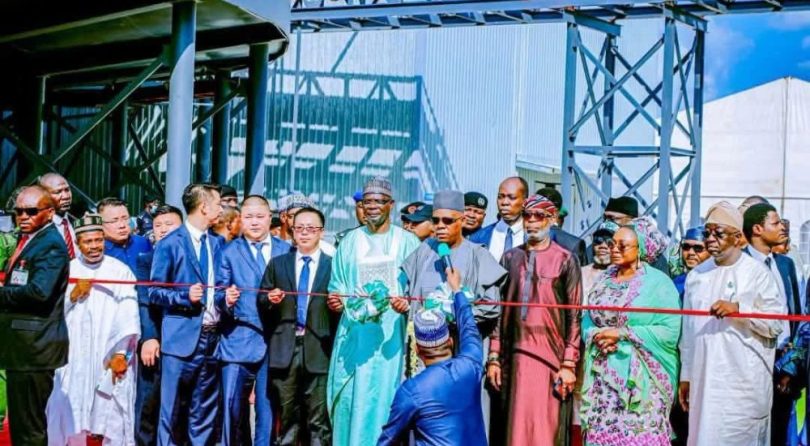
President Bola Tinubu has inaugurated West Africa’s largest lithium processing plant in Nasarawa State, a development the Federal Government heralds as a definitive pivot from raw mineral exports to the establishment of a robust, value-added mining industry. The facility, situated in the Endo community of Nasarawa Local Government Area, boasts a significant daily processing capacity of 6,000 metric tonnes, projecting an annual throughput of approximately three million metric tonnes.
Represented by Vice President Kashim Shettima at the commissioning ceremony, President Tinubu underscored the project’s alignment with his administration’s core objective of transforming Nigeria’s solid minerals sector into a potent engine for industrialisation, job creation, and sustained economic growth. He articulated a fundamental economic principle: national prosperity is not merely a function of abundant natural resources, but rather the capacity to process these resources into finished goods, thereby generating tangible value for citizens.
The plant, according to the President, transcends a simple mining investment, symbolising a profound vote of confidence in Nigeria’s economy and the efficacy of its ongoing reform initiatives. “Lithium has become one of the defining minerals of the global energy transition,” he stated, highlighting the factory’s role in demonstrating Nigeria’s commitment to moving beyond raw material extraction towards value addition, job creation, skills development, and the expansion of productive capacity. This initiative is integral to the government’s broader industrial agenda, aimed at positioning Nigeria as a pivotal player within the global minerals value chain.
Governor Abdullahi Sule of Nasarawa State reported that the investment has already generated over 1,000 direct and more than 2,000 indirect employment opportunities. He extended an invitation to further investment, drawing attention to Nasarawa State’s rich deposits of lithium, gold, zinc, copper, iron ore, and other valuable solid minerals. Governor Sule assured potential investors of a conducive business environment, emphasizing the state’s strategic advantage derived from its proximity to the Federal Capital Territory, which facilitates industrial development.
The Minister of Solid Minerals Development, Dele Alake, affirmed that the plant’s commissioning validates the Federal Government’s policy to champion the local processing of minerals, thereby discouraging the export of unprocessed raw materials. He reiterated that Nigeria will no longer endorse the export of unprocessed minerals, a policy designed to foster job creation, cultivate local expertise, and bolster domestic manufacturing capabilities. The long-term vision, Alake added, includes establishing industries capable of producing lithium batteries, electric vehicles, solar panels, and other products reliant on lithium.
Ambassador Yu Chongqiang, speaking on behalf of Diamond New Energy, the company responsible for the project, expressed confidence in Nigeria’s mining sector and its potential to emerge as a leader in mineral processing and clean energy development. He detailed the company’s investment in processing technology, infrastructure, workforce development, and environmental sustainability, positioning the Nasarawa facility as a cornerstone of a broader strategy to support local manufacturing and strengthen Africa’s clean energy supply chain. This development presents significant opportunities and challenges for legal practitioners, compliance officers, and corporate strategists navigating the evolving landscape of resource governance and industrial policy in Nigeria.
... Nigeria Commissions West Africa’s Largest Lithium Plant, Signalling Strategic Shift to Value-Added Mineral Processing ... Naijaonpoint.