
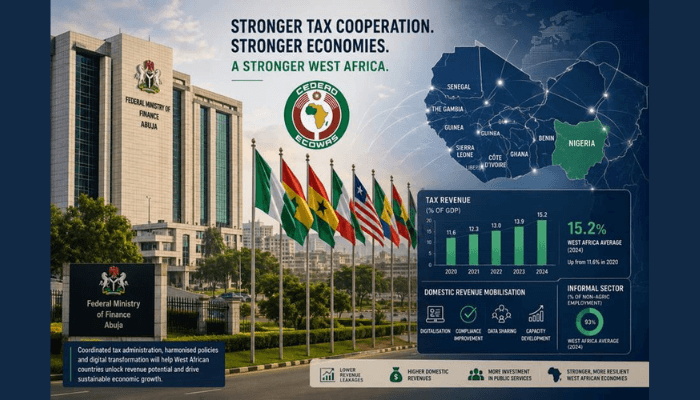
Nigeria’s tax reform agenda is no longer confined to its own borders. Abuja wants West African governments to coordinate tax administration more closely, arguing that stronger regional cooperation could reduce tax leakages, improve revenue collection and make it harder for businesses to exploit differences between national tax systems.
The strategy reflects a broader reality confronting governments across Africa. Businesses, capital and digital services increasingly move across borders, while tax administration remains largely national. As trade expands under the African Continental Free Trade Area (AfCFTA), gaps between tax regimes have made profit shifting, tax avoidance and uneven enforcement easier, limiting how much governments can collect.
For Nigeria, the issue is no longer merely administrative. It has become a fiscal imperative. Despite sweeping tax reforms over the past two years, Nigeria still has one of the world’s lowest tax-to-GDP ratios. Weak revenue mobilisation continues to constrain spending on infrastructure, healthcare and education while forcing the government to rely heavily on borrowing to finance public expenditure.
That explains why the government’s attention is shifting beyond domestic legislation. Speaking at a meeting with the leadership of the West African Tax Administration Forum (WATAF) in Abuja on July 14, Finance Minister and Coordinating Minister of the Economy, Taiwo Oyedele, argued that regional tax cooperation must move beyond technical dialogue to measurable implementation.
He urged WATAF to develop benchmarking tools and performance scorecards to assess how member states implement ECOWAS tax directives, allowing governments to compare performance, identify weaknesses and encourage greater compliance across the region.
Oyedele also called on the organisation to document and publish best practices in areas such as digital tax administration, taxation of the informal sector and broader tax reforms so that successful policies can be replicated more quickly across West Africa.
The proposal marks an important shift in the way governments are beginning to think about tax reform. For decades, improving tax collection largely meant rewriting domestic laws, expanding tax agencies and strengthening compliance within national borders. That approach is becoming less effective as companies increasingly operate across multiple jurisdictions.
Multinational firms often earn profits in several countries, while digital businesses can generate substantial revenue without maintaining a significant physical presence. Without coordinated rules and stronger information sharing, tax authorities struggle to determine where profits should be taxed, allowing revenue to slip through gaps between jurisdictions.
Better regional coordination would also benefit businesses. Companies operating across ECOWAS markets continue to navigate different filing procedures, administrative requirements and enforcement practices despite years of regional integration efforts. Greater harmonisation would lower compliance costs, reduce regulatory uncertainty and make cross-border investment more attractive.
For Nigeria, however, the bigger prize is stronger domestic revenue. Every additional naira collected through taxation reduces the government’s dependence on borrowing and creates more fiscal space for investment in electricity, transport infrastructure, healthcare and education. At a time when debt servicing continues to consume a significant share of public revenue, improving tax collection has become as important as controlling expenditure.
Nigeria has largely completed the legislative phase of its tax reforms, introducing measures designed to simplify tax administration, broaden the tax base and reduce dependence on oil revenues. The harder task now is ensuring those reforms remain effective in an economy where trade, investment and digital commerce increasingly extend beyond national borders.
That is also where regional cooperation has historically struggled. West Africa has no shortage of integration agreements. ECOWAS has adopted numerous protocols intended to facilitate trade and economic cooperation, but implementation has often lagged behind ambition. Uneven compliance has limited many of the benefits those agreements were designed to deliver.
Oyedele’s proposal therefore goes beyond tax administration. Performance scorecards and regional benchmarking are ultimately accountability tools, intended to measure whether member states are implementing the commitments they have already made.
Jules Tapsoba Sulio, Executive Secretary of WATAF, reaffirmed the organisation’s commitment to supporting member countries through technical assistance, research, digital transformation and capacity building, while acknowledging Nigeria’s longstanding financial and institutional support since the forum’s establishment in 2011.
Whether the latest initiative produces measurable results will depend less on new declarations than on whether governments are prepared to adopt common standards and enforce them consistently.
For Nigeria, raising more revenue is no longer only about passing better tax laws or strengthening enforcement at home. In a region where businesses, capital and digital commerce increasingly move across borders, domestic tax reforms will be only as effective as the regional system surrounding them. Nigeria has begun reforming its own tax system. Its next challenge is persuading West Africa to reform alongside it.