
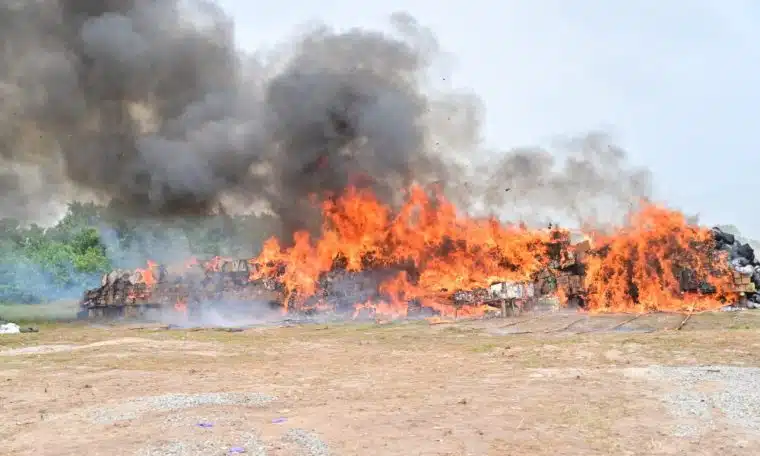
The sheer scale of the drug haul destroyed in Lagos on Monday offered a stark picture of the size of Nigeria’s illicit drug trade.
At Navy Town in Ojo, Lagos, the National Drug Law Enforcement Agency (NDLEA) destroyed 329,865.585 kilograms of illegal drugs valued at about ₦301.06 billion, following orders from the Federal High Court.
The destruction involved narcotics recovered from several parts of Lagos and other strategic locations, including seizures linked to concluded court cases as well as abandoned consignments that had been legally cleared for disposal.
According to the agency, 246,864.535kg of the drugs were seized by its Lagos Strategic Command between April 2025 and May 2026.
A further 83,001.05kg came from operations conducted by the Murtala Muhammed International Airport, Tin Can and Apapa Strategic Commands, the Marine Command and a Special Operations Unit.
The list of substances destroyed reflected the breadth of the illegal drug market confronting law enforcement agencies.
Among them were cocaine, heroin, methamphetamine and various forms of cannabis, including Canadian Loud and skunk. The haul also contained ephedrine, tramadol, codeine-based syrup, other opioids and khat leaves.
For the NDLEA, however, the destruction was about much more than getting rid of seized substances. It was also an attempt to highlight what the agency described as the wider social and security consequences of the illegal drug economy.
NDLEA Chairman and Chief Executive Officer, Brig. Gen. Mohamed Buba Marwa (retd.), said the volume of drugs removed from circulation represented a significant number of potential cases of substance abuse and related criminal activity.
He warned that the consequences of drug trafficking extend beyond individual users, arguing that widespread drug abuse can place additional pressure on families, communities, healthcare facilities and the wider economy.
Marwa also linked the illegal drug trade to Nigeria’s broader security challenges.
According to him, money generated from trafficking can find its way into organised criminal networks, terrorism and other violent activities.
That makes every major seizure a potential financial blow to the networks behind the trade, he argued.
The NDLEA chairman said the agency would therefore continue targeting not only those who physically move and sell narcotics but also the financiers and other individuals supporting trafficking networks.
The money behind the drugs
Marwa’s warning reflects a broader reality of the drug trade: the drugs themselves may be destroyed, but the criminal economy behind them can survive unless its financial channels are also disrupted.
He said the NDLEA would continue pursuing trafficking networks regardless of their structure or location, with the aim of cutting off the financial resources that keep the illegal business alive.
He credited the administration of President Bola Ahmed Tinubu for supporting the agency and acknowledged the cooperation of the judiciary, Lagos State Government, military, other security agencies, international partners, civil society organisations, traditional institutions, the media and members of the public.
He also praised NDLEA personnel involved in the operations, particularly officers working in Lagos and other high-risk locations.
Lagos State Governor Babajide Sanwo-Olu also threw the weight of the state government behind the campaign against drug trafficking.
Represented by the Secretary to the State Government, Bimbola Salu-Hundeyin, the governor said the enormous quantity of drugs destroyed was a reminder of the scale of the challenge confronting communities, particularly young people.
Also Read: What Obasanjo told Adeleke during visit after Osun election
Sanwo-Olu pledged continued cooperation between the Lagos State Government and law enforcement agencies in tackling both drug trafficking and substance abuse.
Customs: drug trafficking feeds other crimes
The Nigeria Customs Service also stressed the security implications of the illegal drug economy.
Its Comptroller General, Bashir Adewale Adeniyi, commended the NDLEA and noted that the seized substances had been intercepted across several entry and transit points, including airports, seaports and land borders.
Adeniyi argued that drug trafficking cannot be viewed in isolation because criminal organisations can use profits from the trade to finance other forms of violent crime.
Destroying the seized drugs, he said, therefore denies traffickers access to potentially huge sums of money.
The Chief of Naval Staff, Vice Admiral Idi Abbas, represented by the Flag Officer Commanding Western Naval Command, Rear Admiral Abdullahi Mustapha, similarly assured the NDLEA of continued support from the Nigerian Navy.
The destruction of 329,865kg of narcotics may have removed a staggering quantity of illegal substances from circulation, but it also raises a difficult question: how much more remains within Nigeria’s communities and criminal networks?
Marwa called for parents, schools, religious organisations, traditional rulers and the media to become more actively involved in preventing drug abuse.
His argument is that law enforcement alone cannot solve a problem that begins long before an arrest or seizure.
For every consignment intercepted at a port, airport or border, there are users, distributors, financiers and networks operating far beyond the point where the drugs are eventually seized.
That is why, beneath the spectacle of a ₦301 billion drug haul going up in flames, lies a much bigger battle — one that involves not only destroying narcotics, but breaking the market that keeps producing, moving and demanding them.