
Joel Ajayi
Ringo Sports in the 70s offers several benefits, particularly in promoting grassroots development, youth engagement, tourism, and economic growth through sports all of sudden it faded away.
Until recent time when National Sports Tourism Conference and Exhibition NASTOCE who know the important of these sports to mankind, society and country at large come together to champion the return of the game for good health and economic prosperity to the country.
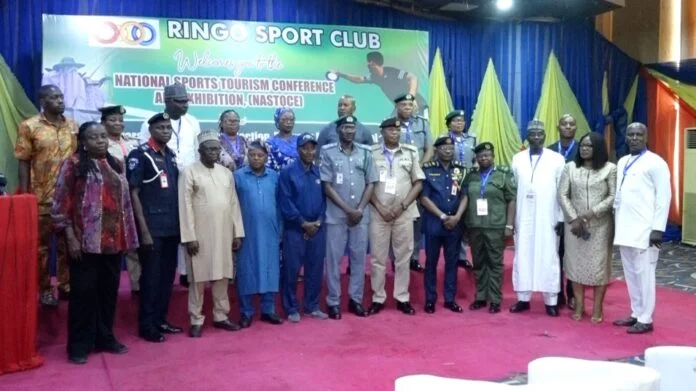
Speaking at the maiden edition of the NASTOCE on Tuesday in Abuja, the convener of the event Mohammed Sule reveals the strong relationship between sports and tourism will no doubt bring more growth and development to the country.
The event with the Theme: leveraging on the Inter-section Between Muti-sectoral MDAs to promote Sports Tourism in Nigeria gathered stakeholders across the country to champions return and revival of Ringo Sports in Nigeria.
He described sports and tourism as “sister sectors” that naturally complement each other, noting that when both industries are properly harnessed, they can significantly boost the economy and improve socio-economic growth.
According to him, several countries have successfully maximised the opportunities in sports and tourism to strengthen their economies, adding that Nigeria should not be left behind.
He said the idea behind the National Sports Tourism Conference and Exhibition (NASTOC) was to create a platform where the synergy between both sectors could be explored for national progress.
On the revival of Ringo Sports, he explained that the game was once popular in Nigeria decades ago and can still attract interest if properly reintroduced.
He noted that the sport is played on a badminton or volleyball court and can be contested in one-a-side, two-a-side or three-a-side formats, depending on the available space.
Recalling his personal experience, he said he played the game as far back as 1978 during his secondary school days and believes it remains an exciting sport that promotes fitness, agility and healthy living.
He added that efforts are already underway to reposition the sport and bring it back into the mainstream sporting scene in Nigeria.
The convener, who also has a background in journalism, media practice, public relations and tourism, said his professional experience has inspired him to combine sports and tourism as tools for economic transformation.
He explained that institutions such as the Federal Fire Service, Nigeria Customs Service, Nigeria Immigration Service and Federal Airports Authority of Nigeria all play important roles in supporting sports and tourism development.
According to him, customs facilitate the importation of sports equipment and infrastructure materials, immigration handles travel documentation for athletes and visitors, while airports serve as key gateways for tourists and sporting delegations.
He therefore called for stronger collaboration among all government agencies and private stakeholders to unlock the full economic value of sports tourism in Nigeria.
He urged Nigerians to recognise that regardless of sector or profession, there is always a connection to sports and tourism, insisting that partnership remains the key to sustainable growth.
The event ended with a charge to all stakeholders to work together in advancing Nigeria’s economy through the combined power of sports and tourism.
Related