
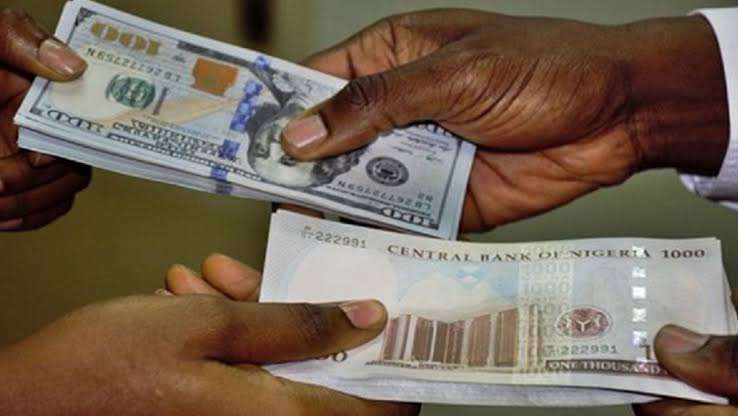
The naira weakened against the United States dollar on Monday at the Nigerian Foreign Exchange Market (NFEM) window despite an increase in foreign exchange inflows into the country’s currency market.
Data released by the Central Bank of Nigeria (CBN) showed that the naira depreciated by N12.36 during Monday’s trading session, with the dollar quoted at N1,405.62 compared with N1,393.26 recorded on Friday.
This represents a 0.9 percent decline in the value of the local currency at the official market.
While the naira weakened at the official window, it remained relatively stable in the parallel market, commonly known as the black market. In that segment, the currency closed at N1,420 per dollar.
The gap between the official and parallel market exchange rates narrowed further, suggesting a gradual convergence between both segments of the foreign exchange market.
The spread declined to N15, representing about 1.07 percent, compared with N27 or 1.94 percent recorded at the close of trading on Friday.
Analysts view the narrowing gap as a sign of improving alignment in the foreign exchange market following ongoing reforms introduced by the Central Bank to enhance transparency and liquidity.
Recent market data also indicate that foreign exchange inflows have strengthened in recent weeks.
As of the end of last week, total FX inflows into the Nigerian market reached $1.26 billion, representing a 17.76 percent increase from $1.07 billion recorded the previous week, according to data released by the research department of Coronation Merchant Bank.
Market analysts say the improvement in inflows is providing liquidity support to the foreign exchange market, although demand pressures continue to influence exchange rate movements.
On the external front, Nigeria’s foreign exchange reserves have also recorded modest growth. Data from the apex bank show that the country’s gross external reserves rose to $49.93 billion as of March 5, 2026.
This represents a week-on-week increase of about 0.48 percent, equivalent to an accretion of approximately $236.21 million.
The increase aligns with the sharp improvement in the country’s net foreign exchange reserves in recent years. The Central Bank recently disclosed that net FX reserves rose to $34.8 billion at the end of 2025, compared with $3.99 billion recorded two years earlier.
Analysts expect the naira to trade within a relatively stable range in the near term, supported by sustained foreign portfolio investment inflows and increased participation by exporters in the foreign exchange market.
In addition, ongoing geopolitical tensions in global energy markets have contributed to firmer crude oil prices, a development that could further support Nigeria’s external reserves and improve foreign exchange supply in the coming months.
Despite this outlook, the naira recorded an overall weaker performance last week at the official market. The currency depreciated by 2.14 percent week-on-week in the NFEM window, closing at N1,393.26 per dollar compared with N1,363.42 in the previous week.
This followed a relatively stronger midweek performance when the naira traded to an intraweek high of N1,387.10 per dollar before weakening toward the end of the week.
A similar trend was recorded in the parallel market, where the naira depreciated by 2.10 percent week-on-week to close at N1,430 per dollar.
At current levels, the parallel market rate continues to trade at a modest premium relative to the official NFEM rate, with the spread estimated at about 2.64 percent.
Analysts say the gradual narrowing of the gap between the two markets signals progress toward greater stability and efficiency in Nigeria’s foreign exchange system as ongoing reforms continue to take effect.