
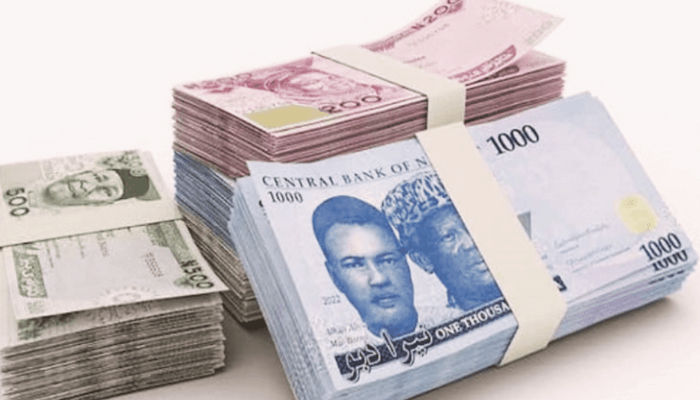
The naira on Wednesday appreciated by 0.8 percent year-to-date in the official foreign exchange (FX) market as Nigeria’s external reserves continued to show steady growth.
Data from the Central Bank of Nigeria (CBN) showed that the naira gained N10.81 between January 2, 2026, the first trading day of the year, and Wednesday, when the dollar was quoted at N1,420.04, compared with N1,430.85 on Tuesday at the Nigerian Foreign Exchange Market (NFEM). On a day-to-day basis, the local currency weakened slightly by 38 kobo, closing at N1,420.04 on Wednesday from N1,419.66 on Tuesday at the NFEM.
At the parallel market, also known as the black market, the naira held steady at N1,490 per dollar, according to street traders.
Nigeria’s external reserves maintained a steady upward trajectory, rising to $45.77 billion as of January 13, 2026, according to CBN data.
Dollar supply rebounded by 38 percent month-on-month in December 2025, supported by increased foreign exchange sales by the CBN, data from FMDQ showed.
Total FX inflows into the market rose sharply by 38 percent month-on-month to $2.8 billion, marking a recovery from the 67 percent contraction recorded in November.
Despite the rebound, FX supply in December remained the second weakest level in 16 months, highlighting lingering fragilities in inflows. Inflows from domestic corporates fell 5 percent month-on-month to $420 million, while all other sources of FX supply showed improvements.
Analysts at FBNQuest attributed the recovery in FX supply largely to heightened activity by the CBN in the market. FX sales by the apex bank rose to $654 million in December, up from $318 million in November. According to the analysts, the CBN’s increased intervention reflects efforts to boost market liquidity amid subdued participation from offshore investors, whose inflows have remained weak.