
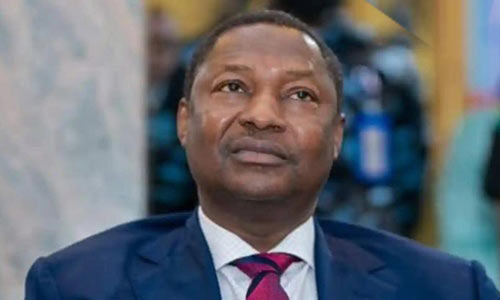
Former Attorney-General of the Federation (AGF) and Minister of Justice, Abubakar Malami, has rejected allegations linking him to terrorism financing, following a SaharaReporters publication that named him among Nigerians allegedly connected to terror financiers.
The SaharaReporters article, published on Friday, reported that two suspects arrested under a counter-terrorism investigation were “linked to” Mr Malami and other prominent Nigerians.
In a statement on his Facebook page on Friday evening, the Senior Advocate of Nigeria (SAN) said he has never been accused, investigated, or charged by any Nigerian or international agency in connection with terrorism financing.
He added that the retired military officer cited as the principal source did not accuse him of any wrongdoing and that the report misrepresented his role.
Although Mr Malami was never personally accused of any terrorism-related allegations, the Muhammadu Buhari administration, of which he was a key official, often came under criticism for allegedly concealing the identities of suspected high-profile terrorism financiers.
In May 2021, Mr Malami, as AGF, publicly announced that investigations had revealed many highly placed Nigerians and businessmen involved in financing terrorism. He said the “strongly” suspected financiers were already being profiled for prosecution and warned that no one involved in the crime would be spared.
“We shall certainly and aggressively pursue those people that are involved in terrorist financing as far as the Nigerian State is concerned,” he said.
However, during Buhari’s administration, Mr Malami resisted public pressure to reveal the identities of the arrested terrorism financiers, noting that disclosure would only occur after their prosecution and conviction. The promised prosecutions were not publicly known to have taken place, and the identities of the suspects remained undisclosed until the administration’s tenure ended in May 2023.
The allegations levelled against Mr Malami in the SaharaReporters story coincided with reports of his recent questioning by the EFCC over alleged mismanagement of recovered national funds, including parts of the Abacha loot. He was invited on 28 November and later released on administrative bail. Mr Malami denied the allegations and has not been charged with any crime regarding the EFCC investigation.
Spotlighting his record in office, Malami cited his role in strengthening Nigeria’s anti-money laundering (AML) and counter-terrorism financing (CFT) framework.
“We similarly worked on the passage and implementation of the Terrorism (Prevention and Prohibition) Act, 2022, which strengthened Nigeria’s legal regime against terrorism, updated offences and penalties, and reinforced provisions dealing specifically with the financing of terrorism in line with international standards and United Nations obligations. These reforms…formed part of the body of work later assessed by the Financial Action Task Force (FATF) and contributed to Nigeria’s eventual removal from the FATF ‘grey list’ of jurisdictions under increased monitoring,” he stated.
He stressed that engagement with a wide range of individuals and entities is a normal part of public office and does not imply criminal involvement.
Mr Malami also urged responsible reporting on national security issues, reaffirming his commitment to the rule of law, strengthening justice and security institutions, and protecting his legal rights against misrepresentation.
He reiterated that engagement with diverse stakeholders in public office does not imply criminality and called on the media to avoid damaging reputations and undermining public confidence in state institutions. He reaffirmed his dedication to the rule of law and strengthening Nigeria’s justice and security framework.
He reiterated that engagement with diverse stakeholders in public office does not imply criminality and called on the media to avoid damaging reputations and undermining public confidence in state institutions. He reaffirmed his dedication to the rule of law and strengthening Nigeria’s justice and security framework.