
THE Federal Government has reaffirmed its commitment to transforming Nigeria’s livestock sector through digital innovation and strategic investments aimed at promoting industrialisation, value addition and private sector-led growth across the livestock value chain.
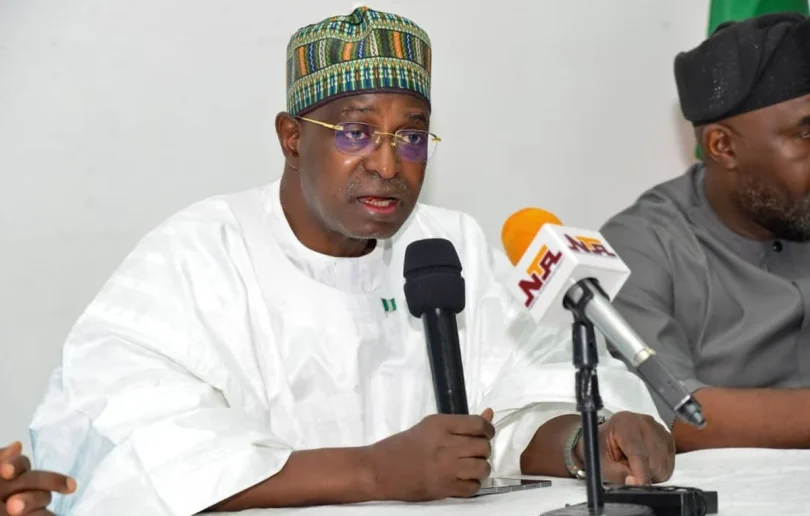
The Minister of Livestock Development, Idi Mukhtar Maiha, stated this on Saturday during the second day of his working visit to Kano State, where he unveiled the Kano State Livestock Information Management System (LIMS) at the Gwale Model Veterinary Hospital and inspected the KANOTAN S.A. Tannery Industry.
Maiha described the digital platform as a landmark innovation that aligns with the Federal Government’s efforts to modernise livestock administration through technology, data-driven planning and efficient service delivery.
The Livestock Information Management System integrates livestock registration, veterinary health management, disease surveillance, vaccination monitoring, licensing, farmer support services and digital medical records into a single online platform accessible to government agencies and the public.
The minister disclosed that the Federal Government’s planned national livestock digital platform would be interoperable with Kano State’s system to facilitate seamless information sharing.
“On behalf of President Bola Ahmed Tinubu, I congratulate Kano State for taking this bold step.
“This is a model worthy of emulation, and we will continue working together to ensure that digital innovation strengthens livestock development across Nigeria.
“When we launch our national digital infrastructure, there will be connectivity between the national platform and what Kano has developed. That synergy will strengthen livestock governance, improve planning and provide reliable data for policy formulation,” he said.
Maiha urged the Kano State Government to continue expanding the platform to capture data across all livestock value chains, including dairy, poultry, hides and skins, meat production, livestock markets, processors, veterinarians, animal scientists and other industry stakeholders.
Earlier, the Chairman of the Nigerian Veterinary Medical Association, Dr. Mubashshir Mustapha Umar, demonstrated the platform’s data-mining capabilities, highlighting its potential to generate reliable information for policy formulation.
The minister later visited the KANOTAN S.A. Tannery Industry, where he toured the company’s leather processing facilities and held discussions with industry operators.
He described the company’s operations as evidence of Nigeria’s untapped industrial potential and called for increased investment in local leather processing.
“I am really amazed at what I have seen today. What we have witnessed here confirms that Nigeria possesses the capacity not only to process its leather locally but to compete globally. This is a pointer to economic diversification driven by our livestock resources,” he said.
Maiha noted that although Nigeria has one of Africa’s largest livestock populations and produces more than 50 million hides and skins annually, much of the value has historically been lost through the export of semi-processed leather.
He said the Federal Government was determined to reverse the trend by encouraging complete local processing and manufacturing.
“The future of this industry lies in value addition. We must move beyond exporting semi-processed leather to manufacturing finished products such as footwear, bags and other leather goods that create significantly more jobs and wealth for Nigerians,” he said.
According to the minister, the global leather footwear market is projected to exceed 628 billion dollars by 2033, while leather goods will account for hundreds of billions of dollars in additional value, presenting major export opportunities for countries that invest in manufacturing.
Maiha also called on governments at all levels to prioritise the procurement of locally manufactured school footwear, citing Kano State’s estimated population of over 3.5 million school-age children and KANOTAN’s target of producing 200,000 pairs of leather sandals before the end of the year.
“If every child wears sandals produced in Kano from Nigerian leather, it will trigger an economic revolution. Such deliberate procurement policies will stimulate production, expand employment and strengthen local industries,” he said.
Responding, the Chief Executive Officer of KANOTAN S.A. Tannery Industry, Bashir Dankulu, commended the Federal Government for prioritising livestock development.
He disclosed that the company currently processes up to 50,000 skins daily, sources raw materials from across Nigeria and neighbouring countries, employs about 1,000 permanent workers and provides seasonal employment for thousands more.
Also speaking, the President of the National Leather and Leather Products Association of Nigeria (NALPAN), Mustapha Nabegu, appealed to the Federal Government to establish strategically located skin collection centres across livestock-producing areas.
He said the centres would improve the preservation, grading and aggregation of hides and skins, reduce post-slaughter losses, ensure a steady supply of quality raw materials to tanneries and enhance the competitiveness of Nigeria’s leather industry.