
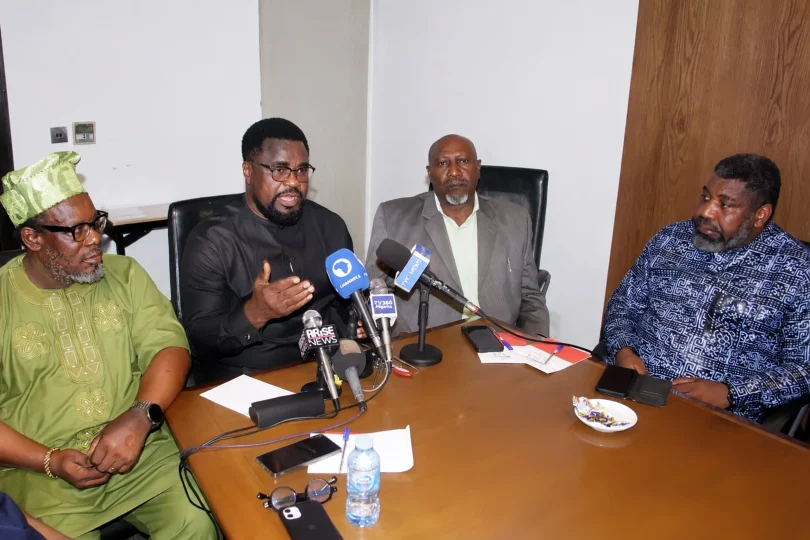
A group of concerned lawyers and public interest analysts has urged the Federal Government not to interfere with or abandon the investigation and prosecution of former Minister of Innovation, Science and Technology, Uche Nnaji, over allegations of certificate forgery.
Addressing a press conference in Lagos on Saturday, the group, led by lawyer Liborous Oshoma, commended the Independent Corrupt Practices and Other Related Offences Commission (ICPC) for taking steps to investigate the former minister but criticised what it described as delays in bringing him to justice.
The group alleged that despite Mr. Nnaji’s resignation following reports questioning the authenticity of his academic credentials, he should still face prosecution over what it described as multiple instances of certificate forgery.
The lawyers referenced an investigation published by Premium Times in October 2025, which alleged that although Nnaji was admitted to study Microbiology/Biochemistry at the University of Nigeria during the 1981/82 academic session, he did not graduate after failing a compulsory virology course.
According to the group, the investigation relied on correspondences exchanged between Nnaji and the university’s registry between 1985 and 1986, including a handwritten application dated May 19, 1986, in which he sought permission to retake the failed course after missing an earlier examination on health grounds.
The lawyers argued that the documents raised questions over how Nnaji allegedly obtained a degree certificate dated July 1985, which they said was later submitted during his ministerial nomination and Senate confirmation process, despite his subsequent court filing indicating that the university had not issued him a certificate.
They also cited findings of a Federal Government panel reportedly established by the Ministry of Education following Nnaji’s petition alleging manipulation of his academic records.
According to the group, the panel examined university records, graduation lists, and registry documents and reportedly reached the same conclusion as the newspaper investigation that Nnaji did not graduate from the university.
The lawyers further questioned the authenticity of the former minister’s National Youth Service Corps discharge certificate, alleging that it indicated he served between April 16, 1985, and May 15, 1986—before his purported graduation in July 1985.
They also claimed the certificate bore the signature of a former NYSC Director-General who assumed office in 1988, nearly two years after the discharge date indicated on the document.
ALSO READ: Suspected robbers kill technician in Ondo
The group noted that the ICPC announced on July 1 that Nnaji had been arrested at the Nnamdi Azikiwe International Airport in execution of a bench warrant issued by the Federal High Court.
According to the commission, the arrest followed the former minister’s alleged failure to honor multiple invitations relating to investigations into allegations of forgery of a University of Nigeria degree certificate and an NYSC discharge certificate submitted during his ministerial screening in 2023.
The lawyers urged President Bola Ahmed Tinubu to ensure that the investigation and any ensuing prosecution proceed without political interference.
“We commend the efforts of the ICPC so far but condemn the undue delays in bringing the former minister to justice,” Oshoma said.
He argued that the matter highlighted what he described as unequal treatment between influential public officials and ordinary Nigerians in the administration of justice.
The group also alleged that Nnaji received salaries, allowances, and other benefits while serving as minister based on credentials whose authenticity is now under investigation.
Consequently, the lawyers called on the Federal Government to recover all salaries and allowances paid to the former minister from 2023 until his resignation in October 2025 if the allegations are established in court.
They further urged the government to review official decisions taken during Nnaji’s tenure as minister, arguing that public confidence required full accountability.